Here’s a secret most homeowners don’t know until they’re standing in a showroom: the gorgeous “ceramic” floor in the model kitchen is often vinyl. Tile pattern vinyl flooring has gotten so convincing that even I sometimes have to crouch down and touch a floor to be sure. It mimics stone, marble, and ceramic tile visuals while staying warmer, softer, and dramatically cheaper than the real thing. I’ve installed it in bathrooms, laundry rooms, and open-plan kitchens, and this guide walks you through the costs, the trade-offs, and how to buy well.
What Is Tile Pattern Vinyl Flooring?
At its core this is luxury vinyl printed and textured to look like tile rather than wood. The design layer carries a high-resolution photo of stone or ceramic, and a clear wear layer on top protects it while an embossed texture adds realistic surface feel. Better products use embossed-in-register texturing, where the bumps and grout lines you feel line up exactly with the printed image, which is what sells the illusion up close.
You’ll find it in a few formats. Luxury vinyl tile, or LVT, comes in square or rectangular planks that install like tile. Sheet vinyl offers continuous rolls with tile patterns printed across the width, popular for bathrooms because of the minimal seams. Peel-and-stick vinyl tiles are the budget entry point, with adhesive backing you press straight to the subfloor. Rigid-core products with SPC or WPC cores add stability and a more premium underfoot feel.
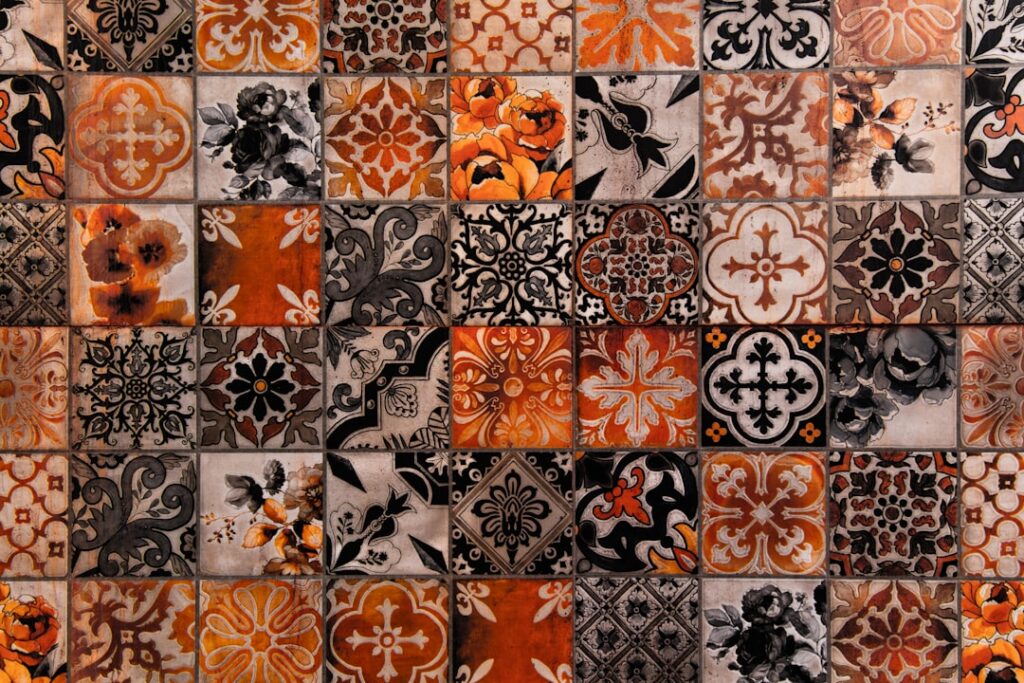
Many tile-look vinyls include a grout-line feature, and the good ones let you install a matching grout strip between planks for a genuinely tiled appearance. Sizes mirror real tile, from 12 by 12 inch squares to large-format 12 by 24 inch and 18 by 18 inch pieces, plus hexagon and other shapes for a more custom look. The variety is why this category has exploded in popularity.
Pros of Tile Look Vinyl
The headline advantage is comfort and warmth. Real ceramic and stone tile feel cold and hard underfoot, especially on a winter morning, and they’re punishing on dropped dishes and tired legs. Vinyl stays warmer, gives slightly underfoot, and is far more forgiving when you drop a glass. In a kitchen where you stand for hours, that difference is something you feel every single day.
Water resistance is another strong point. Quality tile pattern vinyl flooring is fully waterproof, which makes it ideal for bathrooms, laundry rooms, mudrooms, and basements where real tile’s grout lines can trap moisture and grow mildew. Vinyl has no porous grout to seal and reseal, so cleanup is a quick damp mop. That low-maintenance nature is a big reason people choose it over the ceramic it imitates.
Then there’s cost and installation. Tile-look vinyl runs a fraction of what tile-plus-labor costs, and it installs much faster with no mortar, no wet saw, and no days of curing. Click-lock versions float over most existing floors, and a handy homeowner can lay a bathroom in an afternoon. It’s also quieter and softer, and it won’t crack if the house shifts the way rigid ceramic can.
Cons You Should Know About
No floor is perfect, and vinyl has real limits. Up close and under raking light, even the best tile-look vinyl can reveal itself, particularly the cheaper peel-and-stick products with flat, printed grout lines that don’t line up with any texture. If a flawless, indistinguishable-from-ceramic result is your goal, understand that vinyl gets 90 percent of the way there, not 100.
Durability, while good, isn’t tile’s equal in every way. Heavy, sharp impacts can gouge the wear layer, and dragging appliances without protection can tear it. Direct, prolonged sunlight can fade the print over years, so south-facing rooms benefit from window coverings. Very heavy furniture on small feet can leave permanent dents in softer vinyl, something dense ceramic simply doesn’t do.
There are resale and material considerations too. Some buyers still perceive real tile as more premium, so in a high-end home vinyl may not add the value tile would. Vinyl is a plastic product, which concerns eco-minded buyers, though many lines now carry low-VOC certifications like FloorScore. And once a rigid vinyl floor reaches end of life, it isn’t as easily recycled as stone or ceramic.
Cost of Tile Pattern Vinyl Flooring
Pricing spans a wide range by format and quality. Peel-and-stick tiles start as low as $0.79 to $2 per square foot, making them the cheapest way to get a tile look, though they’re the least durable and least convincing. Mid-grade click-lock and glue-down LVT with tile visuals run $3 to $6 per square foot, and premium rigid-core products with embossed-in-register texture and grout strips reach $5 to $8.
Installation adds $2 to $5 per square foot for professional work, though floating click-lock is genuinely DIY-friendly and peel-and-stick needs almost no skill. Compare that to ceramic tile, which commonly runs $7 to $14 per square foot material, plus $8 to $15 in labor because tile-setting is skilled, slow work. A tile-look vinyl floor can cost less than half of a comparable ceramic installation and go down in a fraction of the time.
For a 150-square-foot bathroom, budget roughly $450 to $1,650 installed for tile-look vinyl versus $2,000 to $4,000 for real ceramic. That gap is the entire appeal of the category. Just don’t chase the rock-bottom peel-and-stick for a room that sees water and traffic, because the savings evaporate when you’re replacing it in three years.
Best Rooms for Tile Look Vinyl
Bathrooms are a natural fit thanks to the waterproofing and warmth, and sheet vinyl or rigid-core LVT both work well here. Kitchens benefit from the comfort underfoot and easy cleanup, and the tile look pairs beautifully with the stone-and-ceramic aesthetic those rooms often carry. Laundry rooms and mudrooms, which see water, dirt, and dropped items, are ideal because the floor takes abuse without complaint.
Basements are another strong use case since vinyl handles the occasional moisture that plagues below-grade concrete, unlike laminate or hardwood. Entryways with a stone-look large-format tile pattern make a durable, elegant first impression. About the only place I’d hesitate is a formal, high-end space where genuine natural stone sets the tone, though even there, premium rigid-core products come remarkably close.
Consider the layout of the room too. Large-format tile-look planks make a small bathroom feel bigger and reduce the number of seams, while hexagon and mosaic patterns bring character to a powder room or laundry nook. In open-plan homes where the kitchen flows into a dining or living area, a consistent tile-look vinyl can run seamlessly across the whole space, something real tile can do too but at several times the cost and installation time. Matching a grout-strip color to your wall tile or backsplash ties the whole room together and further sells the ceramic illusion.
How to Buy the Right Product
Focus first on the wear layer, measured in mils. For a busy household aim for a 20-mil wear layer, and don’t go below 12-mil for any room that sees daily traffic. That single spec does more to determine longevity than the price or the brand name. A thick, well-protected wear layer keeps the tile print looking sharp for 15 to 20 years.
Look for embossed-in-register texture and, if realism matters, a grout-strip option, since those two features separate a floor people admire from one they instantly clock as fake. Choose rigid SPC or WPC core products over flexible vinyl for a firmer, more tile-like feel underfoot and better performance over minor subfloor imperfections. Verify the product is fully waterproof if you’re putting it anywhere near water.
Pay attention to subfloor prep even though vinyl forgives more than most floors. Rigid-core products bridge minor imperfections, but a low spot deeper than about 3/16 inch over 10 feet will still create a soft, hollow-sounding area, and a high ridge can telegraph through as a visible line. Sweep the subfloor clean, knock down any high spots, and fill dips with patching compound before you start. Ten minutes of prep prevents the callbacks I’ve seen when someone rushes a floor down over debris.
Finally, order 10 percent extra for cuts and future repairs, keep a few spare planks in the garage, and confirm the warranty covers your use, since residential and commercial ratings differ. Do that groundwork and tile pattern vinyl flooring rewards you with the high-end look of stone or ceramic, the comfort and quiet of vinyl, and a bill that leaves money in your pocket for the rest of the renovation.
Prefer to explore on your own?
See how new flooring looks in your actual room in seconds — free, no signup.
Try the free Floor Studio →