
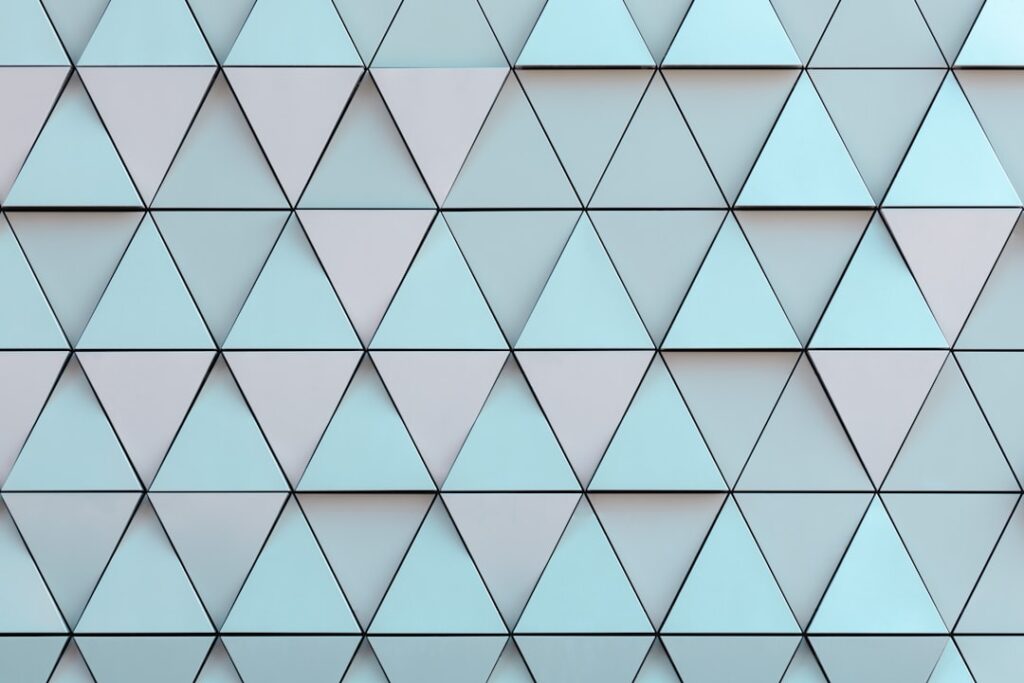
Few tile shapes change the character of a room as quickly as a triangle. Where squares and rectangles read as calm and expected, triangle tile introduces movement, direction, and a distinctly modern edge. The same three-sided shape can be arranged into scales, chevrons, diamonds, starbursts, or crisp color-blocked fields, so a single product line can produce wildly different looks depending only on how you set it. That flexibility is what makes triangles a favorite of designers and an increasingly popular choice for homeowners who want something beyond the standard subway grid.
Part of our Tile & Grout guide — explore the full guide →
The Shapes Behind the Shape
Not all triangles are the same, and the geometry matters for the patterns you can create. Equilateral triangles, with three equal sides, tessellate into hexagons and six-point stars and are the workhorse of most triangle mosaic sheets. Isosceles and elongated triangles, taller than they are wide, are used for scale patterns and dramatic sunburst layouts. Half-square right triangles are essentially squares cut on the diagonal and are perfect for two-tone pinwheels and harlequin fields where you want sharp color blocking.
When you shop, pay attention to whether a triangle tile is sold as a loose individual piece or preassembled on a mesh-backed mosaic sheet. Small triangles, roughly two to four inches per side, almost always come mounted on twelve-inch sheets so you are not setting hundreds of tiny pieces one at a time. Larger format triangles, in the eight to twelve inch range, are sold individually and make a bolder statement with fewer grout lines. Both approaches have their place, and the choice steers the entire feel of the finished surface.
Mosaic Sheets Versus Large-Format Triangles
Mosaic triangle tile is the friendlier option for first-time installers and for detailed, jewel-like patterns. Because the small triangles are already aligned on mesh, you set them a sheet at a time, and the many grout joints help the surface conform to walls that are not perfectly flat. The tradeoff is more grout to clean and more visual busyness, which reads beautifully on a shower niche, a fireplace surround, or a powder room accent wall but can overwhelm a large floor.
Large-format triangles flip those tradeoffs. With fewer, longer joints, they feel architectural and calm even though the shape itself is dynamic, and they suit contemporary floors, feature walls, and commercial-style spaces. The catch is that big triangles are less forgiving. Any bow in the wall or dip in the floor shows up along those long straight edges, so proper substrate prep and a good notched-trowel technique matter far more than they do with a mosaic sheet. If your walls are wavy, mosaics hide sins that large format will broadcast.
Layouts That Define the Room
The single most exciting thing about triangles is how many distinct patterns come out of one product. A scale or fish-scale layout, where elongated triangles alternate point-up and point-down, creates a rippling, almost woven texture that looks stunning on a kitchen backsplash. Chevron and herringbone-style arrangements lead the eye down a hallway or up a wall, adding a sense of length or height. Diamond fields, made by pairing two triangles, give a classic argyle rhythm that suits both traditional and transitional rooms.
Color is the multiplier here. A single triangle tile shape in two or three tones can be blocked into geometric bands, faded in an ombre from dark at the floor to light at the ceiling, or scattered in a random confetti pattern for a playful, handmade feel. Before you commit, lay a few square feet out dry on the floor and photograph it. Triangles create optical effects that are hard to predict from a showroom sample, and five minutes of dry-laying will save you from a pattern you did not expect once it is permanently set in thinset.
Grout: The Detail That Makes or Breaks It
Grout color does more work on triangle tile than on almost any other shape because the joints themselves form the pattern. A high-contrast grout, such as charcoal against white triangles, celebrates the geometry and turns every seam into a graphic line. A matched or tone-on-tone grout mutes the joints and lets the tile color and any subtle sheen carry the design, which is the move when you want texture without visual noise. Neither is wrong; they simply tell different stories.
For joint width, most triangle mosaics are designed for a tight one-sixteenth to one-eighth inch grout line, while larger triangles often look best with a crisp one-eighth inch joint. Because triangles have three points that all meet at tight angles, use an unsanded grout on very narrow joints and a quality sanded or high-performance grout on wider ones. In wet areas like showers, epoxy grout is worth the extra effort since it resists staining in all those crowded little joints where mildew loves to hide.
Materials and What They Cost to Run
Triangle tile comes in nearly every material you would expect from a modern tile aisle, and the material drives both the price and the mood. Glazed ceramic and porcelain are the everyday workhorses, durable and affordable, and porcelain in particular handles floors and wet areas without complaint. Glass triangles bounce light around a backsplash and give a jewel-box glow, though they show water spots and demand a white or clear-setting thinset so the adhesive does not shadow through the translucent body. Natural stone triangles, cut from marble or slate, bring organic veining to the geometry but need sealing and gentler cleaners.
Handmade and zellige-style triangles carry the most character and the most variation, with subtly different sizes and glaze pooling from piece to piece that reads as artisan rather than sloppy once it is set. Budget accordingly: expect the extra handling and lippage adjustment to add time to the job. Whichever material you choose, order a single dye lot for the whole project, because triangle patterns put many tiles in close contact and even a slight color shift between boxes becomes obvious across a field of shared points.
Where Triangle Tile Works Best
Triangle tile earns its keep as an accent more often than as a whole-house floor. The most reliable wins are feature walls behind a bed or sofa, kitchen and bar backsplashes, fireplace surrounds, powder rooms, and shower niches, all places where a concentrated dose of pattern reads as intentional and luxurious. In these spots the geometry becomes a focal point rather than a distraction, and the modest square footage keeps material cost reasonable even for premium tile.
Using triangles on a full floor absolutely works, especially in a large-format or two-tone diamond layout in an entry, a laundry, or a modern bathroom, but plan for it deliberately. Big triangle floors want to be the star, so keep the surrounding finishes simple. Expect to pay anywhere from roughly eight to twenty-five dollars per square foot for ceramic and porcelain triangle tile, with handmade and marble versions climbing higher. Whatever you choose, buy about ten to fifteen percent extra, because the angled cuts along walls waste more material than a simple square layout and you will want matching spares on hand.
Prefer to explore on your own?
See how new flooring looks in your actual room in seconds — free, no signup.
Try the free Floor Studio →

