Outdoor flooring has to survive UV, freeze-thaw, foot traffic, furniture loading, and the occasional dropped grill spatula — all without becoming a slip hazard when wet. The right choice from the available types of outdoor flooring depends on climate, substrate, traffic, and what role the space plays. A pool deck in Phoenix and a covered porch in Vermont call for very different materials, and the wrong pick fails inside three winters or three summers.
Porcelain Pavers
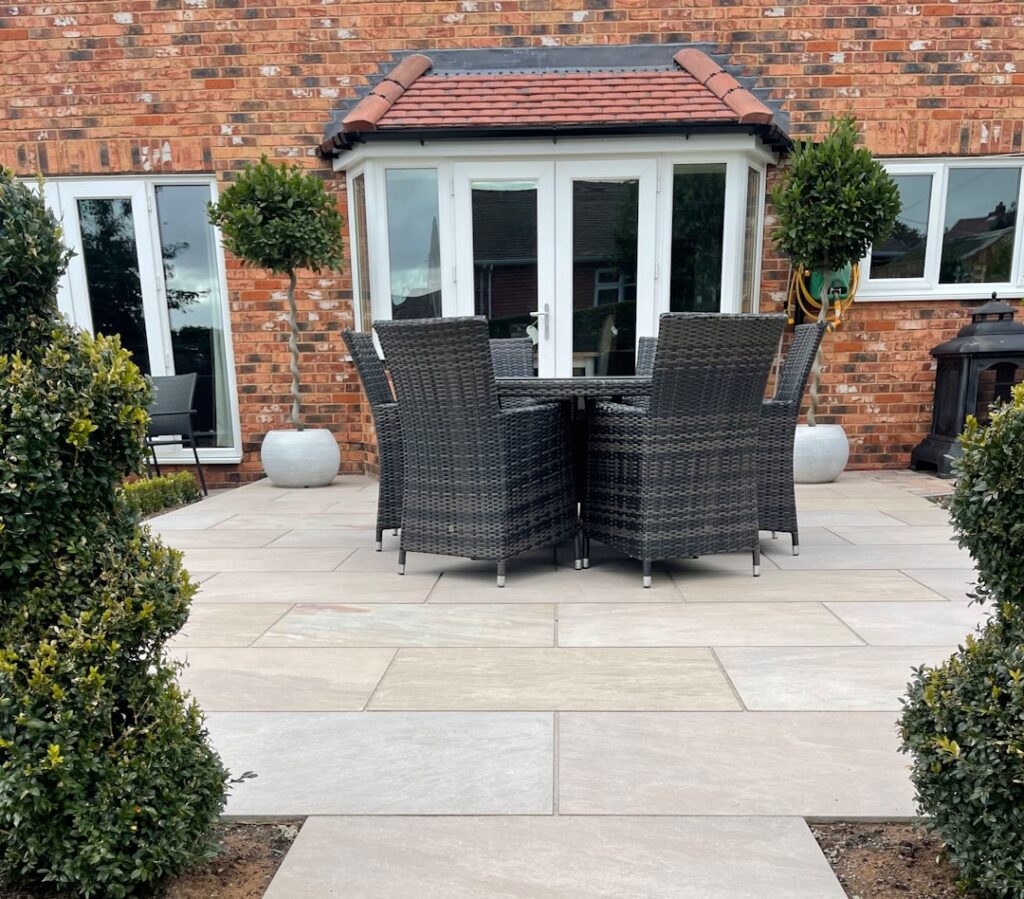
20 mm (3/4 inch) thick porcelain pavers have taken over the premium outdoor flooring category. Brands like Atlas Concorde Marvel Outdoor, Florim Magnum 20mm, Daltile Slate Attache, and MSI Cyrus 2.0 deliver large-format tiles (24 by 24, 24 by 48 inches) rated for outdoor use with PEI Class 5 abrasion, water absorption under 0.1 percent, and freeze-thaw certification. Wet DCOF runs 0.55 to 0.75 with structured surfaces.
Install methods include pedestal systems for rooftops and balconies (no mortar, totally adjustable for slope), thinset over concrete with TCNA outdoor membranes, and gravel-and-sand set for ground-level patios. Pricing: $7 to $16 per square foot for tile, $9 to $22 per square foot installed depending on method. Lifespan: 30+ years.
Once your patio flooring is in place, think about how you’ll use the space. A gazebo adds shade and structure, while a good outdoor furniture set turns it into a spot you’ll actually want to hang out in. A deck box is also worth considering if you need somewhere to stash cushions and outdoor gear.
We may earn a commission when you purchase through our links.
Composite Decking
Trex Transcend, TimberTech AZEK Vintage, Fiberon Sanctuary, and Deckorators Voyage dominate the composite category. Capped composites combine recycled wood fiber and HDPE with a UV-stable polymer cap that resists fade and stains. Premium lines mimic ipe, mahogany, and weathered gray with embossed grain. Boards run 5/4 by 6 inches at 12, 16, and 20 foot lengths.
Material runs $4 to $9 per linear foot for premium capped composite. Installed deck cost lands at $35 to $65 per square foot including framing, fasteners, and railings. Maintenance is mostly limited to annual washing with composite-safe cleaner like Corte-Clean or Olympic Deck Cleaner. Lifespan: 25 to 30 years.
Pressure-Treated and Tropical Hardwood Decks
Pressure-treated southern yellow pine remains the budget standard at $1.80 to $3 per linear foot for 5/4 by 6 boards. Expect annual staining or sealing with products like Cabot Australian Timber Oil or Penofin Hardwood Formula. Service life: 15 to 20 years with discipline.
Tropical hardwoods (ipe, cumaru, garapa) deliver dramatic looks and 40 to 50 year service life. Ipe runs $7 to $14 per linear foot for clear grades. The trade-off is weight (3x cedar), specialty fasteners (Camo Edge Deck system or hidden Ipe Clip), and aggressive pre-drilling for every screw. Annual oiling preserves color; left unsealed, ipe weathers to silver gray.
Natural Stone and Concrete Pavers
Travertine, bluestone, flagstone, and granite all work outdoors with the right install. Travertine pavers run $5 to $9 per square foot for material, $14 to $22 installed. Bluestone runs $6 to $12 material, $16 to $28 installed. The hidden cost is the base — 6 inches of compacted 3/4 inch crushed stone over geotextile fabric for freeze-thaw zones.
Manufactured concrete pavers from Belgard, Techo-Bloc, Cambridge, and Unilock cover the budget end. Pricing: $3 to $7 per square foot material, $12 to $20 installed with proper base. Modular pavers handle pool surrounds, driveways, and walkways with 30+ year service life and trouble-free freeze-thaw performance.
Outdoor Rubber and Recycled Rubber
Playground and pool deck applications often spec poured rubber surfacing or interlocking rubber tiles. Brands like SoftPaving, Polysoft, and Surface America deliver poured-in-place EPDM and SBR systems at $8 to $20 per square foot installed depending on thickness (1/2 to 2 inches). Excellent slip resistance even when wet, ASTM F1292 fall attenuation ratings up to 10 feet of critical fall height for playgrounds.
Interlocking rubber pavers like SoftStall ABBA and EcoStep run $4 to $9 per square foot for DIY install on flat concrete. Skid-resistant texture, 15 to 20 year service life.
Outdoor LVP and Decking Tiles
A newer category: outdoor-rated rigid-core LVP planks and snap-together decking tiles like NewTechWood Ultrashield Naturale and Ikea Runnen. These work for screened porches and covered patios but rarely hold up under direct UV and rain for more than 5 to 7 years. Use only in protected applications. Pricing: $3 to $7 per square foot.
Slip Resistance and Code
Wet DCOF of 0.42 minimum is the ANSI 137.1 standard for occupied wet areas. Pool decks and outdoor walkways should target 0.55 or higher. Structured-finish porcelain, brushed natural stone, embossed composite, and EPDM rubber all hit those numbers easily. Polished travertine and smooth concrete are dangerous when wet — avoid in pool surrounds.
Climate-Specific Picks
- Freeze-thaw zones — porcelain pavers (rated), bluestone, granite, composite decking. Avoid travertine without sealer, soft sandstone, or any product with porosity above 3 percent
- Sun Belt high UV — premium capped composite, porcelain pavers, concrete pavers. Avoid tropical hardwoods without aggressive sealer schedule, dark composites that absorb heat
- Coastal salt exposure — porcelain pavers, capped composite, marine-grade hardwood with 304 or 316 stainless fasteners. Avoid pressure-treated pine (corrosion), iron-bearing stones
- Humid southeast — composite decking, capped LVP under cover, porcelain pavers. Avoid uncapped wood-fiber composites (mold concerns)
Installation Cost by Type
For a 400 square foot patio: porcelain pavers on pedestal $7,200 to $11,200. Porcelain mortar-set $6,800 to $10,000. Travertine pavers $5,600 to $8,800. Composite deck $14,000 to $26,000 including framing. Concrete pavers $4,800 to $8,000. Bluestone $6,400 to $11,200. Outdoor rubber for play surface $3,200 to $8,000.
Pros and Cons Summary
Porcelain pavers: bulletproof and beautiful, but heavy and demand a flat base. Composite decking: low maintenance and warm underfoot, but UV-shade variation can be visible. Natural stone: unmatched character, but freeze-thaw risk and sealing needed. Concrete pavers: best dollar for dollar, but design limitations and shifting joints over time. Rubber: best safety, but limited aesthetic options.
How to Choose
Start with substrate — concrete slab, joisted deck, or ground prep needed. Add climate zone considerations. Layer in foot traffic and furniture load. Settle on aesthetic last. Buying a stunning material that does not fit your climate or substrate is the universal outdoor flooring mistake. The right product chosen first, then the right color, lasts for decades.
Prefer to explore on your own?
See how new flooring looks in your actual room in seconds — free, no signup.
Try the free Floor Studio →