Choosing wall tile looks simple until you stand in the aisle and realize the same 3-by-6 inch subway shape comes in ceramic, porcelain, glass, and marble at wildly different prices. Understanding the types of wall tiles available, and where each one earns its keep, is the difference between a backsplash that lasts 25 years and one that cracks or stains within two. I have set tile in showers, kitchens, and fireplace surrounds for years, and the material choice matters as much as the installer’s hand.
- Ceramic Wall Tile: The Everyday Workhorse
- Porcelain Wall Tile: Denser and More Durable
- Glass Tile: Light, Color, and Shine
- Natural Stone Wall Tile
- Mosaic and Specialty Shapes
- Finishes: Glossy, Matte, and Textured
- Metal, Cement, and Terracotta Options
- Layout Patterns That Define the Look
- Choosing the Right Tile for Your Project
- Weight, Substrate, and Wall Prep
This guide covers the main tile categories, the sizes and finishes that define them, real costs per square foot, and the rooms where each type performs best.
Ceramic Wall Tile: The Everyday Workhorse
Ceramic is the most common wall tile for good reason. Made from fired clay with a glazed surface, it is lightweight, easy to cut with a basic snap cutter, and forgiving for DIY installers. Standard field tiles run from small 4-by-4 inch squares to popular 3-by-6 inch subway shapes and larger 4-by-12 inch planks, with material costs typically between $1.50 and $5 per square foot.
Because ceramic is softer than porcelain, it is ideal for walls, which never bear foot traffic, but it is not rated for floors in high-use areas. The glazed surface wipes clean easily, making it a strong pick for kitchen backsplashes and bathroom walls. Its main limitation is that the body underneath the glaze is more porous, so a chipped edge reveals a lighter clay color that stands out against a dark glaze.
Porcelain Wall Tile: Denser and More Durable
Porcelain is ceramic’s tougher cousin, fired at higher temperatures around 2,200 degrees Fahrenheit from a denser clay that absorbs less than 0.5 percent water. That low absorption makes it the safer choice for wet zones like shower walls and outdoor kitchens, where moisture resistance matters. Through-body and color-body porcelain also hides chips better because the color runs deeper into the tile.
The trade-off is workability and cost. Porcelain is harder to cut and usually requires a wet saw with a diamond blade rather than a hand snapper, and material runs $3 to $8 per square foot. For a shower surround that will see daily steam and spray, the extra durability and moisture resistance is worth the premium over standard ceramic.
Glass Tile: Light, Color, and Shine
Glass tile brings a luminous, reflective quality no other material matches, bouncing light around a room and making small spaces feel brighter. It comes most often as mosaics on 12-by-12 inch mesh sheets, in subway shapes, or in linear stacked planks, and it is completely nonporous, so it never stains and wipes clean with a damp cloth.
Glass is a premium option at $7 to $30 per square foot, and it demands a skilled installer. Because it is translucent, the thinset color shows through, so a white polymer-modified thinset is essential, and cuts must be ground smooth to avoid sharp edges. I reserve glass for backsplash accent bands and shower niches where its shimmer pays for the higher labor.
Natural Stone Wall Tile
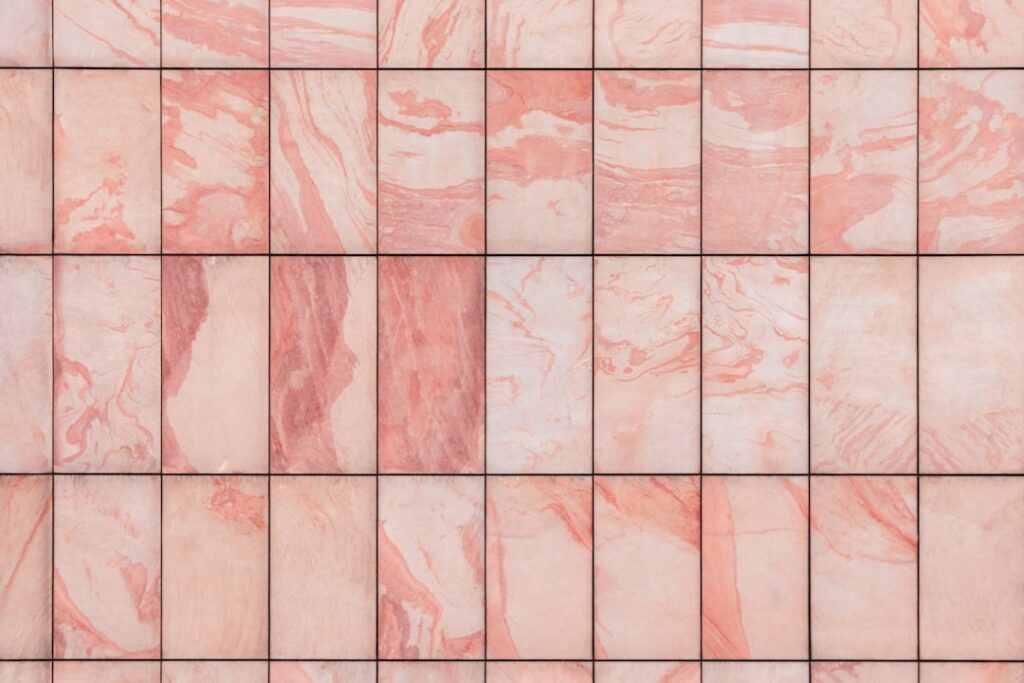
Natural stone, including marble, travertine, slate, and limestone, delivers organic veining and color variation that manufactured tile only imitates. A honed marble subway wall in a bathroom reads unmistakably high-end, and each tile is genuinely one of a kind. Stone typically runs $7 to $20 per square foot, with exotic marbles climbing higher.
Stone’s beauty comes with real maintenance. Marble and limestone are porous and acid-sensitive, so they must be sealed on installation and resealed every one to two years, and they will etch if splashed with lemon juice or wine near a kitchen. If you love the look but not the upkeep, a porcelain tile that mimics Carrara marble delivers 90 percent of the visual with none of the sealing.
Mosaic and Specialty Shapes
Mosaics are less a material than a format, composed of small tiles, usually under 2 inches, mounted on mesh sheets for easy installation. They come in glass, porcelain, stone, and metal, and they are the go-to for shower floors because the numerous grout lines provide slip resistance and the small format hugs a sloped drain. Penny rounds, hexagons, and fish-scale shapes all fall in this category.
Specialty shapes have exploded in popularity, from elongated hexagons to arabesque lanterns and dimensional zellige. These handmade Moroccan-style zellige tiles carry irregular edges and color variation that give a wall genuine artisan character, though at $10 to $25 per square foot and with a fussier installation, they are a splurge reserved for feature walls.
Finishes: Glossy, Matte, and Textured
Finish changes how any tile type reads and performs. Glossy glazes reflect light and feel classic on a subway backsplash, but they show water spots and require more frequent wiping. Matte finishes hide fingerprints and smudges, which makes them practical for busy bathrooms, while textured and three-dimensional tiles add shadow and depth to a feature wall.
Match the finish to the room’s job. A glossy white ceramic keeps a kitchen backsplash bright and easy to clean, while a matte porcelain suits a spa-like bathroom. Textured tiles look stunning but collect grease behind a stove, so keep the heavily dimensional options away from the cooktop zone.
Metal, Cement, and Terracotta Options
Beyond the mainstream categories sit a handful of specialty materials worth knowing. Metal tiles in stainless, copper, and aluminum, usually sold as mosaics or thin strips, add an industrial edge to a backsplash and resist heat well behind a range, though they scratch and run $15 to $40 per square foot. Cement or encaustic tiles carry bold painted patterns pressed into the body rather than printed on top, so the design wears in rather than off, but they are porous and need sealing like natural stone.
Terracotta and handmade clay tiles bring warm, earthy color and a rustic surface that suits Mediterranean and Southwestern kitchens. Because unglazed terracotta absorbs water readily, it belongs on dry accent walls or must be sealed thoroughly before use near a sink. These materials cost more in both dollars and labor, but a single feature wall in cement tile can define an entire room for $12 to $25 per square foot installed.
Layout Patterns That Define the Look
The same tile transforms completely depending on how it is set. A 3-by-6 inch subway tile laid in a classic 50 percent offset reads traditional, the identical tile stacked in a straight vertical grid looks crisp and modern, and a herringbone run turns it into a designer statement. Diagonal and chevron layouts add movement but also add 10 to 20 percent to material waste because of the extra angled cuts.
Grout is part of the pattern, not an afterthought. A contrasting dark grout against white subway tile emphasizes the geometry and hides kitchen grime, while a matched grout makes a large-format wall read as one seamless surface. Keep grout joints tight at 1/16 to 1/8 inch for rectified porcelain and slightly wider for handmade tiles whose irregular edges need room to breathe.
Choosing the Right Tile for Your Project
Start with the room’s demands. Shower walls need porcelain or sealed stone rated for wet exposure, kitchen backsplashes reward easy-clean glazed ceramic or glass, and a fireplace surround can showcase dramatic stone or zellige without worrying about moisture. Match the tile size to the wall too, since large-format tiles suit big open walls while mosaics fit tight niches and curved surfaces.
Whatever you select among the many types of wall tiles, budget 10 to 15 percent extra for cuts, breakage, and future repairs, and confirm your installer is using the correct thinset and, for wet areas, a proper waterproofing membrane behind the tile. Get those fundamentals right and any of these materials will hold its beauty for decades.
Weight, Substrate, and Wall Prep
Different tile types put different loads on a wall, and the substrate has to be matched to the material. Lightweight ceramic and thin glass mosaics can go over properly prepared drywall in a dry backsplash, but heavy natural stone and thick porcelain often need a cement backer board to carry the weight without sagging or cracking the joints over time. As a rule I switch to a half-inch backer board once tile pushes past roughly 8 pounds per square foot, which covers most stone and large-format porcelain.
Flatness is the other prep fundamental that homeowners skip. Large-format tiles above 15 inches ride hard on any hump in the wall and leave lippage, one edge sitting proud of the next, so the surface should be flat within 1/8 inch over a 10-foot span before the first tile goes up. Fixing a wavy wall with a skim coat or shimming the backer board costs a little time up front and saves a lot of frustration mid-install, no matter which of the types of wall tiles you have chosen.
Prefer to explore on your own?
See how new flooring looks in your actual room in seconds — free, no signup.
Try the free Floor Studio →