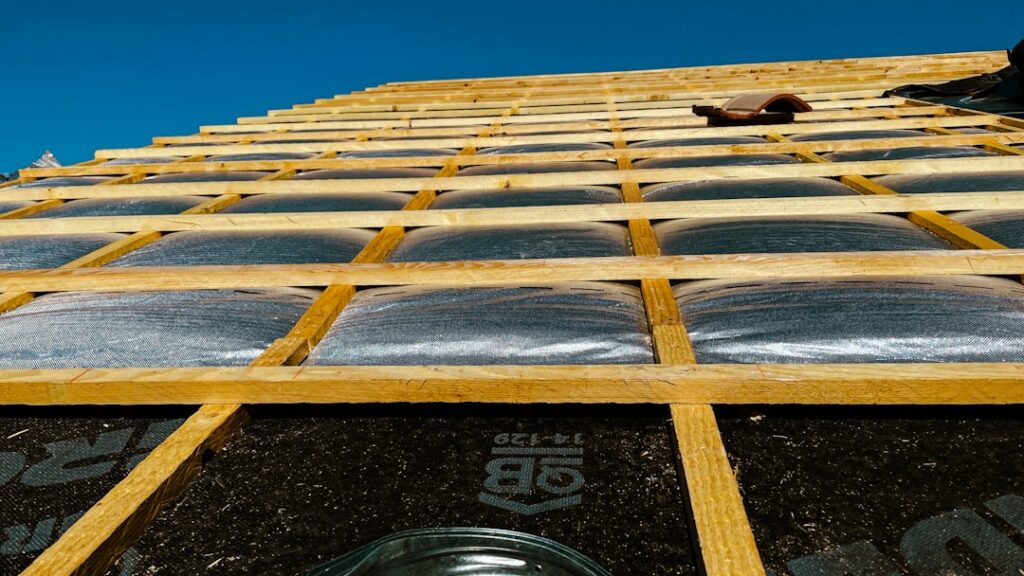
If a roofer or a big-box store associate has left you confused about Tyvek roof underlayment, you’re not alone. Here’s the clarification most homeowners need up front: the famous white Tyvek wrap you see stapled to house framing is a house wrap for walls, not a roofing product. DuPont does make a roofing line, but the plain HomeWrap is designed to shed liquid water while letting wall assemblies breathe, and it is not rated to sit under shingles.
- House Wrap vs. Roof Underlayment
- Where the Tyvek Name Legitimately Belongs: Tyvek Protec
- Synthetic Underlayment vs. Traditional Felt
- How It Gets Installed
- Why You Can’t Just Use Wall House Wrap on a Roof
- Where Ice-and-Water Shield Fits In
- Cost of Roof Underlayment
- Pros and Cons of Synthetic (Tyvek Protec) Underlayment
- The Bottom Line
That distinction matters, because putting the wrong DuPont product under your shingles can void warranties and cause callbacks. Let me sort out what actually goes on a roof, where the Tyvek name legitimately belongs, and how it stacks up against old-school felt.
House Wrap vs. Roof Underlayment
Both products are weather barriers, but they solve different problems in different locations. House wrap goes on exterior walls behind the siding. Its job is to block bulk water and wind-driven rain while remaining highly vapor-permeable so moisture inside the wall can escape and dry out.
Roof underlayment goes on the roof deck, under the shingles or metal. It has to survive high heat, tolerate UV exposure during construction, resist tearing under foot traffic, and lie flat under a heavy, hot shingle load. Standard wall house wrap isn’t engineered for those roof conditions, which is exactly why you shouldn’t substitute it. Use a product built for the roof deck.
Where the Tyvek Name Legitimately Belongs: Tyvek Protec
DuPont does make a genuine roofing underlayment, and it’s called Tyvek Protec. This is the product roofers mean when they correctly say “Tyvek” on a roof. Protec is a synthetic (polypropylene-based) roof underlayment engineered specifically for the deck, and it comes in a few grades:
- Tyvek Protec 120: The lighter-duty option for most residential slopes.
- Tyvek Protec 160: Heavier, with more UV resistance and grip.
- Tyvek Protec 200: The top-tier version with the highest traction surface and longest UV exposure rating, popular where crews walk a lot or expect delays before shingling.
What sets Protec apart is its embossed walkable surface for safer footing, high tear strength, and a generous UV exposure window (up to about 6 to 12 months depending on grade) so it can stay uncovered during a phased job. That’s the “Tyvek” you actually want on a roof, not the wall wrap.
Synthetic Underlayment vs. Traditional Felt
The bigger picture is that synthetic underlayment, whether Tyvek Protec, GAF FeltBuster, or Owens Corning ProArmor, has largely replaced the old asphalt-saturated felt (the black #15 and #30 “tar paper”). Here’s how they compare:
- Weight: Synthetic rolls are far lighter and cover about four times the area per roll, so fewer trips up the ladder.
- Tear resistance: Synthetics resist tearing and blow-off dramatically better; felt rips at fastener heads in wind.
- Water resistance: Felt can wrinkle, absorb water, and buckle when it gets wet before the shingles go on. Synthetics stay flat and shed water.
- UV exposure: Felt degrades in days of sun; synthetics tolerate months.
- Traction: Modern synthetics have textured, walkable surfaces; wet felt is slick and dangerous.
- Cost: Felt is cheaper per roll, but synthetics cover more and install faster, narrowing the real-world gap.
For most new roofs today, a quality synthetic underlayment is the smarter choice. Felt still shows up on budget jobs and some historic work, but the industry has clearly moved on.
How It Gets Installed
Underlayment installation follows a predictable sequence, and doing it in the right order is what keeps water out. First comes ice-and-water shield, a self-adhering membrane, along the eaves, in valleys, and around penetrations in cold climates. Then the field underlayment like Tyvek Protec rolls out horizontally, starting at the bottom edge and working up.
Each course overlaps the one below by the manufacturer’s spec, usually about 4 inches on horizontal seams and 6 inches on vertical end laps, so water always sheds over, never under. Crews fasten it with cap nails or cap staples (plastic-cap fasteners) rather than plain staples, because the caps hold better and seal around the shank. The printed guidelines right on the roll show the correct overlap and fastener pattern, so a good crew follows them exactly.
Why You Can’t Just Use Wall House Wrap on a Roof
It’s worth spelling out exactly why the plain white Tyvek HomeWrap doesn’t belong under shingles, because the substitution is tempting when you have a leftover roll on the job. Wall wrap is highly vapor-permeable by design, it’s meant to let a wall dry outward. Under a roof, that permeability and the wrap’s lighter construction work against you. Trapped between a hot shingle load and the deck, wall wrap can’t handle the sustained heat, lacks the tear strength for foot traffic, and isn’t rated for the fastener and overlap pattern a roof demands.
Just as important, using a non-roofing product voids the warranty on both the underlayment and often the shingles above it. Shingle manufacturers specify a compatible underlayment as part of their system coverage, and an inspector or an insurance adjuster who spots wall wrap under the shingles can reject a claim. The few dollars “saved” aren’t worth gambling the roof’s warranty and your coverage.
Where Ice-and-Water Shield Fits In
Synthetic underlayment like Tyvek Protec is water-resistant, but it isn’t self-sealing around nails, so it works alongside a second product rather than replacing it. Ice-and-water shield is a rubberized asphalt membrane with an aggressive adhesive back that seals tightly around every fastener that punches through it. That self-sealing quality is what makes it the go-to for the roof’s most vulnerable zones.
Code in cold climates typically requires it along the eaves (to defend against ice dams), and best practice puts it in valleys, around chimneys and skylights, and along low-slope sections regardless of climate. The field of the roof, the big open planes, gets the lighter, faster synthetic underlayment. Layering the two, membrane at the trouble spots and synthetic everywhere else, is how a well-built roof keeps water out even if a shingle blows off.
Cost of Roof Underlayment
Underlayment is a small slice of a total roof budget, but here’s what to expect:
- Synthetic underlayment material: roughly $0.15 to $0.40 per square foot, or about $60 to $150 per 10-square roll.
- Tyvek Protec specifically: often $150 to $200-plus per roll depending on grade and region.
- Traditional #30 felt: around $0.10 to $0.20 per square foot.
- Installed as part of a reroof: underlayment typically adds $0.50 to $1.00 per square foot once labor is folded in.
On a typical 2,000-square-foot roof (20 squares), underlayment material runs a few hundred dollars, a minor line item next to shingles and labor, and absolutely not the place to cut corners.
Pros and Cons of Synthetic (Tyvek Protec) Underlayment
Weighing it out honestly:
- Pros: Lightweight and fast to install, excellent tear and wind resistance, stays flat and sheds water, long UV exposure window, safer walkable surface, and often backed by strong manufacturer warranties when installed as part of a system.
- Cons: Higher material cost than felt, most synthetics are vapor-impermeable so ventilation of the roof assembly matters more, and it must be fastened with proper cap fasteners to perform and stay warrantied.
The Bottom Line
When someone says they want Tyvek roof underlayment, make sure everyone means the same thing. If they mean the white wall house wrap, that belongs on your walls, not under your shingles. If they mean Tyvek Protec, you’re looking at a legitimate, high-performance synthetic underlayment that beats old asphalt felt on nearly every measure. Confirm the exact product on the label, insist on cap fasteners and proper overlaps, and pair it with ice-and-water shield at the vulnerable edges. Do that and the layer no one ever sees will quietly protect your deck for the life of the roof.