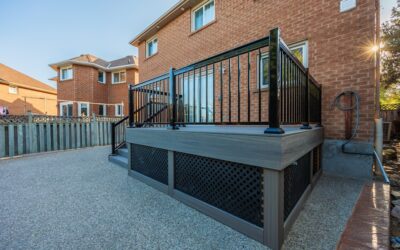
The space under a raised deck is rarely glamorous — exposed posts, dirt or gravel, the occasional tool or pile of leaves. The right under deck skirting ideas hide that mess while improving curb appeal and (in some cases) blocking access for animals that want to nest under your house. Skirting also serves a code purpose in most jurisdictions: any deck more than 30 inches above grade with an enclosed area below may need ventilation or treatment as a habitable space.
Part of our Decks & Outdoor guide — explore the full guide →
How Much Skirting You Actually Need
For a typical 12 by 16 ft second-story deck with the underside 8 ft above grade, you are looking at about 56 linear feet of skirting at 8 ft tall — roughly 450 sq ft of finished surface. That is a real materials budget regardless of the look you choose. Plan for $400 on the low end (basic lattice) up to $7,000 (stone veneer with framed openings).
Always include at least one access door in your skirting plan, framed at 30 to 36 inches wide. Future plumbing, gas line, or electrical work under the deck becomes brutal without it.
Pressure-Treated Lattice (The Budget Default)
4 by 8 ft pressure-treated lattice panels run $30 to $40 each at the box stores. Frame an opening with 2×4 cleats, slip the lattice in, and trim with 1×3. Total materials for a typical deck come in around $400 to $600.
Lattice is breathable, which solves the ventilation issue automatically. The downside is the look — diagonal lattice reads dated to most modern eyes. If you are committed to the price point, square lattice (also called privacy lattice) at the same cost looks cleaner and more contemporary.
Horizontal Slat Skirting
Horizontal 1×4 or 1×6 slats spaced 1/2 inch apart give a modern wraparound effect. Use the same wood or composite as the deck boards to tie the look together. A 56 linear ft run in pressure-treated cedar runs $700 to $900 in materials, in composite around $1,400 to $1,800.
The 1/2 inch gaps provide enough ventilation in most climates and block the view of clutter underneath. Detail that matters: stagger the joints so they do not stack on the same post. Stacked joints look amateur from 30 ft away.
Stone Veneer for High-End Looks
Manufactured stone veneer like Eldorado Stone or Boral Cultured Stone runs $9 to $14 per sq ft for the material, plus $5 to $9 per sq ft for installation labor. Real stone veneer doubles those numbers.
Stone veneer skirting requires a moisture barrier, lath, scratch coat, and stone applied with a polymer-modified mortar. The installation is real masonry work — not a DIY weekend project for most homeowners. Hire a mason. Plan for $4,000 to $7,000 installed for a typical second-story deck.
Composite Panel Systems
Trex, TimberTech, and Azek all sell branded skirting panels designed to match their decking lines. Pre-fabricated tongue-and-groove composite at $11 to $18 per sq ft installs faster than building from individual boards and matches the deck color exactly.
The systems include integrated ventilation channels at the top and bottom, which keeps you compliant with most local codes without modifications. Lifespan matches the deck — typically 25 years.
Solid Vinyl Skirting
Vinyl skirting borrowed from the manufactured housing industry runs $4 to $7 per sq ft installed. It comes in 12 ft sections that interlock and snap into top and bottom tracks. The install is fast, the cost is low, and the look is utilitarian.
Vinyl handles UV poorly. Expect color fading by year 5 to 7 and brittleness at year 10. It is a fine choice for a rental property or a porch you plan to redo in a decade. Not a 30-year solution.
Living Wall Screens
For sun-exposed sides, a wood or metal grid frame planted with climbing vines (clematis, climbing hydrangea, evergreen jasmine in zones 7+) hides the deck underside while greening the elevation. Build a 2×2 cedar lattice grid 12 inches off the actual deck framing — the gap lets the plant breathe and prevents trapped moisture against the structural members.
Install costs are low ($150 to $300 in materials per side) but coverage takes 2 to 4 growing seasons. Plan ahead and consider a temporary lattice during years one and two.
Ventilation Requirements
Most building codes require under-deck areas to have ventilation equal to 1 sq ft of opening per 150 sq ft of enclosed floor area when not treated as conditioned space. Lattice and slat skirting hit that automatically. Solid panel skirting (vinyl, composite, stone veneer) needs purpose-built vents.
Round 6-inch vents at $9 each, installed every 8 to 10 ft along the bottom of the skirting, satisfy the requirement in most jurisdictions. Add a removable insect screen behind each vent to keep wasps and rodents from nesting.
Drainage Underneath
Whatever skirting you pick, the ground under the deck needs proper drainage. Standing water under a deck destroys posts, attracts mosquitoes, and produces the smell that wafts onto the patio every August.
Slope the ground 1/4 inch per foot away from the house. Cover with 2 inches of #57 stone over a permeable landscape fabric. This combination drains rain through to the soil while keeping weeds, leaves, and animals out. Total cost for a 200 sq ft footprint: about $250 in stone and fabric.
Painting and Finishing
If you go with wood skirting, prime end grain twice and topcoat with a flat or low-sheen exterior paint. Sherwin-Williams Duration Exterior at about $80 a gallon holds color for 12 to 15 years. Avoid stain on bottom edges that touch concrete or soil — stain wicks moisture and rots within 3 to 5 years.
The finishing touch on any of these under deck skirting ideas is the access door. Hide hinges on the inside, paint the door to match, and install a magnetic catch. Done well, the door is invisible until you need it. Done poorly, it is the first thing the eye finds and the project never looks finished.