Prefinished hardwood looks pristine in a sample box, but it locks you into a factory color and a beveled edge that telegraphs every plank. Unfinished hickory flooring arrives raw, gets sanded flat across the entire room after install, and accepts whatever stain or finish you specify. The result is a continuous, edge-to-edge surface with the deepest, most controlled color you can buy. Hickory adds 1,820 Janka hardness and dramatic grain contrast that makes oak look bland by comparison — it is the species of choice for log cabins, ranch homes, and modern farmhouses.
Why Choose Unfinished Over Prefinished
Three real reasons. First, custom stain — you can match a specific design palette, copy an existing floor in another room, or create a multi-step reactive color (lye plus iron acetate, fumed, water popping) that no factory offers. Second, a flat, beveless surface — site-finished floors get sanded as one sheet, eliminating the V-grooves that catch dust on prefinished planks. Third, refinishing simplicity — when the floor is sanded the first time on-site, you know exactly what finish system is on it, which makes future recoats predictable.
Hickory’s Defining Traits
Hickory is the hardest commonly available domestic flooring species. At 1,820 Janka, it is 41% harder than red oak. The wood produces sharp light-and-dark contrast — sapwood runs near-white while heartwood ranges from honey to deep reddish-brown. Cabin and character grades include knots, mineral streaks, and color variation that some buyers love and others find too busy.
The hardness comes with installation challenges. Pneumatic nailers must run 110 to 120 PSI to seat cleats fully. Hand-nailed installations are nearly impossible. Hickory dulls saw blades quickly — keep two blades on hand and rotate.
Pros That Justify the Effort
Hardness translates directly to longevity. Hickory floors in cabins built in the 1940s still show original wear surfaces with minor refinishing. Dent resistance is better than oak, maple, or walnut by a meaningful margin. The species also resists water spotting better than many lighter species — its tighter grain absorbs less surface moisture.
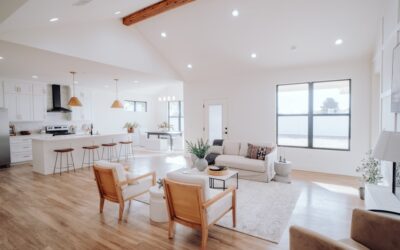
Visual character is the second selling point. Few species produce the same stripe-and-shadow effect on a floor that hickory does. In open-plan homes, the variation breaks up large floor planes that would look monotonous in plain-sawn oak.
Cons to Plan Around
Site-finishing requires renting a drum sander, edger, buffer, and HEPA vacuum. Total rental runs $200 to $350 for a weekend. Stain and finish materials add $400 to $700 for a 1,000 sq ft floor. The labor — roughly 30 to 40 hours for a careful DIYer or two days for a pro crew — is a lot.
Hickory’s hardness makes sanding take 50% longer than red oak. Plan for three drum-sanding passes (36, 60, and 100 grit) and two screen passes. Skip a grit and you leave drum marks that show through stain. Dust is also worse with hickory than most species — its fine dust gets into everything.
Color matching across boards is harder than oak because of the heartwood/sapwood split. Lay out and shuffle planks before nailing to distribute light and dark across the room.
Pricing the Material
Unfinished hickory pricing by grade:
- Cabin/Character grade: $3.00 to $4.50 per sq ft, knots and dramatic color variation
- Number 1 Common: $4.00 to $6.00 per sq ft, moderate color variation
- Select grade: $5.50 to $7.50 per sq ft, mostly heartwood, fewer defects
- Clear grade: $7.00 to $10.00 per sq ft, uniform color, no knots
Wider planks (5 inches and up) carry a 25 to 40% premium. Plain-sawn is the standard cut; quartersawn hickory exists but is rare and runs $9 to $14 per sq ft.
Stain and Finish Options
Hickory takes oil-based stains beautifully. Popular site-stained colors include early American, Jacobean, dark walnut, and provincial. For grayed or whitewashed looks, use a water-popped surface (mist with water before stain) to open the grain. Reactive stains create color depth no pigmented stain can match — Bona Craft Oil and Rubio Monocoat both make compatible products.
For finish, oil-modified polyurethane gives the warmest amber tone and 25-year wear life at $40 per gallon. Waterborne finishes like Bona Traffic HD ($110 per gallon) keep the wood’s natural color and cure faster. Two-component urethanes such as Pallmann Pall-X 98 hold up best in commercial settings.
Installation Sequence
The standard sequence for unfinished hickory flooring:
- Acclimate boxes 10 to 14 days in the install room
- Confirm subfloor is flat, dry, and screwed down
- Lay out and shuffle boards across 4 to 5 open boxes for color
- Nail with 16-gauge cleats, 6 to 8 inches on center
- Drum-sand at 36, 60, 100 grit; edge-sand to match
- Screen at 120 grit, vacuum, tack with mineral spirits
- Stain (if specified) and let cure overnight
- Apply 3 coats of finish, screening between coats
Total Installed Cost
For a 1,000 sq ft project including material, sanding, staining, and finishing, expect:
- DIY install with rental tools: $5,500 to $9,000
- Pro install, mid-grade hickory: $11,000 to $15,000
- Pro install, premium clear grade with custom stain: $15,000 to $22,000
Maintenance and Long-Term Care
Daily care is microfiber dust mop or hard-floor vacuum head. Weekly damp clean with Bona Hardwood Floor Cleaner or a similar pH-neutral product. Avoid steam mops, vinegar-water solutions, and any oil soap — all attack site-applied finishes faster than factory aluminum-oxide coatings. Use felt pads under furniture and area rugs in main traffic paths.
Plan a screen-and-recoat every 5 to 8 years for site-finished hickory. The service runs $1.50 to $3 per sq ft and adds a fresh top coat without removing wood. Full sand-and-refinish every 25 to 40 years. With this care, a quality unfinished hickory floor easily outlasts the homeowner who installed it.
Who Should Choose Hickory Unfinished
Unfinished hickory flooring rewards homeowners willing to invest in the install for a one-of-a-kind floor. It belongs in homes with stable HVAC, custom design needs, or rooms where a beveled prefinished floor would clash with adjacent site-finished sections. Skip it if you need a fast install, dislike grain variation, or live in a space with extreme humidity swings. For everyone else, the combination of hardness, character, and stain flexibility is hard to beat in domestic species.
Prefer to explore on your own?
See how new flooring looks in your actual room in seconds — free, no signup.
Try the free Floor Studio →