Most carpet shoppers default to beige loop and wonder five years later why their living room looks like every other living room. Unique carpet is the category covering custom patterns, colored loops, bound-edge area rugs from broadloom, and statement constructions that turn flooring into design rather than background. Specifying it well takes more planning, and the payoff lasts.
- What Qualifies as Unique Carpet
- Where Unique Carpet Earns Its Keep
- Cons and Real Trade-Offs
- Popular Patterns and Their Use Cases
- Custom Bound Area Rugs from Broadloom
- Fiber and Construction Choices
- Install Cost Breakdown for a Patterned Room
- Where to Specify Unique Carpet
- Sourcing and Sample Strategy
What Qualifies as Unique Carpet
Unique covers four overlapping product families. Patterned broadloom comes from mills like Stark, Fabrica, Stanton, and Couristan and runs $5.99 to $19.99 per square foot. Custom-bound area rugs cut from broadloom add a serged or cotton border, transforming a roll into a 9-foot-by-12-foot or 12-foot-by-15-foot statement piece. Multi-tone loop constructions blend two to five yarn colors in a single tuft for depth that solid-color carpet cannot match.
The fourth bucket is true custom — designer commissions, often through Edward Fields, Tai Ping, or Stark Studio, with hand-tufted wool patterns priced from $25 to $90 per square foot. These rarely fit residential budgets but exist as the reference point for everything below them in the market.
Where Unique Carpet Earns Its Keep
- Hides dirt and wear — multi-color patterns disguise foot traffic and pet accidents up to 3x longer than solid colors
- Defines zones in open-plan rooms — a bound area rug breaks a 40-foot great room into living, dining, and conversation spaces
- Anchors design themes — a single patterned carpet sets color and tone for furniture, drapery, and art selection
- Increases resale story — buyers in $600K and above markets respond visibly to designer rugs and patterned broadloom
- Replaceable in pieces — bound area rugs roll up and move with you, unlike wall-to-wall installs
Cons and Real Trade-Offs
Pattern matching at seams is the most underappreciated cost. A geometric or large-repeat pattern requires 15% to 25% additional material to align across seams on a typical 400 sq ft room. Solid carpet uses 10% waste — patterned can hit 30% on complex designs. That alone can swing a $3,000 job to $4,200 before labor.
The second issue is fitter skill. Pattern-matching seams takes 50% to 100% longer than solid carpet installs and requires a fitter who has done dozens of patterned jobs. Expect $1.50 to $2.50 per square foot in labor for patterned broadloom versus $0.85 to $1.25 on solid roll goods.
Popular Patterns and Their Use Cases
- Animal print (zebra, leopard) — typically wool sisal blends, $7.99 to $18.99 per square foot, dining rooms and home offices
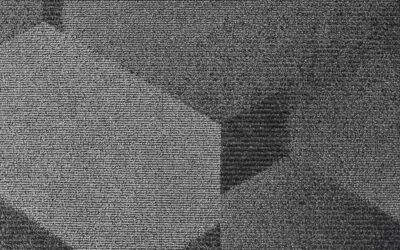
- Geometric trellis and lattice — Stanton Royal Dutch and Fabrica Astoria styles, $5.99 to $11.99 per square foot
- Persian and Oushak repeats — machine-woven wool blends, $6.99 to $14.99 per square foot, formal living rooms
- Striped and Bauhaus modern — multi-color loops, $4.99 to $9.99 per square foot, kid rooms and stairs
- Tartan and herringbone — wool nylon blends, $7.99 to $13.99 per square foot, libraries and dens
Custom Bound Area Rugs from Broadloom
Buying broadloom by the foot and binding into an area rug is the value play in unique carpet. A 9-foot-by-12-foot bound rug from a $7.99 per square foot Stanton or Fabrica pattern costs roughly $863 in material plus $120 to $200 for cotton or serged binding. Compare that with a similar size hand-tufted designer rug at $3,200 to $6,500.
Binding options matter. Cotton tape binding wraps in matching or contrasting color and lasts 15 to 25 years residential. Wide canvas binding adds a formal frame and runs slightly more. Serged binding uses thick yarn whipped over the edge — durable but less formal. Avoid latex-glued binding, which yellows and stiffens within 5 to 7 years.
Fiber and Construction Choices
Wool is the traditional unique-carpet fiber. New Zealand wool from Stark or Stanton runs $9.99 to $17.99 per square foot and lasts 25 to 40 years in moderate residential use. Wool nylon blends at 80% wool / 20% nylon improve abrasion resistance for stairs and entries without losing the natural look. Pure nylon at $4.99 to $8.99 per square foot covers most modern patterned constructions and resists fading better than wool under direct sun.
For pet households, triexta SmartStrand patterned options from Mohawk and Karastan deliver real stain protection in unique patterns at $3.99 to $6.99 per square foot. Solution-dyed nylon by Shaw and Stainmaster handles sun rooms without UV fading over 15 to 20 years.
Install Cost Breakdown for a Patterned Room
A representative 350 sq ft patterned broadloom install in 2026 breaks down like this. Material at $7.99 per square foot with 25% pattern waste: $3,496. Pad at $0.69 per square foot: $242. Tack strip, transitions, seam tape, and supplies: $120. Furniture moving and old carpet disposal: $220. Fitter labor at $1.85 per square foot: $648. Total installed: about $4,726, or $13.50 per square foot all in.
Save 20% to 30% by choosing a small repeat or non-directional pattern, which drops waste from 25% back to 12% to 15%. Stanton Crescent Heights and Fabrica Marrakesh patterns specifically engineer small repeats to ease this issue.
Where to Specify Unique Carpet
Stairs and hallways carry the highest visual impact for the smallest square footage — a runner with binding tape on 14 steps and an 18-foot upper hallway covers about 60 to 80 sq ft and runs $700 to $1,800 installed. Dining rooms work because chairs sit on the rug and add weight that anchors the pattern visually. Formal living rooms with limited foot traffic stretch the wear-life of more expensive wool constructions.
Avoid high-pile patterned products in mudrooms, kitchens, and home gyms — the pattern shows wear concentrated in walkways within 12 to 24 months. For those zones, a flat-weave or sisal-look construction in solution-dyed nylon delivers the visual interest without the wear penalty.
Sourcing and Sample Strategy
Unique carpet rarely comes off a showroom rack ready to go. Plan 3 to 6 weeks lead time for patterned broadloom and 6 to 10 weeks for custom-bound area rugs from a specialty workroom. Pull 12-inch by 12-inch samples or, better, request a 24-inch by 24-inch memo sample on patterned styles since small swatches do not show the full repeat. Lay samples in the actual room for 72 hours under your usual lighting, because pattern carpets read very differently under LED 2700K, 3000K, and natural north-facing daylight. Mock the pattern alongside fabric swatches from drapery or upholstery you plan to keep so the color story works in the room rather than only in isolation.