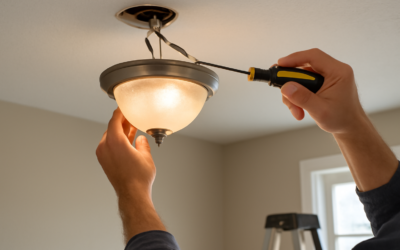
A vanity fixture that is too narrow leaves dark shadows at the edges of the mirror, while one that overhangs the glass looks like it was bought for a different bathroom. The simplest rule for vanity light size is to choose a fixture about 75 percent of the mirror’s width and never wider than the mirror itself. Over a 36 inch mirror, that means a fixture around 24 to 30 inches wide.
Part of our Bathroom Remodeling & Flooring guide — explore the full guide →
Width is only half of the decision. The number of bulbs, the total lumens and the color quality of the light determine whether the fixture actually helps you shave, apply makeup or check your skin. A well-sized fixture with the wrong bulbs still casts harsh shadows under the eyes and chin.
- Vanity Light Size Guidelines by Mirror Width
- When a 48 Inch Vanity Light Fits
- Choosing a 60 Inch Vanity Light Fixture or Two Fixtures
- Bulb Count, Lumens and Color
- Tools and Steps for Choosing and Installing
- Matching Fixture Style to Bathroom Size
- Electrical Safety in Bathrooms
- Troubleshooting Common Vanity Lighting Problems
- Cost Ranges
- When to Call a Licensed Electrician
- Frequently Asked Questions
Mounting height is its own topic, usually 75 to 80 inches above the floor for a fixture over the mirror, so the focus here stays on width, bulb count and output.
Vanity Light Size Guidelines by Mirror Width
Mirror width is the most reliable reference, because the fixture frames the mirror visually. Most vanity light size guidelines land in the same place: fixture width at roughly two-thirds to three-quarters of the mirror width, centered over the mirror.
| Mirror width | Fixture width | Typical bulb count |
|---|---|---|
| 18 to 24 in | 12 to 18 in | 1 to 2 |
| 30 in | 18 to 24 in | 2 to 3 |
| 36 in | 24 to 30 in | 3 |
| 48 in | 32 to 38 in | 3 to 4 |
| 60 in | 40 to 48 in | 4 to 5 |
| 72 in | 48 to 60 in | 5 to 6, or two fixtures |
If the mirror is much narrower than the vanity, size the fixture to the mirror first, then check that it still looks proportional to the cabinet. When in doubt, a fixture slightly smaller than the mirror always looks better than one hanging past it.
Sizing to the vanity instead
Some designers size to the vanity cabinet, especially when a wall-to-wall mirror spans the whole counter. In that case, aim for a fixture at least half the vanity width and up to about three-quarters. A 36 inch vanity suits an 18 to 27 inch fixture, a 48 inch vanity a 24 to 36 inch fixture, and a 60 inch vanity a 30 to 45 inch fixture.
When a 48 Inch Vanity Light Fits
A 48 inch vanity light is a common size, and it fits best over a mirror about 60 to 64 inches wide or across a 60 inch vanity with a broad mirror. Mounted over a 48 inch mirror, the fixture would match the glass edge to edge, which can look heavy; most people prefer leaving a few inches of mirror showing on each side.
Four to five bulbs or an integrated LED bar works well at this width. Look for even spacing so no area of the mirror falls into a shadow gap, and confirm the fixture’s center lines up with the faucet or the vanity center.
Choosing a 60 Inch Vanity Light Fixture or Two Fixtures
A 60 inch vanity light fixture suits long double vanities, typically 72 inches or wider, with one continuous mirror. It gives a clean, unified line and enough coverage to light both sinks.
Double vanities with two separate mirrors work better with two fixtures, one centered over each mirror and each sized to that mirror. A pair of 24 inch fixtures over two 30 to 36 inch mirrors usually looks more balanced than one long bar crossing the gap between them. Separate fixtures also let you put each side on its own switch if two people get ready at different times.
Bulb Count, Lumens and Color
Any vanity light size guide should also address output. A good starting target is about 1,600 lumens of total light at the vanity for a single sink, roughly the output of a traditional 100 watt incandescent, and around 2,400 to 3,200 lumens for a double vanity. Larger bathrooms or dark finishes need more.
- Bulb spacing: one bulb or LED segment per 6 to 8 inches of fixture width keeps light even.
- Color temperature: 2700K to 3000K feels warm and flattering; 3500K to 4000K reads crisper and helps with makeup accuracy.
- Color rendering: look for a CRI of 90 or higher so skin tones look natural.
- Diffusion: frosted glass or diffused LED lenses reduce glare in the mirror.
- Dimming: a compatible dimmer lets you go bright for grooming and soft for night use.
Over-mirror vs side sconces
A single fixture over the mirror is the standard choice, but it casts light downward and can leave shadows under the eyes. Side sconces mounted about 60 to 66 inches high and 28 to 40 inches apart light the face from both sides and eliminate most shadows. Many bathrooms combine both: a modest bar over the mirror and sconces at each side. If you use sconces, each one needs much less width; 4 to 6 inch wide shades are typical.
Tools and Steps for Choosing and Installing
When picking a bathroom vanity light fixture, gather a tape measure, painter’s tape, a pencil and the mirror and vanity dimensions. Then:
- Measure the mirror width and the vanity width.
- Calculate the target width at about 75 percent of the mirror.
- Mock it up with painter’s tape on the wall at the planned height to check proportion.
- Check the electrical box location. It should be centered over the mirror; many fixtures have a backplate wide enough to cover a box that is slightly off-center.
- Confirm the fixture is damp-rated for bathroom use, or wet-rated if it will sit inside a shower area.
- Turn off the breaker and confirm power is off at the box with a non-contact voltage tester before removing the old fixture.
- Mount the bracket, connect wires per the manufacturer’s diagram including the ground, and secure the fixture.
- Install bulbs, restore power and test.
Matching Fixture Style to Bathroom Size
Proportion is not only about width. A small powder room with a 24 inch mirror can feel cluttered by a chunky multi-globe bar, even if it measures correctly, so slim profiles and single shades suit tight spaces. In a large primary bath with a tall ceiling, a fixture that is technically the right width may still look thin; choosing a design with more visual height, such as taller glass shades or a thicker LED bar, helps it hold its own against a big mirror.
Finish matters too. Pick a metal finish that matches or deliberately complements the faucet and cabinet hardware. Chrome and polished nickel read lighter on the wall, while matte black and aged brass add visual weight and can make a fixture seem a size larger than it is. Keep that in mind when deciding between two widths that both fall within the recommended range.
Electrical Safety in Bathrooms
Vanity lights are line-voltage fixtures on household 120 volt wiring. Always shut off the breaker and confirm power is off with a non-contact voltage tester, and never work on live circuits. Bathroom receptacles must be GFCI protected, and any added outlet, new circuit or relocated box is a job for a licensed electrician, often with a permit. Plug hair dryers and curling irons directly into the wall outlet rather than into extension cords. Use a stable step stool, and keep tools off the wet countertop.
Troubleshooting Common Vanity Lighting Problems
- Shadows under the eyes: the fixture is too high or too narrow. Add side sconces or a wider fixture.
- Glare in the mirror: switch to frosted bulbs or a diffused LED fixture.
- Dark edges of the mirror: the fixture is under 50 percent of the mirror width. Size up.
- Fixture looks oversized: it is wider than the mirror. Choose one that leaves a few inches of glass visible on each side.
- Box is off-center: use a fixture with a wide backplate, or have an electrician move the box.
Cost Ranges
Basic vanity bars often cost under $100, while mid-range fixtures with good diffusers or integrated LEDs typically run $100 to a few hundred dollars. Larger 48 and 60 inch fixtures sit toward the higher end. Swapping a fixture on an existing box is usually a modest electrician fee; moving the box or adding sconces with new wiring through finished drywall raises labor costs considerably.
When to Call a Licensed Electrician
Replacing a vanity fixture on an existing, centered box is a common DIY task. Call a licensed electrician to add sconce boxes, move a box, add a new circuit or GFCI outlet, wire a dimmer or work with older wiring. A pro will also confirm the fixture’s rating matches its location in the bathroom.
Match vanity light size to the mirror, give it enough lumens and good color quality, and the fixture will do its real job: lighting your face evenly every morning.
Frequently Asked Questions
What size vanity light do I need for a 36 inch mirror?
A fixture around 24 to 30 inches wide, roughly three-quarters of the mirror width, with about 3 bulbs or an equivalent LED bar.
Should a vanity light be wider than the mirror?
No. A fixture wider than the mirror tends to look oversized. Leave at least a few inches of mirror visible on each side.
What size mirror does a 48 inch vanity light fit?
A 48 inch fixture fits best over a mirror about 60 to 64 inches wide, which usually means a 60 inch or larger vanity.
How many lumens does a bathroom vanity need?
Aim for about 1,600 lumens at a single vanity and roughly 2,400 to 3,200 lumens for a double vanity, more in large or dark-finished bathrooms.
Is one long fixture or two separate lights better for a double vanity?
One long fixture suits a single continuous mirror. Two separate mirrors usually look better with two fixtures, each centered and sized to its own mirror.