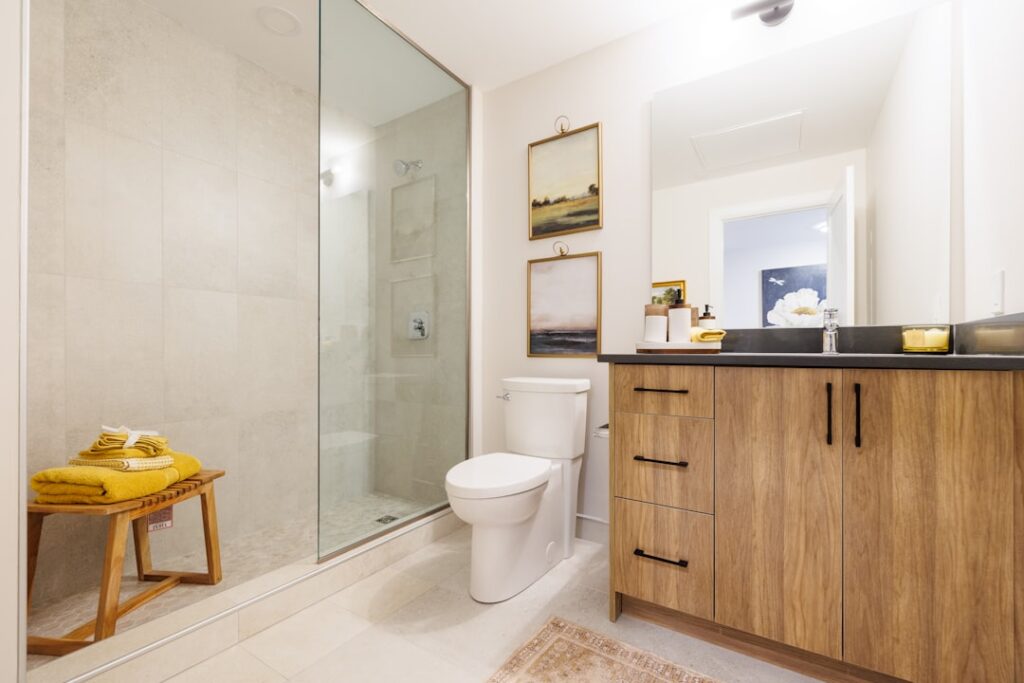
A backless stool looks tidy tucked under a counter, but sit on one for ten minutes doing your hair and you’ll feel your lower back complain. A vanity stool for bathroom with back solves that by giving your spine something to rest against while you lean in toward the mirror. It’s the difference between perching and actually sitting. If you spend real time at the vanity for makeup, skincare, or blow-drying, the back support is worth the slightly larger footprint. Here’s how to choose one that fits your counter, your body, and your bathroom’s humidity.
- Why the Back Support Matters
- Getting the Seat Height Right
- Materials That Survive a Bathroom
- Upholstered Back vs. Solid Back
- Footprint, Legs, and Storage Fit
- Style Matching Your Vanity
- Weight Rating and Build Quality
- Swivel, Fixed, or Rolling
- Cleaning and Long-Term Care
- Common Buying Mistakes to Avoid
- Making the Final Call
Why the Back Support Matters
Grooming isn’t a quick sit-down. You lean forward to the mirror, then rock back to check the result, and you repeat that for twenty or thirty minutes. Without a backrest, your core does all the stabilizing, which is why a backless stool feels fine at first and tiring later.
A low backrest, even a short one that hits the small of your back, lets you shift weight and stay upright without effort. Look for a back that rises 8 to 14 inches above the seat. Taller than that starts to read like a dining chair and won’t slide under a counter; shorter than 6 inches barely does anything.
Getting the Seat Height Right
Seat height is the number people get wrong most often. Standard vanity counters sit at 32 to 36 inches, and you want roughly 10 to 12 inches of clearance between the seat top and the underside of the counter so your thighs clear comfortably. That math puts most vanity stool seats in the 18- to 24-inch range.
- Standard vanity (32 in counter): Aim for an 18- to 20-inch seat.
- Comfort-height vanity (36 in counter): Go 22 to 24 inches, or choose an adjustable stool.
- Makeup drop-down (30 in counter): A shorter 16- to 18-inch seat works best.
If you’re between sizes or share the bathroom, a gas-lift adjustable stool that swings from 18 to 24 inches solves the problem for everyone. Just confirm the version you buy has a back, since many adjustable models are backless bar-style.
Materials That Survive a Bathroom
Bathrooms swing from steamy to dry several times a day, and that cycle is hard on furniture. Skip untreated solid wood unless it’s sealed, and be wary of cheap MDF frames that swell if they wick up shower moisture. Your best bets balance moisture resistance with comfort.
Powder-coated steel or aluminum frames shrug off humidity and hold up for years. Sealed hardwood such as teak or bamboo handles moisture naturally and looks warm. For the seat and back cushion, performance fabric, marine-grade vinyl, or genuine leather clean up easily; avoid loose-weave upholstery that traps hairspray and skin oils. A wipeable seat is not a luxury in a bathroom, it’s basic maintenance.
Upholstered Back vs. Solid Back
You’ll choose between a padded, upholstered backrest and a solid wood or metal back. Each has a case.
An upholstered back is more comfortable for long sessions and softens a hard-tiled room visually. The downside is cleaning; fabric backs absorb humidity and need occasional spot treatment. A solid or slatted back wipes clean in seconds and never harbors mildew, but it’s less forgiving against your spine. My usual recommendation for a busy family bath is a solid or vinyl-wrapped back, and an upholstered version for a quieter primary suite where moisture is better controlled by good ventilation.
Footprint, Legs, and Storage Fit
A stool with a back still needs to disappear when you’re not using it. Measure the knee space under your vanity, because a toe-kick recess or a drawer bank can limit how far the stool tucks in. Four splayed legs are the most stable but take the most floor; a pedestal base or sled legs slide back further.
Watch the leg tips too. Hard plastic or metal feet scratch tile and vinyl, so add felt or rubber glides. On a small bathroom floor, a compact stool with a footprint under 15 by 15 inches keeps the walk path clear. If your vanity has an open kneehole cutout, a low-back stool with slim legs can nest entirely inside it and vanish.
Style Matching Your Vanity
The stool is a visible piece of furniture, so treat it as part of the design rather than an afterthought. Pull a finish from something already in the room. A brushed-nickel frame echoes your faucet; a wood-tone leg picks up the vanity cabinet; a fabric color can nod to a towel or a wall shade.
For traditional baths, a curved wood back with a tufted cushion suits the space. Modern rooms look best with a clean-lined metal frame and a low, flat back. Farmhouse and transitional baths land nicely with a woven or cane back paired with a linen seat. When in doubt, match metals first, since a mismatched finish reads louder than a mismatched wood tone.
Weight Rating and Build Quality
Check the stated weight capacity before you buy. A quality vanity stool should list a rating of at least 250 to 300 pounds, and anything without a published number is a gamble. Give the legs a wiggle if you’re shopping in person; joints should be bolted or doweled, not just stapled.
On adjustable models, the gas cylinder is the part that fails first. Cheap cylinders sink slowly under weight within a year, so look for a stool with a Class 3 or Class 4 rated cylinder. Reputable stools in the $80 to $200 range usually spell this out; bargain stools under $50 rarely do.
Swivel, Fixed, or Rolling
The base style changes how the stool moves, and that affects daily use more than people expect. A fixed-leg stool stays put, which feels stable and never rolls away when you sit, but you have to physically pick it up to reposition it at the counter.
A swivel stool rotates on its base, letting you turn toward the mirror or away without shuffling the whole seat, which is genuinely convenient during a long grooming session. Rolling stools on casters move effortlessly along a wide vanity, handy if you shift between a sink station and a makeup station, but casters roll on hard tile and can drift when you sit, so look for locking casters or a braked base. For most bathrooms I recommend a fixed or swivel base over casters, since a stool that scoots out from under you is more annoyance than help. If you do want to roll, spend the extra for locking wheels and a heavier base that won’t tip.
Cleaning and Long-Term Care
A stool in a humid bathroom needs a little upkeep to stay looking new. Hairspray overspray, skin oils, and product residue build up on the seat and back, and left alone they turn a light cushion dingy within a year.
Wipe a vinyl or leather seat weekly with a damp cloth and a mild soap, and treat a fabric back with a fabric-safe cleaner as needed. For metal frames, an occasional wipe keeps water spots and any early corrosion at bay; if you see rust starting on a cheap frame, that’s a sign the finish wasn’t powder-coated. Wood frames benefit from an annual coat of furniture wax or oil if they’re sealed. Check the leg glides every few months and replace worn felt pads before the bare foot starts scratching your floor. None of this takes more than a few minutes, and it’s the difference between a stool that looks tired in two years and one that still looks sharp in ten.
Common Buying Mistakes to Avoid
A few predictable errors turn a good purchase into a returned one. The most common is buying on looks alone and ignoring the seat height, which leaves you with a stool that’s too tall to slide under the counter or so low your knees hit the underside.
The second is choosing a fabric back that can’t handle bathroom moisture, then watching it mildew or stain. The third is overlooking the weight rating and ending up with a wobbly seat that flexes under normal use. And the fourth is forgetting to measure the kneehole width, so the stool won’t tuck away and ends up blocking the walk path. Avoid all four by shopping with your counter height, kneehole width, and desired clearance in hand, and by insisting on a wipeable seat and a published weight rating. Get those basics right and the stool becomes a piece you barely think about, which is exactly what good furniture should do.
Making the Final Call
Bring three numbers to the store or the checkout page: your counter height, the clearance you want under it, and the width of your kneehole. With those in hand, a vanity stool for bathroom with back is a straightforward pick. Prioritize a wipeable seat, a back that hits your lower spine, and a seat height that leaves your thighs 10 to 12 inches of daylight, and you’ll have a seat you actually enjoy using every morning. Spend the extra twenty dollars on felt glides and a published weight rating, and it’ll serve you for years.