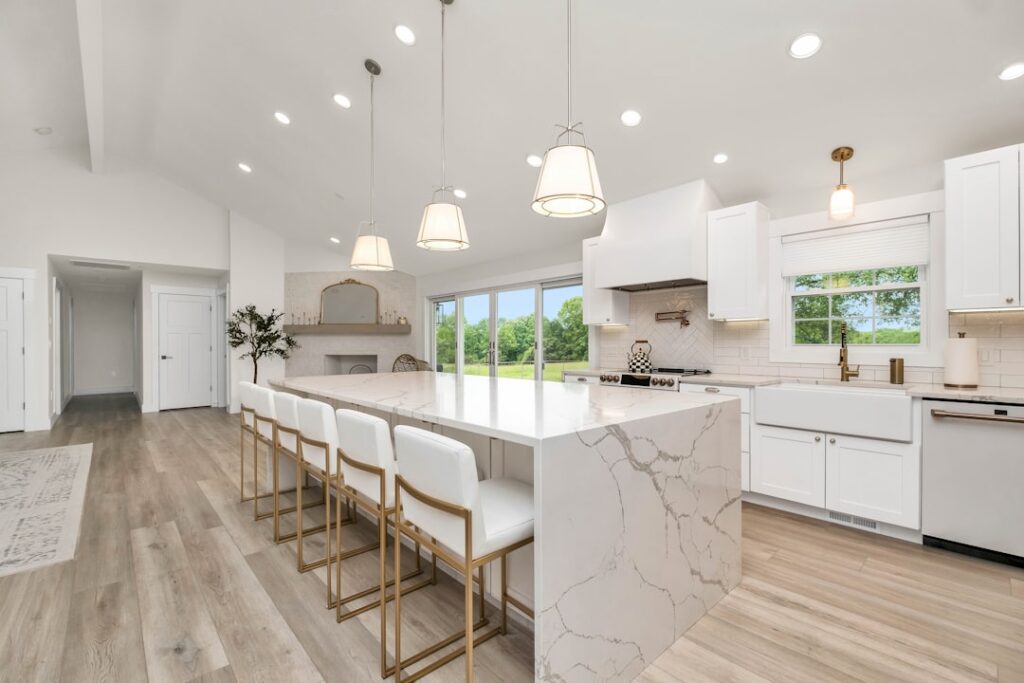
Standard laminate has long carried a warning label for wet rooms, but the latest generation tells a different story. Waterproof laminate flooring for kitchens now ships with sealed cores and locking edges rated to hold standing water for up to 72 hours without swelling, which is exactly why kitchen installations of this material have climbed sharply over the past five years. If you have ever mopped up a dishwasher leak and dreaded the bubbling that followed, this category was designed with you in mind.
What Makes Laminate “Waterproof”
Traditional laminate is built around a high-density fiberboard (HDF) core. Fiberboard is basically compressed wood fiber, and wood fiber drinks water. Once moisture reaches the core, the planks expand, the edges chip, and the seams pop. Waterproof laminate solves this in two ways. First, manufacturers treat or replace the core with water-resistant resins, and some lines swap HDF for a stone-plastic composite. Second, the click-lock joints are coated with a wax or polymer sealant so liquid cannot wick down between boards.
Read the label carefully, because the industry uses two terms that are not interchangeable. “Water-resistant” usually means the surface repels spills you wipe up within a few hours. “Waterproof” means the product carries a tested rating, often 24 to 72 hours of surface exposure, backed by a written warranty. For a kitchen, hold out for the genuine waterproof rating.
The Pros for Kitchen Use
- Spill tolerance: Dropped ice cubes, splashed dishwater, and pet bowls that overflow no longer threaten the floor, as long as you wipe pooled water within the rated window.
- Realistic looks: Modern printed wear layers mimic oak, hickory, and even stone convincingly, with embossed textures that line up with the grain image.
- Scratch resistance: The aluminum-oxide top coat shrugs off dragged chairs and dropped utensils far better than real hardwood.
- DIY-friendly: Floating click-lock planks need no glue or nails, so a confident homeowner can floor an average kitchen over a weekend.
- Price: Expect roughly $2 to $5 per square foot for the material, well under the cost of comparable engineered wood or tile.
The Cons You Should Weigh
No product is perfect, and honesty matters when you are spending real money. Waterproof laminate still has a printed photographic layer, so it will never feel like solid wood underfoot, and a deep gouge that pierces the wear layer exposes the core and cannot be sanded out. Repairs mean replacing a plank.
Underfoot, laminate can sound hollow and feel hard unless you install a quality underlayment. It also does not add resale value the way genuine hardwood does. And while the core resists water, a flooded kitchen left standing for days can still find its way through cut edges around cabinets and pipes. Waterproof is a strong defense, not an invitation to ignore leaks.
Waterproof Laminate vs. Luxury Vinyl Plank
Shoppers almost always cross-shop waterproof laminate against luxury vinyl plank (LVP), and the two are genuine rivals. Laminate generally offers a crisper, more textured wood look and a harder, more scratch-resistant surface. LVP is fully plastic, so it is the safer pick if you expect frequent standing water or a basement-level moisture problem, and it feels slightly softer and warmer underfoot.
For a typical kitchen on the main floor, where spills are wiped up promptly, waterproof laminate usually wins on appearance and price. For a kitchen prone to flooding or built on a damp slab, LVP is the more forgiving choice. There is no universally correct answer; match the product to how wet your room actually gets.
How to Shop: Specs That Actually Matter
When you stand in the store aisle, ignore the marketing and check these numbers:
- AC rating: This abrasion-class score runs from AC1 to AC5. For a busy kitchen, choose AC4 or AC5 for commercial-grade durability.
- Thickness: Look for 8mm to 12mm planks. Thicker boards feel more solid and disguise minor subfloor imperfections.
- Waterproof warranty term: A real waterproof product states the exposure hours and the warranty length in writing, commonly 25 years residential.
- Wear-layer coating: Aluminum oxide is the standard; more of it means better scratch resistance.
- Attached underlayment: Some planks include a foam or cork backing that saves you a separate install step and quiets the floor.
The team at D and G Flooring recommends buying about 10 percent more material than your square footage, both to cover cutting waste and to keep spare planks for future repairs that match your exact dye lot.
Installation Tips for a Watertight Kitchen Floor
The plank itself may be waterproof, but a kitchen install lives or dies by the perimeter and the seams. Start by letting the boxes acclimate flat in the room for 48 hours so the planks match the home’s temperature and humidity. Lay a moisture barrier over concrete subfloors, since slabs can release vapor that condenses under the floor.
Leave a 1/4-inch to 3/8-inch expansion gap around every wall and fixed object, then hide it with baseboard or quarter-round. The most vulnerable spots are around the dishwasher, sink base, and any pipe penetrations, so run a bead of 100 percent silicone caulk to seal those cut edges. Avoid running long, unbroken runs without the manufacturer’s recommended expansion provisions, because laminate expands and contracts with the seasons. Finally, never wet-mop with a sloshing bucket; a damp microfiber mop is all a laminate floor ever needs.
Care and Maintenance
Day-to-day upkeep is genuinely easy. Sweep or vacuum with a hard-floor setting to lift grit before it scratches the surface. For sticky spots, use a cleaner labeled for laminate or a splash of vinegar in water, wrung nearly dry. Skip steam mops, wax, oil soaps, and abrasive pads, all of which can dull or damage the wear layer over time.
Place felt pads under chair and stool legs, lay a washable mat in front of the sink, and wipe spills as they happen. Treated this way, a quality kitchen laminate floor commonly looks sharp for 15 to 25 years before you think about replacing it.
Is It the Right Choice for You?
Waterproof laminate hits a sweet spot for homeowners who want the warm look of wood, a hard-wearing surface, and a friendly price, all in a room where the occasional spill is a fact of life. It is not the answer for a chronically flooded space or for someone set on the feel and resale punch of solid hardwood. But for the vast majority of US kitchens, a well-chosen, properly sealed waterproof laminate floor delivers years of low-stress performance. Measure your room, check the specs above, buy a little extra, and seal those edges, and you will have a kitchen floor that earns its keep.
Prefer to explore on your own?
See how new flooring looks in your actual room in seconds — free, no signup.
Try the free Floor Studio →