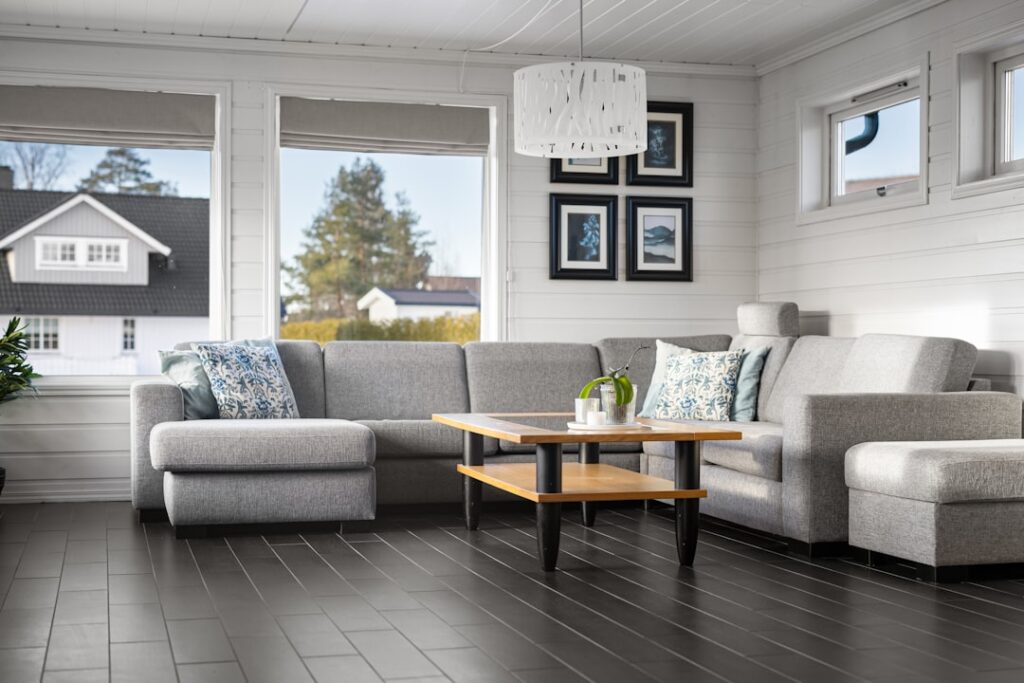
Step onto a bare rigid-core plank floor and it can feel hard and hollow, and every footstep echoes into the room below. Waterproof vinyl plank flooring with pad solves both problems by bonding a cushioning underlayment directly to the back of each plank, giving you a floor that’s warmer, quieter, and softer underfoot right out of the box. It also saves you the hassle and cost of rolling out separate underlayment. Here’s how to choose the right attached-pad floor for your home.
What “With Pad” Really Means
An attached pad is a thin layer, usually cork, foam (IXPE or EVA), or rubber, factory-laminated to the underside of each plank. Instead of buying and installing loose underlayment separately, the cushioning ships already integrated. Cork runs about 1mm to 2mm thick; foam pads are similar. That small layer does a lot: it dampens sound, adds a hair of give, and bridges tiny imperfections in the subfloor.
Combine that pad with a waterproof SPC or WPC core, and you get a floor you can install in a kitchen, bathroom, or basement that also feels comfortable to stand on for hours.
The reason this matters comes down to how rigid-core vinyl behaves without a pad. SPC planks are dense and stiff by design, which is great for dent resistance but makes them feel hard and acoustically “live” over a bare subfloor, every footstep transmits a sharp click into the room and the floor below. An attached pad breaks that direct contact. It gives the plank a thin buffer that absorbs impact energy, softens the sound, and insulates against a cold slab. You’re not giving up the rigid core’s toughness; you’re simply adding a comfort-and-quiet layer that would otherwise require a separate roll of underlayment and an extra afternoon of labor to install.
The Benefits of an Attached Pad
- Quieter floors: The pad absorbs impact and reduces the hollow “click-clack” of rigid vinyl, especially important on upper floors and in condos.
- Warmer underfoot: Cork and foam insulate against a cold slab, making basements and concrete much more livable.
- More comfort: A slight cushion eases fatigue when you’re standing at the sink or stove.
- Faster installation: No separate underlayment to roll, tape, and trim, one fewer step.
- Minor subfloor forgiveness: The pad helps mask very small dips and imperfections.
- Better sound ratings: Many attached-pad floors meet the IIC and STC sound-transmission ratings that HOAs and condo boards require.
Types of Attached Pads
The pad material affects performance, so know what you’re getting:
- Cork: The premium option. Naturally antimicrobial, warm, and an excellent sound absorber. Adds the best acoustic and thermal performance.
- IXPE foam: A closed-cell foam that resists moisture and won’t harbor mold, a strong all-around choice for waterproof floors.
- EVA foam: Lightweight and cushioning, common on mid-range products; slightly less durable than IXPE.
- Rubber: The best sound dampener and most durable, found on higher-end and commercial-grade planks.
For a waterproof floor, closed-cell foam or cork is ideal because it won’t trap water. Avoid open-cell foams that can hold moisture against the subfloor.
Do You Still Need a Moisture Barrier?
Yes, in some cases. Over a concrete subfloor, moisture vapor can migrate up through the slab even under a waterproof plank, and that vapor can get trapped under the attached pad. Many manufacturers require a separate 6-mil polyethylene vapor barrier over concrete, even with an attached pad, so read the installation instructions before you assume the pad handles everything. Over plywood on an upper floor, the attached pad is usually all you need.
Installation Tips
Attached-pad planks install the same way as standard rigid-core vinyl, with a floating click-lock system, but a few points matter:
- Never stack pads: Do not add a second underlayment under an attached-pad plank. Too much cushion causes the locking joints to flex and eventually fail.
- Acclimate 48 hours: Let planks adjust to room temperature and humidity before installing.
- Flatten the subfloor: The pad forgives tiny flaws, but the subfloor still needs to be within 3/16 inch over 10 feet.
- Add the vapor barrier over concrete: Lay a 6-mil poly sheet first if the manufacturer requires it.
- Leave expansion gaps: Keep a 1/4- to 3/8-inch gap at all walls, covered by baseboard.
The single most common mistake is doubling up underlayment. If your plank already has a pad, the floor is complete as-is, aside from any required vapor barrier.
What It Costs
Attached-pad floors carry a modest premium over bare planks:
- Foam-pad vinyl plank: $2.50 to $5 per square foot.
- Cork-backed vinyl plank: $4 to $7 per square foot.
- Professional installation: $2 to $5 per square foot on top.
The pad typically adds $0.30 to $1 per square foot versus the same plank without one, but you save the $0.30 to $0.75 per square foot you’d spend on separate underlayment plus the labor to install it. In practice, the attached-pad version often costs about the same once you account for the underlayment you’d have bought anyway.
Attached Pad vs. Separate Underlayment
You might wonder whether an attached pad or a separate rolled underlayment is better. Each has a place. An attached pad is convenient, consistent, and eliminates a step, and because it’s factory-bonded, it won’t shift or bunch during installation. The trade-off is that you’re locked into whatever pad the manufacturer chose and whatever thickness it is.
A separate underlayment gives you control. If you need a specific acoustic rating for a condo, or you want a thicker cork layer for maximum warmth and sound absorption, buying a premium standalone underlayment lets you dial it in, but only on planks that don’t already have a pad. The cardinal rule stands: never combine the two. Choose an attached-pad plank for convenience, or a bare plank plus a chosen underlayment for customization, but never stack them, or the locking joints will flex and fail within a couple of years.
Understanding Sound Ratings
If you live in a condo or apartment, or you’re finishing an upstairs room, sound ratings decide whether your floor keeps the peace. Two numbers matter. The IIC (Impact Insulation Class) measures how well the floor blocks impact noise, like footsteps, from reaching the room below. The STC (Sound Transmission Class) measures airborne noise reduction. Many HOAs require an IIC of 50 or higher. Attached-pad floors, especially cork-backed ones, often reach IIC ratings in the mid-50s to 60s, comfortably clearing typical requirements. Check the product’s tested rating and keep the documentation, some condo boards ask for proof before they approve a hard-surface floor.
Is It Worth It?
There are a couple of situations where a bare plank plus separate underlayment still wins. If you need a very specific high-performance acoustic rating that exceeds what attached pads offer, or you want a thick premium cork layer for maximum warmth over a frigid basement slab, buying the components separately gives you that control. And if you’re installing a glue-down floor for a heavy commercial-style application, you skip the pad entirely, since glue-down planks bond directly to the subfloor. For the vast majority of residential floating-floor installs, though, the attached pad is the simpler and equally effective choice.
For most homes, the answer is yes. If you’re installing over concrete, on an upper floor, or in a condo with sound requirements, waterproof vinyl plank flooring with pad is an easy call, it’s warmer, quieter, more comfortable, and faster to lay. Choose a cork or IXPE-foam backing, add a vapor barrier over concrete, resist the urge to double up underlayment, and you’ll get a waterproof floor that feels as good as it looks for 15 to 25 years.
Prefer to explore on your own?
See how new flooring looks in your actual room in seconds — free, no signup.
Try the free Floor Studio →