
If you’re staring at a tired room and a tight budget, you’re probably asking exactly what is the cheapest and easiest flooring to install without hiring a pro or renting a truckload of tools. The honest answer is that a handful of modern products let a first-timer refloor an entire room in a weekend for a dollar or two per square foot. The cheapest option isn’t always the easiest, though, so this guide ranks the top DIY-friendly floors by both price and installation difficulty, then helps you match the right one to your room, your skill level, and your wallet.
- The Short Answer
- 1. Peel-and-Stick Vinyl Tile — Cheapest Overall
- 2. Floating Luxury Vinyl Plank — Easiest Great Result
- 3. Laminate Flooring
- 4. Sheet Vinyl
- 5. Carpet Tiles
- Cost and Difficulty at a Glance
- Subfloor Prep: The Step Nobody Should Skip
- Which Rooms Suit Which Floor?
- Tools You’ll Actually Need
- Common Beginner Mistakes to Avoid
- Estimating Your Total Cost
- Which Should You Choose?
The Short Answer
For pure cost, peel-and-stick vinyl tile is the cheapest flooring you can buy, starting around $0.50-$1.50 per square foot. For the best blend of low price and near-foolproof installation, floating luxury vinyl plank (LVP) with a click-lock system is the winner, typically $1.50-$3 per square foot. Both install without professional help, but each suits different rooms. Below, we compare the real contenders so you can pick with confidence.
1. Peel-and-Stick Vinyl Tile — Cheapest Overall
Self-adhesive vinyl tiles are the budget champion. You peel a backing, press the tile to a clean subfloor, and repeat. No glue bucket, no special saw, no underlayment.
- Cost: $0.50-$1.50 per square foot
- Difficulty: Beginner — cut with a utility knife and straightedge
- Time: A 100 sq ft room in 2-4 hours
- Best for: Bathrooms, laundry rooms, rentals, small spaces
The catch is longevity. Cheap peel-and-stick can lift at the edges if the subfloor isn’t perfectly clean and dry, and it shows every bump beneath it. Spend a little more on thicker tiles (2mm-plus) and clean the floor with a degreaser first, and it’ll hold for years.
2. Floating Luxury Vinyl Plank — Easiest Great Result
Click-lock LVP is the product most DIYers reach for today, and it’s easy to see why. The planks snap together edge to edge and float over the subfloor without glue or nails, so mistakes are forgiving and boards can be lifted and re-clicked.
- Cost: $1.50-$3 per square foot for mid-grade
- Difficulty: Beginner to easy — score-and-snap or a cheap cutter, no wet saw
- Time: A 200 sq ft room in a day
- Best for: Kitchens, living rooms, basements, anywhere including damp areas (100% waterproof)
LVP is waterproof, scratch-resistant, and comes in convincing wood and stone looks. Many products include an attached pad, so you skip separate underlayment. It’s the closest thing to a can’t-miss floor for a novice.
3. Laminate Flooring
Laminate uses the same click-lock floating concept as LVP but with a fiberboard core topped by a photographic wear layer. It’s slightly cheaper than premium vinyl at $1-$2.50 per square foot and installs just as quickly over a foam underlayment.
The main difference is water: standard laminate swells if liquid sits in the seams, so it’s better for bedrooms, hallways, and living rooms than bathrooms. You’ll want a $30 pull bar and tapping block, but no saw is strictly required if you buy a manual laminate cutter or use a jigsaw for doorways.
4. Sheet Vinyl
Sheet vinyl comes in wide rolls, so a single piece can cover a small bathroom with almost no seams. At $0.75-$2 per square foot, it’s cheap and highly water-resistant. The tricky part is handling a large, floppy roll and cutting it precisely to fit around toilets and cabinets. For a small square room it’s genuinely easy; for a complex layout, the template-cutting frustrates beginners. Loose-lay and peel-and-stick-backed versions simplify things considerably.
5. Carpet Tiles
Modular carpet squares are an underrated easy option. Many have adhesive backing or interlocking edges, so you press them down in a grid for $1-$3 per square foot. They add warmth and sound absorption, hide subfloor imperfections better than hard flooring, and if one stains you replace a single square. They’re perfect for basements, playrooms, and home offices.
Cost and Difficulty at a Glance
- Peel-and-stick vinyl tile — $0.50-$1.50/sq ft. Cheapest. Very easy.
- Sheet vinyl — $0.75-$2/sq ft. Cheap. Easy in simple rooms.
- Laminate — $1-$2.50/sq ft. Low cost. Easy floating install.
- Carpet tiles — $1-$3/sq ft. Forgiving over rough subfloors.
- Click-lock LVP — $1.50-$3/sq ft. Best all-around easy DIY floor.
Subfloor Prep: The Step Nobody Should Skip
Every easy floor above shares one requirement: a clean, flat, dry subfloor. This is where beginners cut corners and pay for it later. Peel-and-stick tile telegraphs every crumb and ridge beneath it, and its adhesive fails on dusty or damp surfaces. Floating floors like LVP and laminate need a subfloor flat to within about 3/16 inch over 10 feet, or the planks flex and the click joints eventually separate.
Before installing anything, sweep and vacuum thoroughly, then check for high and low spots with a long level or straight board. Fill dips with a $30 bag of self-leveling compound and sand down high spots. On concrete, tape down a sheet of plastic overnight to check for moisture; condensation underneath means you need a vapor barrier first. Twenty minutes of prep here prevents the single most common DIY flooring failure: lifting edges and popping seams a few months in.
Which Rooms Suit Which Floor?
Matching the product to the room keeps your cheap floor from becoming an expensive redo:
- Bathrooms and laundry rooms: Waterproof peel-and-stick vinyl, sheet vinyl, or LVP. Avoid standard laminate.
- Kitchens: Click-lock LVP for its waterproof core and dropped-dish durability.
- Living rooms and bedrooms: Laminate or LVP, both quick and forgiving over foam underlayment.
- Basements: LVP or carpet tiles, which tolerate the slight moisture and temperature swings concrete slabs bring.
- Home offices and playrooms: Carpet tiles for warmth, quiet, and easy single-square replacement.
Tools You’ll Actually Need
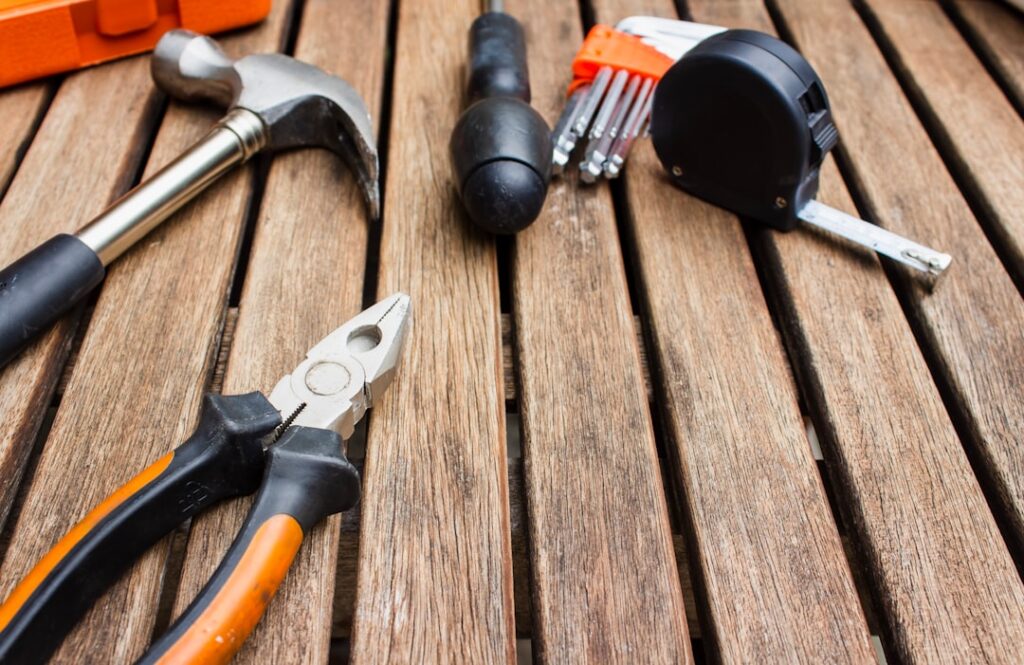
One reason these floors qualify as easy is the short tool list. For peel-and-stick and click-lock products you’ll need a tape measure, a utility knife or laminate cutter, a straightedge, a tapping block and pull bar for planks, and spacers to hold an expansion gap at the walls. Total tool cost is often under $50, and many home centers rent the specialty pieces. No wet saw, no nail gun, no mortar.
Common Beginner Mistakes to Avoid
Most DIY flooring regrets trace back to a short list of avoidable errors. Steer clear of these and your project will look professional:
- Skipping the expansion gap: Floating floors need a 1/4 to 3/8 inch gap at every wall so they can expand and contract with temperature. Butt them tight and they’ll buckle in summer.
- Not acclimating the material: Let laminate and LVP sit in the room for 48 hours before installing so the planks adjust to the home’s humidity.
- Ignoring the subfloor: Installing over a dirty, damp, or uneven base is the top cause of lifting edges and failed adhesive.
- Starting without a dry layout: Plan your first row so you don’t end with a sliver-thin plank at the far wall. Measure the room and adjust the starting row width.
- Forgetting transitions: Budget $5-$15 per doorway for T-molding or reducer strips that bridge to adjoining rooms.
Estimating Your Total Cost
To budget accurately, measure the room’s square footage and add 10 percent for cutting waste, or 15 percent if you’re laying planks on a diagonal. Then add the extras: underlayment if it isn’t attached (about $0.30-$0.50 per square foot), transition strips, and a small tool kit. Even with those, a 150 square foot bathroom in peel-and-stick tile can come in under $150 in materials, while the same room in mid-grade click-lock LVP lands around $350-$500. Compared with $3-$8 per square foot in professional labor you’d otherwise pay, doing it yourself typically cuts the project cost in half.
Which Should You Choose?
Pick peel-and-stick tile if squeezing every dollar matters most and the room is small. Choose click-lock LVP if you want a waterproof, durable floor that looks like real wood and forgives beginner mistakes, which for most homeowners is the smartest answer to what is the cheapest and easiest flooring to install. Reach for laminate to save a bit in dry rooms, sheet vinyl for tiny simple bathrooms, and carpet tiles when comfort and a rough subfloor are in play. Whatever you choose, a clean, flat, dry subfloor is the one non-negotiable step that separates a floor that lasts from one that fails.
Prefer to explore on your own?
See how new flooring looks in your actual room in seconds — free, no signup.
Try the free Floor Studio →

