
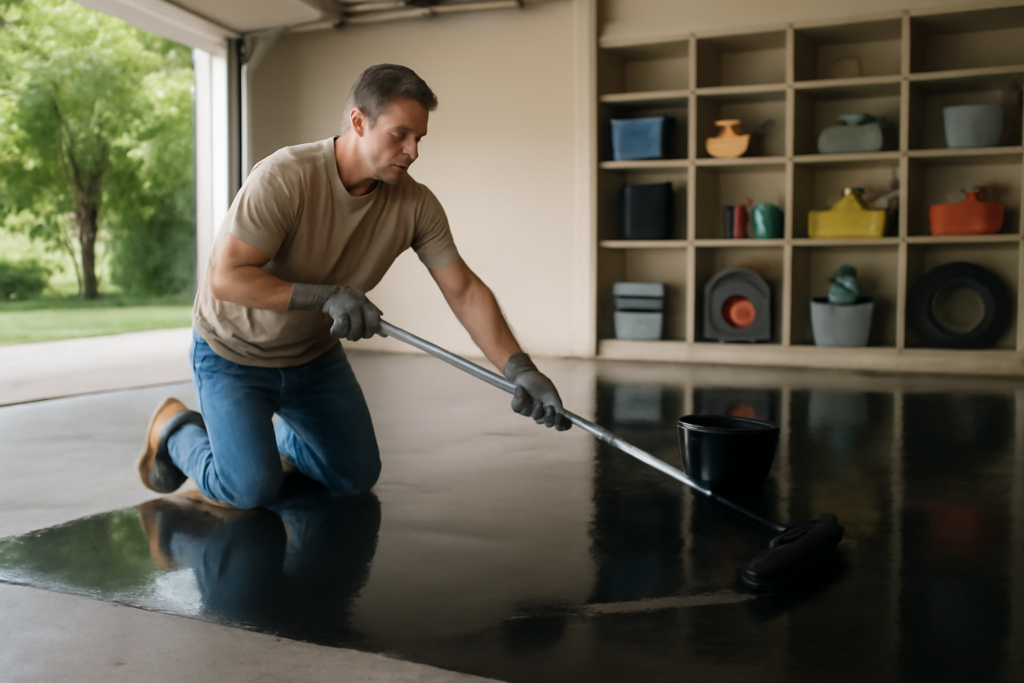
A black garage epoxy floor delivers a sleek, showroom look that turns an ordinary garage into a space you actually want to hang out in. Done right, it resists oil, road salt, hot tires, and dropped tools while giving you a glossy surface that wipes clean in seconds.
Part of our Epoxy, Concrete & Garage Floors guide — explore the full guide →
Before you buy a kit or call a coating crew, it helps to understand what black actually does in a garage. It hides some things and reveals others, it soaks up heat, and it demands more careful prep than a lighter color. Here is everything I tell homeowners who ask about going black.
- Why Choose Black Garage Epoxy
- The Look: Solid, Flake, and Metallic
- The Heat Absorption Concern
- Hiding Stains but Showing Dust
- Surface Prep: The Make-or-Break Step
- Black Garage Epoxy Cost Per Square Foot
- Topcoat and Anti-Slip Options
- Maintenance to Keep It Looking Sharp
- DIY Kits Worth Considering
- Final Thoughts on Black Garage Epoxy
Why Choose Black Garage Epoxy
Black is the boldest, most dramatic base color you can put down, and it pairs with almost any accent. It reads high-end, mimics the look of polished showroom floors, and makes chrome tool chests, red cabinets, and colored flake really pop. For car enthusiasts and home gyms, nothing else looks quite as clean.
The practical upside is that solid black masks certain stains beautifully. Motor oil, tire marks, and dark grime blend in rather than screaming at you the way they do on light gray. If your garage sees real use, black forgives a lot between cleanings.
If you’re running out of room even with a clean garage floor, a backyard shed takes the overflow — seasonal gear, tools, lawn equipment. And if you’re parking outside while the garage doubles as a workshop, a carport keeps your car covered without needing a second garage.
We may earn a commission when you purchase through our links.
The Look: Solid, Flake, and Metallic
Black is not one finish. You have three main directions, and they change the price, the maintenance, and the vibe.
- Solid black: A single uniform color with a clear topcoat. The most modern and minimalist look, but also the least forgiving of dust and imperfections.
- Black with flakes: Vinyl color chips broadcast into the base coat. A black base with gray, silver, blue, or white flake hides dust and scratches far better and adds subtle texture underfoot.
- Black metallic: A metallic pigment swirled into the epoxy creates a deep, three-dimensional look like liquid marble or a pearl car finish. Stunning, but it is the trickiest to install and shows every footprint until the topcoat cures.
For most homeowners, a black base with a light flake blend is the sweet spot: it looks great, hides dust, and is much more practical than glass-smooth solid black.
The Heat Absorption Concern
Dark colors absorb more solar and radiant heat, and black is the darkest of all. In an attached, insulated garage this rarely matters. But if you have a detached garage with large south-facing windows or a door you leave open in summer, a black floor in direct sun can run noticeably warmer than gray.
In practice, the heat is only an issue where sunlight lands directly on the floor for hours. Quality epoxy is rated well beyond typical garage temperatures, so the coating itself is fine up to around 140 to 150 degrees Fahrenheit surface temp. If your garage bakes in afternoon sun, consider a flake blend, which visually breaks up the black and reflects a bit more light than a solid pour.
Hiding Stains but Showing Dust
Here is the honest tradeoff every black-floor owner learns. Black is fantastic at hiding dark stains, oil drips, and tire marks. It is terrible at hiding light-colored dust, drywall powder, salt residue, lint, and dried water spots.
A solid black floor will show a dusty footprint the day after you sweep. This is the single biggest reason installers steer homeowners toward a flake finish. The multicolor chips camouflage dust between cleanings and keep the floor looking sharp with less effort. If you are set on solid black, just accept that you will be dust-mopping weekly to keep that mirror finish.
Surface Prep: The Make-or-Break Step
Epoxy is only as good as the prep beneath it, and black shows adhesion failures clearly. Skipping prep is why big-box one-coat kits peel within a year.
- Clean and degrease: Scrub out all oil and grease. Any contamination stops epoxy from bonding.
- Repair cracks and pits: Fill with a patching compound and let it cure.
- Profile the concrete: Acid-etch or, better, mechanically grind the slab to open the pores so epoxy can grip. Grinding is the pro standard.
- Moisture test: Tape a plastic square down overnight; condensation means you need a moisture-blocking primer first.
- Vacuum and dry: The slab must be spotless and fully dry before the base coat goes down.
Concrete should be at least 28 days cured before coating, and you want an ambient temperature between 60 and 85 degrees Fahrenheit during application.
Black Garage Epoxy Cost Per Square Foot
Budget $3 to $10 per square foot for a black garage epoxy floor. DIY kits land at the low end; professional multi-coat systems with flake, primer, and a polyurethane topcoat land at the high end.
- DIY water-based kit: $3 to $5 per square foot in materials for a two-car garage.
- Professional flake system: $6 to $10 per square foot installed, including grinding, base, flake, and topcoat.
- Metallic epoxy: $8 to $15 per square foot professionally installed because of the artistry involved.
A standard 400- to 500-square-foot two-car garage typically runs $1,500 to $4,000 for a durable professional job.
Topcoat and Anti-Slip Options
Black epoxy with a glossy clear coat gets slick when wet, and wet black is genuinely slippery. Add an anti-slip additive to the topcoat, usually a fine polymer grit or aluminum oxide broadcast into the clear layer. It barely changes the look but dramatically improves traction.
A polyurethane or polyaspartic topcoat over the epoxy adds UV stability (important for black, which can slightly chalk in sunlight over years) and boosts abrasion and chemical resistance. Polyaspartic also cures fast, letting you drive on the floor in as little as 24 hours versus several days for standard epoxy.
Maintenance to Keep It Looking Sharp
Black rewards a simple routine. Dust-mop or use a soft push broom a couple of times a week to stay ahead of the dust that black loves to display. Damp-mop with a pH-neutral cleaner as needed, and wipe up oil or brake fluid promptly.
Avoid harsh degreasers and abrasive pads that dull the gloss. Put down mats where hot tires park to reduce hot-tire pickup, and slide furniture or jacks rather than dragging them to prevent scratches that show up starkly on a dark floor.
DIY Kits Worth Considering
Two brands dominate the DIY black garage epoxy space. Rust-Oleum EpoxyShield is the widely available big-box option, affordable and beginner-friendly, though its water-based formula is thinner and less durable than pro systems. Follow the etch-and-clean prep to the letter and it holds up reasonably for light-duty garages.
For a tougher DIY result, ArmorPoxy sells 100 percent solids epoxy kits with black bases, flake blends, and matching topcoats that come far closer to professional durability. They cost more and are less forgiving during application, but the finish lasts. Whichever kit you choose, buy enough for two base coats and a separate clear topcoat rather than trusting a single-coat product to survive a working garage.
Final Thoughts on Black Garage Epoxy
A black garage epoxy floor is one of the best-looking upgrades you can give a garage, but it rewards realistic expectations. Choose a flake or metallic finish if you want the drama without constant dust-mopping, respect the prep, add an anti-slip additive, and top it with a polyaspartic clear coat for longevity. Do that, and you will have a deep, glossy floor that looks like a showroom and shrugs off everything a garage throws at it.


