The names are almost identical, and showroom salespeople sometimes use them interchangeably, but quartz and quartzite are fundamentally different materials. If you are shopping for countertops and wondering what is the difference between quartz and quartzite, this guide breaks down everything that matters: how they are made, how they look, how they perform, what they cost, and which one suits your kitchen or bathroom best.
We have installed both materials extensively over the past three decades, and the confusion between them leads to more buyer regret than almost any other countertop decision. Understanding the distinction before you visit a fabricator saves you time, money, and the frustration of living with the wrong material.
Composition and How They Are Made
Quartz countertops are engineered stone. They are manufactured in a factory by combining approximately 90 to 94 percent ground natural quartz crystals with 6 to 10 percent polymer resins, pigments, and recycled materials. The mixture is pressed into slabs under intense heat and pressure (called a Bretonstone process), creating a uniform, non-porous surface. Major brands include Caesarstone, Cambria, Silestone, and MSI.
Quartzite countertops are natural stone. Quartzite forms when sandstone is subjected to extreme heat and pressure deep within the earth over millions of years, a geological process called metamorphism. The result is a dense, hard metamorphic rock that is quarried, cut into slabs, and polished. Each slab is unique. No two quartzite countertops look exactly alike.
The critical takeaway: quartz is man-made with natural materials. Quartzite is 100 percent natural. This fundamental difference drives almost every other distinction between the two, from appearance to maintenance to heat resistance.
Appearance and Aesthetic Differences
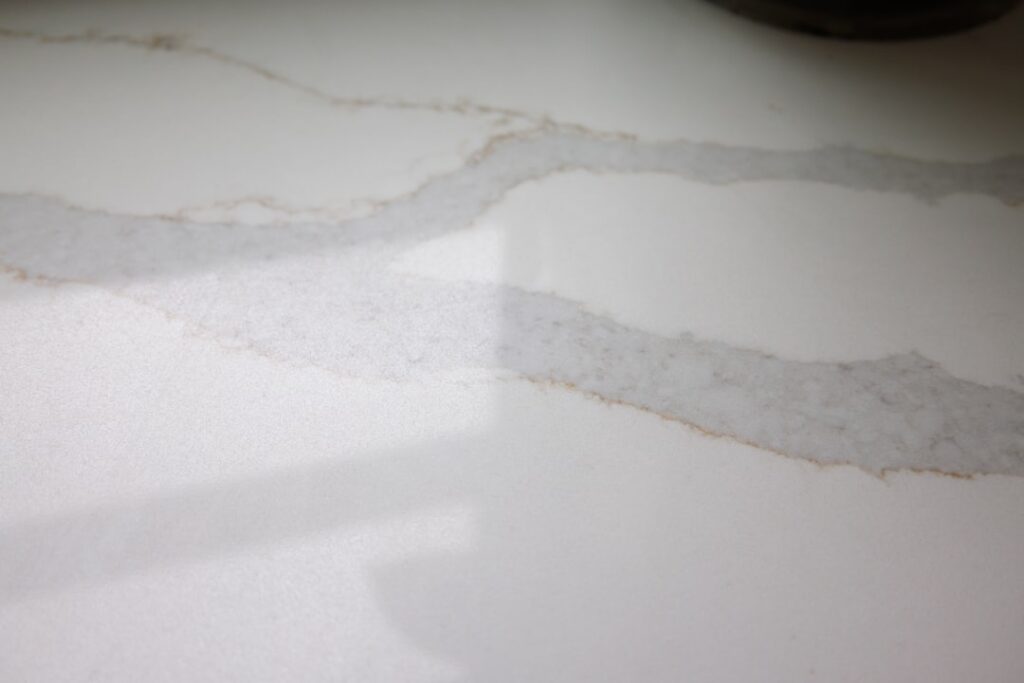
Quartz appearance: Because quartz is engineered, manufacturers have precise control over color, pattern, and consistency. You can get quartz in solid colors, subtle speckled patterns, or designs that convincingly mimic marble, concrete, and other natural stones. The pattern is uniform across the slab, which means what you see in the showroom sample is what you get installed. This consistency is a major selling point for homeowners who want a predictable result.
Quartzite appearance: Quartzite offers the dramatic, one-of-a-kind beauty of natural stone. Colors range from pure white (like the popular Taj Mahal and White Macaubas varieties) to soft grays, golds, blues, and greens. The veining and movement in quartzite are organic and unpredictable, created by millions of years of geological forces. No two slabs match, which makes quartzite feel more luxurious and unique but also means you must hand-select your specific slab at the stone yard.
Key visual difference: If you want consistent, controlled aesthetics, quartz is the better choice. If you want natural variation, depth, and a truly one-of-a-kind surface, quartzite delivers something that no manufactured product can replicate.
Durability and Hardness
Both materials are extremely hard, but they achieve their durability differently.
Quartz hardness: Quartz registers at 7 on the Mohs hardness scale. The engineered composition makes it highly resistant to scratches, chips, and cracks under normal kitchen use. Because the resin binders create a non-porous surface, quartz is also highly resistant to staining. It does not chip as easily as natural stone because the resin provides a slight flexibility that absorbs impact.
Quartzite hardness: Quartzite is one of the hardest natural stones used for countertops, also registering at 7 on the Mohs scale and sometimes higher. It is harder than granite and significantly harder than marble. However, quartzite is a natural material with natural variations, which means some areas of a slab may have softer mineral inclusions or micro-fissures that are more vulnerable to chipping.
Scratch resistance: Both materials resist scratches from kitchen knives and normal use. Quartzite has a slight edge in raw hardness, while quartz’s consistent composition means there are no weak spots.
Chip resistance: Quartz is more chip-resistant overall because the resin component adds flexibility. Quartzite edges, particularly on mitered or waterfall installations, can chip if struck with a heavy object.
Stain resistance: Quartz is non-porous and does not stain under normal conditions. Quartzite is porous and will stain if not properly sealed, particularly with oils, wine, and acidic liquids. This is one of the biggest practical differences between the two materials.
Heat Resistance
This is where quartzite has a clear and significant advantage.
Quartzite: As a natural stone formed under extreme geological heat and pressure, quartzite handles heat beautifully. You can place a hot pan directly on quartzite without damage. It will not scorch, discolor, crack, or melt. For avid cooks who frequently move pots from stove to counter, quartzite is one of the best countertop materials available.
Quartz: The polymer resin in engineered quartz is heat-sensitive. Temperatures above 300 degrees Fahrenheit can scorch, discolor, or crack the surface. A hot pan placed directly on quartz can leave a permanent mark that no cleaning will remove. This is one of the most common causes of quartz countertop damage, and it is irreversible. Trivets and hot pads are mandatory with quartz.
If heat resistance is a priority for your kitchen, quartzite is the definitively better choice. This single factor is often the deciding point for homeowners who cook frequently.
Maintenance Requirements
Quartz maintenance: Minimal. Clean daily with mild soap and water. No sealing required, ever. Quartz is non-porous, so bacteria, liquids, and stains cannot penetrate the surface. Avoid bleach-based cleaners and abrasive pads, which can damage the resin over time. The low maintenance is one of quartz’s biggest advantages and a major reason for its popularity.
Quartzite maintenance: Moderate. Quartzite is a porous natural stone that requires sealing with an impregnating stone sealer upon installation and every 1 to 2 years thereafter. Sealing fills the microscopic pores in the stone and prevents liquids from being absorbed. Even with sealing, you should wipe up spills promptly, especially oils, wine, citrus, and coffee. Clean daily with a pH-neutral stone cleaner or mild soap and water.
The maintenance reality: Quartz is genuinely set-it-and-forget-it. Quartzite requires periodic attention. If you have previously owned granite, the quartzite sealing routine will feel familiar. If you have never maintained natural stone and do not want to start, quartz is the lower-effort option.
Cost Comparison
Both quartz and quartzite are premium countertop materials, and their price ranges overlap significantly.
Quartz installed cost: $50 to $120 per square foot, with most kitchens landing between $60 and $90 per square foot. Entry-level brands (MSI Q Quartz, Allen + Roth) start at $50 to $65. Mid-range brands (Silestone, Caesarstone) run $65 to $90. Premium brands (Cambria) range from $80 to $120 or more.
Quartzite installed cost: $60 to $150 per square foot. Common quartzite varieties like White Princess and Fantasy Brown fall in the $60 to $90 range. Premium varieties like Taj Mahal, Calacatta, and Azul Macaubas can reach $100 to $150 per square foot. Exotic or rare quartzite slabs can exceed $200 per square foot.
For a typical 30-square-foot kitchen: Quartz installation runs $1,500 to $3,600. Quartzite installation runs $1,800 to $4,500. The cost difference narrows considerably at the mid-range level and widens significantly at the premium end.
Additional quartzite costs: Factor in sealing products ($15 to $30 every 1 to 2 years) and the time or cost of slab selection at the stone yard. Quartzite fabrication may also cost slightly more because natural stone requires more care during cutting to avoid cracks along natural fissures.
Which One Should You Choose
The right choice depends on your priorities, lifestyle, and budget. Here is a decision framework based on our experience guiding hundreds of homeowners through this exact decision.
Choose quartz if: You want the lowest possible maintenance. You prefer consistent color and pattern across your countertops. You have a firm budget and want predictable pricing. You do not place hot pans directly on countertops (or are willing to always use trivets). You want a wide selection of colors including options that are not available in natural stone.
Choose quartzite if: You want the beauty and uniqueness of natural stone. Heat resistance matters to you — you cook frequently and want to set hot pans down without worry. You do not mind sealing the surface every year or two. You appreciate that no other kitchen will have the exact same countertop. You want a material that feels genuinely luxurious and has strong resale appeal in higher-end homes.
Choose either if: Durability and scratch resistance are your primary concerns (both excel). You want a premium countertop that lasts 20 or more years. You are choosing between the two based solely on aesthetics — both look stunning in the right application.
One common misconception: Some people choose quartzite thinking they are getting a natural version of quartz with the same non-porous, no-maintenance properties. They are not. Quartzite requires sealing and more careful daily care. Make sure you are choosing quartzite for its genuine advantages (heat resistance, natural beauty, uniqueness) and not because you confused it with quartz.
Frequently Asked Questions
Is quartzite more expensive than quartz?
On average, yes. Quartzite typically costs $60 to $150 per square foot installed, while quartz runs $50 to $120. However, there is significant overlap in the mid-range. A premium quartz brand like Cambria can cost as much as or more than common quartzite varieties like White Princess or Fantasy Brown.
Does quartzite need to be sealed?
Yes. Quartzite is a natural, porous stone that requires sealing upon installation and every 1 to 2 years thereafter. Without sealing, it can absorb liquids and stain. Quartz (engineered stone) never needs sealing because its resin binders make it non-porous.
Can you put hot pans on quartzite?
Yes. Quartzite is a natural stone formed under extreme heat and handles hot pans without damage. This is one of its key advantages over quartz, which can scorch, discolor, or crack from contact with hot cookware due to its heat-sensitive resin component.
Which is harder, quartz or quartzite?
They are very close, both rating around 7 on the Mohs hardness scale. Quartzite can occasionally rate slightly higher depending on its mineral composition. In practical kitchen use, both are highly scratch-resistant and you are unlikely to notice a difference in hardness during daily activities.
How do I tell quartz and quartzite apart?
Look at the back of the slab. Quartz (engineered) has a uniform, manufactured look on the back with consistent color. Quartzite (natural) has a rough, natural stone back with visible crystalline structure. The surface pattern also differs — quartz patterns repeat predictably, while quartzite has organic, non-repeating veining and movement.