A towel bar in the wrong spot is a daily nuisance, forcing you to drip across the floor or cram a wet towel where it never fully dries. Getting where to hang towel bars in bathroom layouts right is part measurement, part common sense, and part knowing the standard heights the pros use. The goal is simple: towels should hang within easy reach of where you use them, spread out enough to dry properly, and be mounted securely into something that will hold their weight for years. Nail those three things and you avoid the most common and frustrating bathroom mistakes.
- The Standard Towel Bar Height
- Hand Towel and Washcloth Heights
- Placement Near the Shower and Tub
- Spacing and Spreading Towels to Dry
- Anchoring the Bar Securely
- Common Placement Mistakes to Avoid
- Alternatives When Wall Space Is Tight
- Choosing the Right Bar Style and Finish
- How high should a towel bar be from the floor?
- Where should I put the towel bar in relation to the shower?
- Do towel bars need to be anchored into studs?
- The Bottom Line
The Standard Towel Bar Height
The single most asked question has a reliable answer. Mount a towel bar so its center sits about 48 inches above the finished floor. This standard height works for most adults, keeping towels off the floor while remaining easy to grab. The generally accepted range runs from 42 to 48 inches to the center of the bar, so you have some flexibility to suit your household.
Adjust within that range for who uses the bathroom. In a kids’ bathroom, drop the bar lower, around 36 to 42 inches, so children can reach it. In a bathroom used by very tall people, nudge toward the upper end. The key is measuring from the finished floor, including any tile, so your height stays accurate.
Hand Towel and Washcloth Heights
Not every bar holds a full bath towel. Hand towel rings and bars near the sink follow different guidelines:
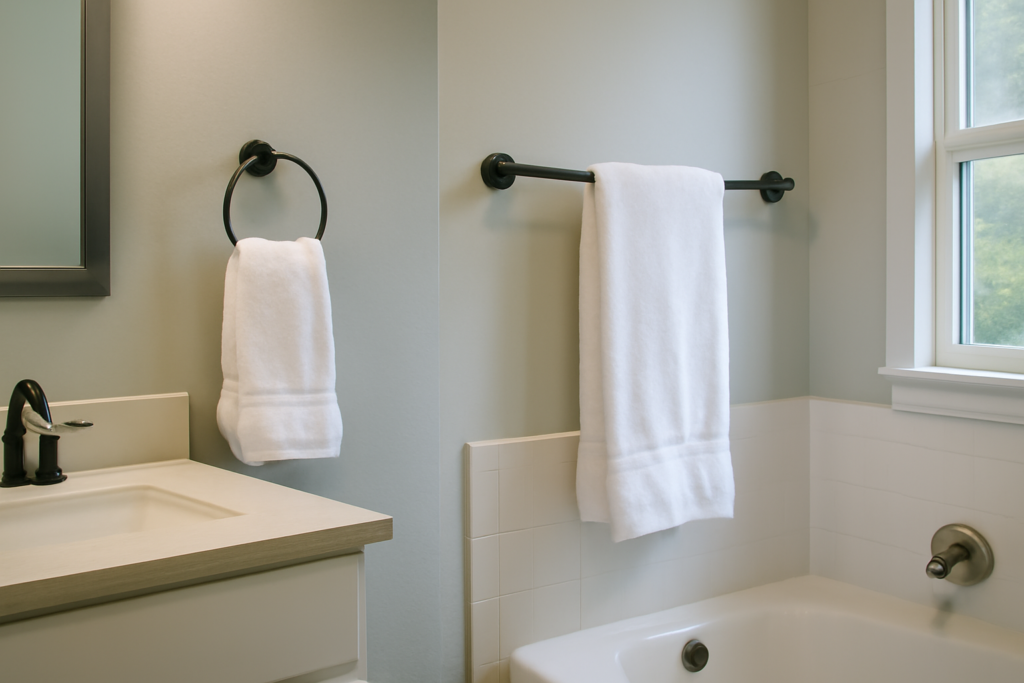
- Hand towel ring or bar: mount 20 to 24 inches above the vanity countertop, or roughly 50 to 52 inches off the floor, positioned to the side of the sink for easy reach.
- Towel bar for washcloths: often placed near the sink or tub at a height convenient for the specific use.
Placing the hand towel to the side of the vanity, rather than directly behind the faucet, keeps it dry and within a natural arm’s reach when you finish washing your hands.
Placement Near the Shower and Tub
The most important placement rule is proximity to where you dry off. A bath towel bar should be within arm’s reach of the shower or tub so you can grab your towel the moment you step out, without dripping across the room. Mount it on the wall closest to the shower entrance, ideally just outside the splash zone so the towel stays dry until you need it.
Avoid placing the bar inside the shower spray or directly against a wet wall, where towels never dry and mildew takes hold. A few feet from the shower opening, on an adjacent dry wall, is the sweet spot. If space allows, a bar on the back of the door or on a nearby wall gives towels room to air out between uses.
Spacing and Spreading Towels to Dry
A towel that hangs bunched up stays damp and starts to smell. For a towel to dry properly, it needs to hang spread out, so bar length and spacing matter. A standard bath towel needs about 24 inches of bar width to hang open. If you are installing multiple bars, leave enough vertical space between them, at least 6 to 12 inches, so a towel on the upper bar does not touch the one below.
When two people share a bathroom, install two separate bars rather than crowding both towels onto one. Cramped towels never dry, which is the leading cause of that musty bathroom odor. Give each towel its own generous span of bar.
Anchoring the Bar Securely
A towel bar that pulls out of the wall is both frustrating and damaging. Because towels get yanked and leaned on, secure mounting is essential. The best anchor is a stud, so use a stud finder and, wherever possible, drive at least one mounting bracket screw into solid wood framing.
When a stud is not where you need it, which is common, use heavy-duty drywall anchors rated for the load. Toggle bolts or self-drilling metal anchors hold far better than the cheap plastic cone anchors included with many bars. For tile walls, drill carefully with a diamond or carbide bit, use anchors designed for tile, and never overtighten, which can crack the surface. Placing at least one bracket into a stud dramatically increases holding strength.
Common Placement Mistakes to Avoid
A few errors show up again and again:
- Mounting too high or too low — stick to the 42 to 48 inch range for bath towels.
- Placing bars too far from the shower — you end up dripping across the floor.
- Crowding towels — bunched towels stay wet and smell.
- Ignoring the door swing — a bar behind a door can get knocked or block the door.
- Skipping the level — always use a level so the bar hangs straight.
Dry-fit and pencil-mark your locations before drilling. Hold a towel up in the planned spot and reach for it as if stepping out of the shower to confirm the placement feels natural.
Alternatives When Wall Space Is Tight
Small bathrooms often lack open wall area for a full bar. In that case, consider over-the-door towel racks, a towel bar mounted on the back of the door, hooks instead of bars, or a freestanding towel stand. Hooks are the most forgiving option, since a towel only needs to be looped over rather than spread across a long bar, though it will not dry quite as fully as one hung flat. A heated towel rail is a premium upgrade that both stores and dries towels efficiently.
Choosing the Right Bar Style and Finish
Placement matters most, but the bar itself should complement your bathroom and hold up to daily use. Standard towel bars come in widths of 18, 24, and 30 inches; a 24-inch bar is the most common and gives a bath towel room to hang spread out. In a larger bathroom, a 30-inch bar accommodates oversized towels or two hand towels side by side.
Match the finish to your other fixtures for a cohesive look. If your faucet and shower trim are brushed nickel, choose a brushed nickel bar; matte black, chrome, and brushed brass are all popular and should coordinate rather than clash. For material, solid metal bars in stainless steel or brass resist the constant humidity better than cheap hollow or plastic-core versions, which can loosen or corrode over time.
Consider the mounting style too. Concealed-screw brackets give a cleaner appearance, while some bars use set screws hidden underneath. Whatever you pick, confirm the bracket spacing matches where your studs or anchors will land, so you are not forced to compromise placement to fit the hardware.
How high should a towel bar be from the floor?
Mount a bath towel bar with its center about 48 inches above the finished floor, within an accepted range of 42 to 48 inches. Lower it to 36 to 42 inches in a children’s bathroom so kids can reach their towels.
Where should I put the towel bar in relation to the shower?
Place it within arm’s reach of the shower or tub entrance, on a dry adjacent wall just outside the splash zone. This lets you grab your towel immediately without dripping across the bathroom floor.
Do towel bars need to be anchored into studs?
Ideally, yes. Driving at least one bracket screw into a stud gives the strongest hold. Where studs are unavailable, use heavy-duty toggle or metal drywall anchors rather than cheap plastic ones, and use tile-rated anchors on tiled walls.
The Bottom Line
Knowing where to hang towel bars in a bathroom comes down to reach, drying room, and secure mounting. Set bath towel bars around 48 inches high, keep them within arm’s reach of the shower on a dry wall, give each towel enough span to hang spread out, and anchor into studs or heavy-duty anchors. Adjust heights for kids, use hooks or over-door racks in tight spaces, and always dry-fit before you drill. Handle those basics and your towels stay off the floor, dry faster, and hang exactly where you need them.