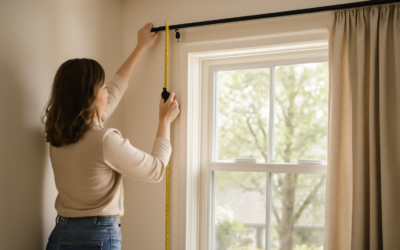
The single fastest way to make a room look more expensive is to fix the curtain rod placement. Most homeowners install rods exactly at the top of the window casing, which is precisely the wrong spot. Knowing where to mount curtain rods for height and width is the difference between a window that looks shrunken and one that draws the eye to the ceiling. The good news is that the rules are simple, the math is easy, and the upgrade costs nothing more than a longer rod and a few extra inches of fabric.
Height: Always Higher Than You Think
The textbook rule is to mount the rod halfway between the top of the window casing and the ceiling. In a room with eight-foot ceilings and a window casing that ends at 80 inches, that puts the rod at roughly 88 inches — about four inches above the casing. In rooms with nine or ten-foot ceilings, mount the rod just below crown molding or four inches below the ceiling itself.
The visual effect is dramatic. A rod hung four inches higher than the casing makes the entire window appear taller and the room feel grander. A rod hung at the casing makes a standard window look squat. If you can only follow one rule, this is the one.
Width: Extend 8 to 12 Inches Past the Frame
Standard rods sized to the window opening leave curtains stacked against the glass when they’re open, blocking light and shrinking the apparent window. Run the rod six to twelve inches past the casing on each side and the curtains stack onto the wall, exposing the entire window during the day.
For a 36-inch wide window, that means a rod at least 48 inches long with the brackets mounted six inches past each side. For wider picture windows or sliding glass doors, you can stretch up to 18 inches past the frame on each side without it looking off.
The Floor-to-Ceiling Hack for Low Ceilings
Eight-foot ceilings are the norm in most American homes built after 1970, and they can feel boxy. Mount the rod within an inch of the ceiling — even if it’s far above the window — and hang floor-length curtains. Your eye registers the full vertical run of fabric as the room’s height. This trick is borrowed straight from designers who shoot magazine spreads in normal-ceiling-height rooms and make them look like loft apartments.
Curtain Length: Where the Hem Should Land
Three accepted curtain lengths work for nearly every situation:
- Float — hem ends 1/2 inch above the floor. Cleanest look, easiest to vacuum under, and what designers default to.
- Kiss — hem just brushes the floor. Tailored, traditional, demands precise measuring.
- Puddle — hem extends two to six inches onto the floor. Romantic but a dust magnet, best for formal rooms with low traffic.
Hems that float two or three inches above the floor look like ill-fitting pants. Always go floor-length, never short.
Mounting Hardware That Holds
Heavy drapery panels can pull rods straight off drywall. Use a 1-1/4 inch or larger rod for any window over 60 inches wide, and screw brackets into wall studs whenever possible. When studs don’t fall where you need them, install proper drywall anchors rated for at least 50 pounds per anchor. Toggle bolts (Snap Toggles or strap toggles) are the gold standard.
Center brackets are required on rods over 48 inches to prevent sag. Rods over 100 inches need at least two center brackets. Skip them and you’ll have a permanent dip in the middle within a year.
Layering Sheers and Drapes
Double-rod brackets let you hang a sheer curtain on the inner rod and blackout drapes on the outer. Mount the brackets a full inch higher than you’d mount a single rod to compensate for the inner rod position, and choose drapes long enough to cover both layers when the sheer is in full sun.
An alternative is a ceiling-mount track for the sheer behind a wall-mount rod for the drapes. The track disappears against a white ceiling and gives a clean, layered look without doubling the visible hardware.
Special Situations
Some windows need a different approach entirely. Bay windows benefit from a continuous flexible track rod that follows the angles, with the rod mounted at the same height across all three sections. French doors look best with rods extended a full 12 inches past each side so curtains never block the door’s swing path. Picture windows over 80 inches wide need either a heavy-duty 1-3/8 inch rod or two separate panels meeting in the center to avoid sagging.
For windows with deep sills or radiators below, sill-length curtains (ending 1/2 inch above the sill) are the only practical option. Even then, mount the rod high to maximize the visual height.
Quick Measuring Checklist
Before you drill, take down five measurements and write them on the back of an envelope:
- Distance from the floor to the casing top
- Distance from the casing top to the ceiling
- Width of the casing exterior
- Distance to the nearest wall on each side
- Stud locations within 12 inches of where the brackets will go
With those five numbers you can calculate exact bracket placement, rod length, and curtain length without a single trip back to the store.
The Final Look
Curtain rods are humble hardware that punch far above their cost in visual impact. Knowing where to mount curtain rods — high enough to grow the room, wide enough to clear the glass, with hardware sturdy enough to hold real fabric — turns standard builder windows into the most dramatic feature in the room. Stop hanging curtains like you’re hiding the window and start using them to frame it.