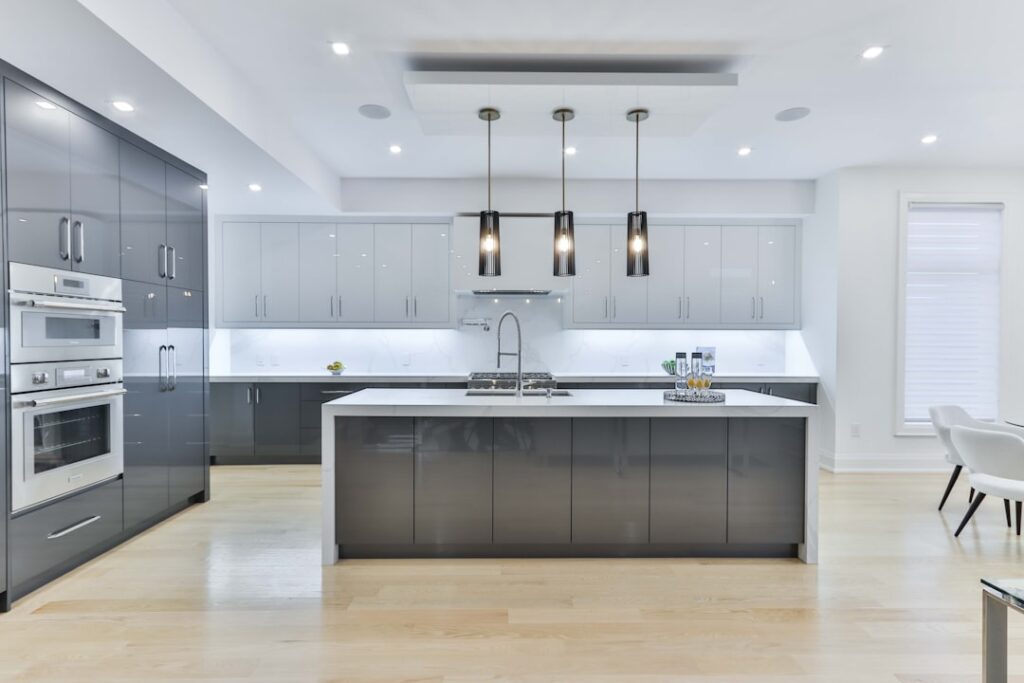
The two-tone combo has dominated kitchen design boards for nearly a decade and shows no sign of slowing down. White cabinets with black handles deliver high contrast that reads modern, farmhouse, transitional, or contemporary depending on which whites and which hardware shapes you choose. The look photographs beautifully, sells well to home buyers, and pairs with nearly any countertop. But the difference between a timeless installation and a 2018 Pinterest cliche comes down to a handful of specific decisions about finish, sizing, and proportion. Here’s how to get those decisions right.
Why the Combo Works So Reliably
White and black sit at opposite ends of the value scale, which creates maximum visual contrast. Cabinets occupy roughly 30 percent of the visible surface area in a typical kitchen, so they dominate the room’s perceived color palette. White cabinets push light around effectively, making small kitchens feel larger. Black hardware breaks the monotony and outlines the cabinet doors, drawing the eye to the architectural lines instead of the flat painted surface.
The contrast also hides fingerprints and grease better than tone-on-tone hardware on white cabinets. Brushed nickel or polished chrome on white shows every smudge. Matte black mostly conceals routine kitchen contact.
Choosing the Right White
Not every white works. Pure clinical whites like Behr Ultra Pure White feel sterile and too cool in most kitchens. Warm whites like Sherwin-Williams Alabaster SW 7008 or Benjamin Moore White Dove OC-17 have just enough warm undertone to read inviting without going cream. For a slightly cooler modern look, Sherwin-Williams Pure White SW 7005 or Benjamin Moore Decorator’s White OC-149 hold up well against black hardware.
Avoid whites with pink or yellow undertones. Pink-toned whites like Benjamin Moore Linen White read dated against modern black pulls. Yellow-toned creams clash with the cool tone of black hardware.
Test paint samples in your kitchen lighting before committing. Whites read very differently under north-facing daylight, west-facing afternoon sun, and warm LED downlights.
Black Finish Options
Black hardware comes in three primary finishes, each with different visual weight.
Matte black is the most common choice. The non-reflective surface absorbs light, reads softer than gloss black, and pairs equally well with warm and cool whites. Brands like Top Knobs, Schaub, and Amerock offer matte black pulls in the $5 to $25 range per piece. Cheap big-box matte black hardware sometimes chips on edges within a year — pay slightly more for powder-coated finishes that resist wear.
Oil-rubbed bronze (ORB) reads as a warm dark brown with copper highlights, not true black. Confusingly often labeled as black at Home Depot and Lowe’s. Verify in person before committing. Works for farmhouse and traditional kitchens but reads dated against very white cabinets.
Matte black with brass accents (two-tone hardware) appeared around 2022 and gained ground fast. Combines the modern look of black with a warm metal touch. Rejuvenation and Schoolhouse stock high-quality options in the $25 to $60 per pull range.
Hardware Shape and Sizing
Shape sets the era of the design more than color does. Match the shape to your cabinet style:
- Square or rectangular bar pulls: contemporary and modern shaker cabinets
- Cup pulls or bin pulls on drawers: farmhouse and traditional
- Round knobs (1 to 1.5 inches): traditional, transitional, smaller spaces
- Tubular finger pulls (long, slim): European modern and minimalist designs
- Mixed pulls and knobs: pulls on drawers, knobs on doors — works for almost any style
Sizing scales with cabinet size. Use 3-inch (center-to-center) pulls on drawers under 24 inches wide. Step up to 4 to 5 inches for 24- to 30-inch drawers, and 6 to 8 inches for larger drawer fronts and pantry doors. Knobs typically run 1.25 to 1.5 inches in diameter for standard doors.
Hardware Placement Standards
Placement matters as much as size. Industry standards from the Kitchen Cabinet Manufacturers Association (KCMA) and most professional installers:
- Door knobs: 2.5 to 3 inches diagonally from the corner of the door panel, opposite the hinge
- Door pulls: vertical orientation, 2.5 to 3 inches from the bottom of upper cabinet doors and from the top of base cabinet doors
- Drawer pulls: centered horizontally, centered vertically on drawers under 6 inches tall, slightly above center on taller drawers
- Appliance pulls (refrigerator, dishwasher panels): match the largest pulls used elsewhere in the kitchen
Use a hardware installation template ($8 to $15 from Liberty or Amerock) to ensure consistent placement. Off-center hardware reads as sloppy and undermines the whole design.
Countertop and Backsplash Pairings
White cabinets with black handles tolerate almost any countertop choice, but some combinations sing. White quartz from Cambria’s Brittanicca series or Caesarstone’s Misty Carrera ($65 to $95 per sq ft installed) creates a clean monochrome canvas where the black hardware pops. Honed black quartz or soapstone counters reinforce the black accent without overwhelming. Butcher block warms up the cool palette for farmhouse builds.
For backsplash, white subway tile (3×6, 4×12, or zellige-style irregular versions) is the safest pairing. Black grout adds bold definition; gray grout (Mapei Warm Gray 09 is a popular choice) keeps things subtle. Marble-look quartz slab backsplashes also work well.
Cost Breakdown
Hardware costs scale with the kitchen size and finish quality. A typical 25-cabinet kitchen needs 25 to 35 pieces of hardware. Budget tiers:
- Builder-grade big-box hardware: $4 to $10 per piece, $100 to $350 for the kitchen
- Mid-range from Amerock, Liberty, or Top Knobs: $10 to $25 per piece, $300 to $875 total
- Designer brands like Rejuvenation, Schoolhouse, Berenson: $25 to $80 per piece, $750 to $2,800 total
Painting existing cabinets white runs $30 to $60 per linear foot DIY or $1,500 to $5,000 hired out. Sherwin-Williams Emerald Urethane Trim Enamel or Benjamin Moore Advance both produce factory-quality finishes on properly prepped cabinets.
Common Mistakes to Avoid
Three errors show up regularly. First, undersized hardware on large drawers. A 36-inch pot drawer with a 3-inch knob looks comically wrong. Scale up to 8- or 10-inch bar pulls. Second, mixing finishes inconsistently. Pick matte black or oil-rubbed bronze and stick to it across all cabinets, hinges, and adjacent fixtures. Third, ignoring the visible hinge color. European-style soft-close hinges in chrome clash with matte black pulls. Spray hinges with matte black appliance epoxy or specify matte black hinges from suppliers like Blum or Salice.
Staying Power and Resale Value
White cabinets with black handles have proven longevity. The combo has been popular since around 2015 and still tests well with home buyers in 2026. Real estate agents report white-cabinet kitchens command 3 to 5 percent higher list prices in most markets compared to stained wood. Replace dated brushed nickel or oil-rubbed bronze hardware with matte black for less than $300 and refresh an entire kitchen’s aesthetic in a weekend without touching the cabinets themselves.