Replacing every floor in your home at once is the biggest single design decision most owners ever make, and most regret rushing it. Whole house flooring ideas should start with how you actually live, not with what looks great on Instagram. A working-from-home parent with two dogs and a coffee habit needs different floors than a retired couple with hardwood-loving guests. This guide walks through real combinations that hold up, with budget ranges, transition strategies, and pitfalls to skip.
- Plan the Public Areas First
- Idea 1: Hardwood Throughout, Tile in Wet Zones
- Idea 2: LVP Everywhere Except Bedrooms
- Idea 3: Polished Concrete Plus Carpet Bedrooms
- Idea 4: Mixed Hardwood and Tile Open Plan
- Coordinating Colors and Tones
- Pros of Whole-House Planning
- Cons and Hidden Costs
- Order of Operations for a Whole-House Project
- Budget Worksheet for 2,200 sq ft
- Final Thoughts on Whole-House Flooring
Plan the Public Areas First
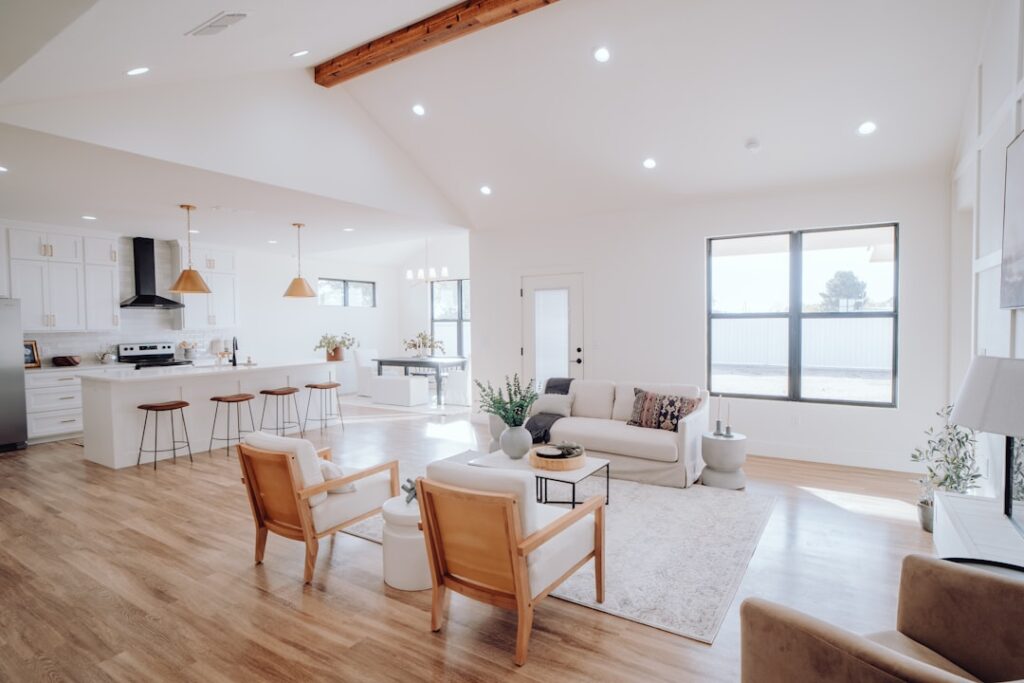
Public areas (living room, dining, kitchen, entry, hallways) carry the most visual weight, so pick that material first and let the bedrooms and baths follow. The dominant choice in 2026 is wide-plank engineered hardwood or premium luxury vinyl plank, both in white oak or warm walnut tones.
Running a single material from front door through dining room creates the seamless flow that buyers and designers love. It also simplifies furniture placement because you do not have to worry about transition strips mid-room.
Idea 1: Hardwood Throughout, Tile in Wet Zones
This classic combination remains the highest-resale-value approach for traditional homes. Run 5 or 7 inch white oak engineered hardwood across all main living areas, halls, and bedrooms. Switch to 12 by 24 inch porcelain tile in bathrooms and the laundry room.
Total installed cost for a 2,200 sq ft home: roughly $18,000 to $28,000 in 2026. Plan on $6.50 to $9 per sq ft for hardwood and $7 to $11 for bathroom tile including underlayment.
Idea 2: LVP Everywhere Except Bedrooms
For families with pets, kids, and busy schedules, premium SPC luxury vinyl plank delivers nearly hardwood looks at half the price and full waterproof performance. Specify a 22 mil wear layer, 8 mm overall thickness, and an IXPE attached pad.
Run LVP through every public area and bathroom, then switch to carpet in the bedrooms for warmth and sound. Total for 2,200 sq ft: $10,000 to $16,000 installed.
Idea 3: Polished Concrete Plus Carpet Bedrooms
Modern and industrial homes increasingly use polished concrete in the public areas and carpet in the bedrooms. Polished concrete runs $4 to $9 per sq ft if the slab is in good condition, with the higher end including decorative coloring or scoring.
Pair with hydronic floor heat under the slab for comfort. The concrete-plus-carpet combo works particularly well in single-story homes on slab and in renovated lofts where the existing slab is already exposed.
Idea 4: Mixed Hardwood and Tile Open Plan
Open-concept floor plans benefit from material zoning. Use 7 inch hardwood in the living and dining areas, then transition to a coordinated 24 inch porcelain plank in the kitchen for spill protection. Match undertones carefully so the change feels intentional rather than patched.
The transition usually happens at the kitchen island or under a cabinet toe-kick, hidden from sightline. Budget roughly $7 to $10 per sq ft blended across the two materials.
Coordinating Colors and Tones
- Pick a single undertone family (warm/golden, neutral, or cool/gray) and stick with it across every room.
- Match grout color to the LVP or hardwood tone when materials meet so the transition reads as one floor.
- Sample large pieces (at least 12 by 12 inches) and view them in your home’s natural and artificial light.
- Avoid trendy colors like pure white-washed oak or jet-black ebony unless you commit for 10+ years.
- Keep transition strips the same finish as the trim, not the floor, for cleaner sightlines.
Pros of Whole-House Planning
The biggest advantage is consistency. Buying all materials at once locks in pricing and ensures dye lots match across the home. Hiring a single installer also cuts labor costs by 10 to 15% compared to staging the work over multiple years because mobilization and tear-down happen once.
Resale also improves. Homes with coordinated flooring throughout sell faster and at higher prices than homes with patchwork installations from different decades.
Cons and Hidden Costs
Replacing every floor at once is disruptive. Expect to live elsewhere for 2 to 4 weeks during a whole-house install, plus another 7 to 14 days before placing furniture and rugs. Pet boarding, restaurant meals, and temporary housing can add $2,000 to $5,000 to the project budget.
Capital cost is also significant. A 2,200 sq ft whole-house install runs $12,000 at the budget end to $40,000 for premium materials and labor. Financing through retailer programs adds 6 to 12% interest if you cannot pay cash.
Order of Operations for a Whole-House Project
- Order all materials and store them on site for 7 to 10 days of acclimation.
- Start with the bedrooms and rear of the house so the front entry stays usable longest.
- Tile work first because thinset cure times affect the rest of the schedule.
- Hardwood and LVP second, after all wet work is dry.
- Carpet last because it is the easiest to protect during final trim and paint touch-ups.
- Move furniture back room by room, starting with bedrooms.
Budget Worksheet for 2,200 sq ft
Quick reference for typical 2026 installed costs:
- Premium engineered hardwood throughout: $20,000 to $30,000.
- Mid-range LVP throughout: $9,000 to $14,000.
- Hardwood public + carpet bedrooms + tile baths: $17,000 to $26,000.
- LVP public + carpet bedrooms + tile baths: $11,000 to $17,000.
- Polished concrete public + carpet bedrooms: $13,000 to $20,000.
Final Thoughts on Whole-House Flooring
Whatever combination you pick, the success of a whole-house project comes down to three things: realistic budgeting (add 15% contingency), strict color coordination, and a single competent installer or crew running the whole job. Get three quotes, see installed samples in your actual lighting, and pick the contractor whose previous projects look as good five years later as they did on day one.
Prefer to explore on your own?
See how new flooring looks in your actual room in seconds — free, no signup.
Try the free Floor Studio →