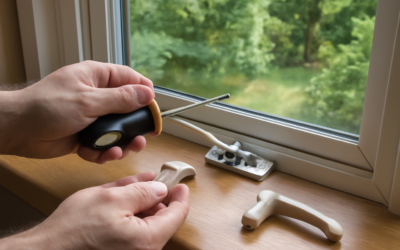
Walk into a high-end kitchen and you will often notice the faucet has three separate pieces spread across the sink deck instead of one all-in-one fixture. That is a widespread kitchen faucet, a configuration where the spout and the two handles mount as individual components, typically 8 to 16 inches apart. The spread-out layout looks custom and gives you flexibility in placement, but it also means more holes, more connections, and a few decisions you do not face with a single-hole faucet. This guide explains how the style works, how to install it, and whether it is the right pick for your sink.
What “Widespread” Actually Means
In faucet terminology, the mounting style describes how the parts attach to the sink or countertop. A widespread faucet separates the hot handle, the cold handle, and the spout into three distinct pieces that connect underneath the deck with flexible supply tubing. The handles sit on either side of the spout with a gap between them, usually measured 8 inches or more center to center. This differs from a centerset faucet, where the handles and spout share a single base plate on 4-inch centers, and from a single-hole faucet, where everything mounts through one opening.
Widespread designs are more common in bathrooms, but widespread-style kitchen faucets do exist, especially bridge faucets and pot-filler-inspired layouts that echo the separated look. The appeal is a tailored, furniture-like appearance and the ability to space components to fit a specific sink.
Counting Your Sink Holes
The number and spacing of holes in your sink or countertop dictates what will fit. Before you buy anything, flip the sink over or look under the deck and count the pre-drilled holes.
- Three holes on wide centers: The classic widespread setup, one for the spout and one for each handle.
- Four holes: Common on kitchen sinks, leaving an extra hole for a side sprayer, soap dispenser, or air gap.
- Standard spacing: Kitchen deck holes are often drilled on 4-inch centers for centerset or 8-inch for widespread; measure center to center to confirm.
If your sink has more holes than the faucet uses, cover the extras with a soap dispenser, a filtered-water tap, or a hole cover. If it has too few, some countertops and stainless sinks can be drilled to add them, though that is a job for a pro on stone or a risk on enameled cast iron.
Styles and Finishes
Widespread and bridge-style kitchen faucets lean traditional and transitional, though modern versions exist. Consider the look you want:
- Bridge faucets: Connect the hot and cold handles across the top with an exposed pipe, a hallmark of farmhouse and classic kitchens.
- Two-handle high-arc: Separate handles flank a tall gooseneck spout that clears large pots.
- Cross vs lever handles: Cross handles read vintage; smooth levers feel more contemporary and are easier to turn with wet or full hands.
Popular finishes include polished chrome, brushed nickel, matte black, and warm brass. Match the finish to your cabinet hardware and other fixtures for a cohesive look, and note that brushed and matte finishes hide water spots and fingerprints better than polished ones.
Two Handles vs Single Handle
The defining trait of a widespread faucet is separate hot and cold handles, which is both a feature and a tradeoff. Two handles give precise, independent control of temperature and flow, and many people prefer the classic look. The downside is that mixing temperature takes two hands, which is less convenient when your hands are full or messy. A single-handle faucet lets you adjust temperature and volume with one motion, often with a wrist or forearm. If ease of one-handed use matters in a busy kitchen, weigh that against the widespread style’s appearance.
Installation Overview
Installing a widespread kitchen faucet is more involved than a single-hole model because you connect three separate pieces, but it is within reach for a confident DIYer.
- Shut off the water at the under-sink valves and open the old faucet to relieve pressure.
- Remove the old faucet and clean the deck thoroughly.
- Set the spout and handles through their holes, using the supplied gaskets or a bead of plumber’s putty where specified.
- Secure each piece from below with its mounting nuts.
- Connect the supply lines and the tubing that links the handles to the spout, following the maker’s diagram for hot and cold.
- Turn the water back on slowly, remove the aerator to flush debris, then check every connection for leaks.
Because there are more joints under the sink, take extra care to hand-tighten then snug each fitting, and run water for a few minutes while watching for drips.
Features Worth Looking For
Beyond the layout, the internal quality determines how the faucet performs over years of daily use:
- Ceramic disc valves: The gold standard for drip-free, long-lasting operation over rubber washers.
- Solid brass body: More durable and corrosion-resistant than zinc or plastic internals.
- Spout height and reach: A high-arc spout clears stockpots; make sure the reach lands water in the center of the bowl.
- Included sprayer: Some widespread kitchen sets add a matching side sprayer in the fourth hole for rinsing.
Cost and Value
Widespread and bridge-style kitchen faucets tend to cost more than basic single-handle models because of the extra components and their design-forward appeal. Expect roughly $150 to $400 for a solid mid-range option, with premium bridge faucets in designer finishes reaching $500 to $900. Spending on ceramic valves and a brass body pays off in leak-free years of service, so it is usually worth avoiding the cheapest options that use plastic internals.
Matching the Faucet to Your Sink
The faucet and sink have to work as a pair. A tall high-arc widespread faucet looks striking but can splash in a shallow sink, so pair a gooseneck spout with a deeper bowl of at least 8 to 9 inches. For a large farmhouse or apron-front sink, a bridge faucet with a high spout suits the scale, while a compact prep sink calls for a smaller-spread, lower-profile set. Check the spout reach so water lands near the center of the bowl, not against the back wall or the front lip. If your sink is set under a window, measure the clearance so the handles and spout do not hit the sash when the window opens. Getting this pairing right prevents the daily annoyance of splashing and awkward reach.
Maintenance and Longevity
Because a widespread faucet has more connection points than a single-hole model, a little routine care keeps it leak-free. Wipe the finish with a soft cloth and mild soap rather than abrasive cleaners, which dull the surface, and dry brushed or matte finishes to avoid water spots. If the flow weakens, unscrew the aerator and soak it in white vinegar to clear mineral scale, common in hard-water areas. A slow drip at a handle usually means a worn ceramic cartridge, which is a simple, inexpensive replacement. Check the connections under the sink once or twice a year and snug any that have loosened. With basic upkeep, a quality brass-bodied widespread faucet lasts well over a decade.
Pros and Cons Summed Up
Weighing the tradeoffs makes the decision clear. On the upside, a widespread faucet offers a custom, high-end appearance, flexible spacing that fits a range of sinks, precise independent hot and cold control, and a design that anchors traditional and transitional kitchens. On the downside, it costs more than a basic single-hole faucet, requires more holes and more under-sink connections, and mixing temperature takes two hands rather than one. Installation is a bit more involved, and cleaning around three separate bases takes marginally more effort than wiping one. For homeowners who value the classic look and the tailored feel, those tradeoffs are well worth it; for those who prize one-handed convenience above all, a single-handle pull-down may suit better. Knowing your priorities up front prevents buyer’s remorse.
The Bottom Line
A widespread kitchen faucet delivers a custom, tailored look with separate handles and spout that suit traditional, farmhouse, and transitional kitchens beautifully. Before you buy, confirm your sink’s hole count and spacing, decide whether two-handle control fits how you cook, and prioritize ceramic valves and brass construction for durability. With careful attention to the extra under-sink connections during installation, a widespread faucet becomes a standout, long-lasting centerpiece for your kitchen.