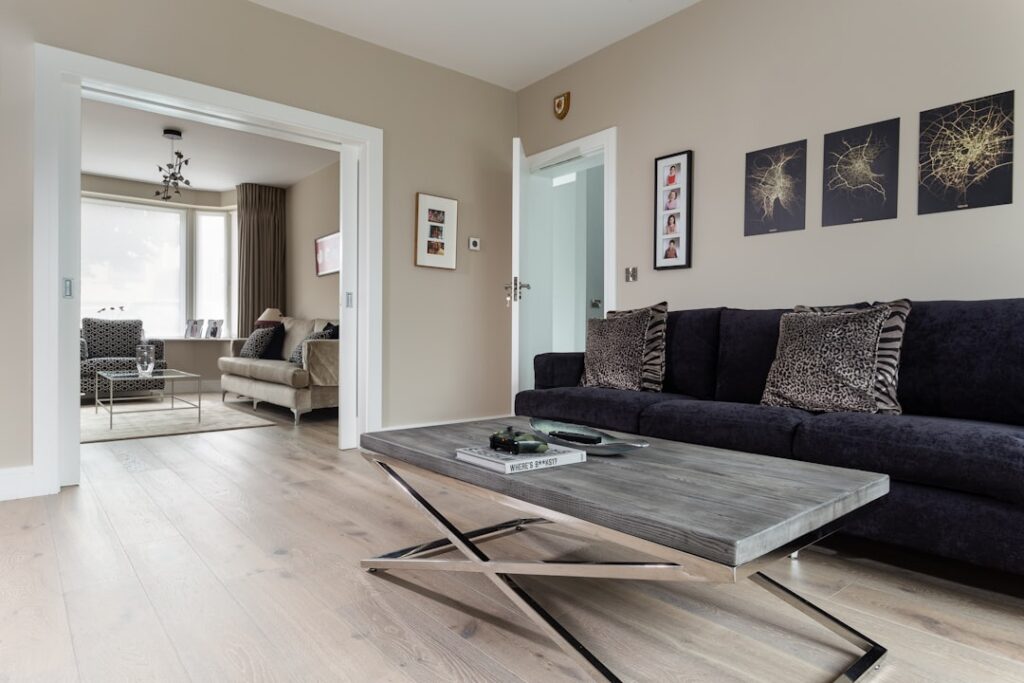
Modern printing technology now reproduces oak grain, knots, and color variation so convincingly that many people cannot tell a quality plank from real timber until they kneel down and touch it. That realism is why wood effect laminate flooring has become one of the most popular choices for homeowners who want the warmth of hardwood at a fraction of the price, often $1 to $5 per square foot compared with $6 to $15 for solid wood. This guide breaks down how it is made, its advantages and drawbacks, and how to buy the right product for your home.
What Is Wood Effect Laminate Flooring?
Wood effect laminate is a multi-layer synthetic flooring designed to mimic the appearance of natural timber. Each plank is built from four bonded layers. The base is a moisture-resistant backing that stabilizes the plank. Above it sits a dense core, usually high-density fiberboard, which provides strength and impact resistance. The third layer is the photographic decor layer, a high-resolution image of real wood that gives the floor its convincing grain. On top is a clear wear layer, a tough transparent coating that resists scratches, fading, and everyday wear.
Because the wood look is a printed image rather than real timber, manufacturers can offer an enormous range of species, colors, and finishes, from pale Scandinavian oak to deep walnut and rustic reclaimed barnwood, often at a consistent price.
The Advantages of Wood Effect Laminate
Laminate has earned its popularity for several practical reasons:
- Affordability: It delivers a hardwood look for significantly less money, both in materials and installation.
- Durability: The wear layer resists scratches and dents better than solid wood, making it well suited to busy households.
- Easy installation: Most modern laminate uses a click-lock floating system that requires no glue or nails, making it a realistic do-it-yourself project.
- Low maintenance: Routine sweeping and an occasional damp mop keep it looking new. There is no sanding, staining, or refinishing.
- Pet and kid friendly: The hard, sealed surface stands up to claws, toys, and spills better than real wood.
- Design variety: The printed decor layer means almost any wood look is available, including rare or exotic species.
The Drawbacks to Consider
No flooring is perfect, and laminate has limits you should weigh honestly:
- Moisture sensitivity: Standard laminate cores can swell if water seeps into the seams and sits there, so it is not ideal for bathrooms unless it is a water-resistant product.
- Cannot be refinished: Once the wear layer is damaged, you replace the plank rather than sand it. Hardwood can be refinished multiple times.
- Underfoot feel: Lower-grade laminate can sound hollow or feel hard, though a quality underlayment improves both.
- Resale perception: Some buyers still value genuine hardwood more highly, which can matter at sale time.
Many of these downsides are minimized by choosing a higher-grade product and installing it in the right rooms.
Understanding AC Ratings
One of the most useful things a buyer can learn is the AC rating system, which grades laminate durability from AC1 to AC5. The rating tells you how much traffic a floor can handle:
- AC1: Light residential use, suitable for bedrooms and closets.
- AC2: General residential use for moderate-traffic rooms.
- AC3: Heavy residential and light commercial, a strong all-around choice for most homes.
- AC4: General commercial, ideal for high-traffic households and busy entryways.
- AC5: Heavy commercial use such as stores and offices.
For a typical home, an AC3 or AC4 rating offers the best balance of durability and value. Paying for AC5 in a quiet bedroom is usually unnecessary.
Choosing Thickness and Finish
Plank thickness typically ranges from 7mm to 12mm. Thicker planks feel more solid underfoot, dampen sound better, and tend to have more realistic embossing. A 10mm or 12mm plank generally feels closer to real hardwood than a thin 7mm board. Surface texture matters too. Look for embossed-in-register finishes, where the texture aligns with the printed grain, because they create the most convincing wood look. Finishes range from smooth and glossy to hand-scraped and matte, with matte and textured options usually reading as more authentic.
Where to Install Wood Effect Laminate
Laminate performs beautifully in living rooms, bedrooms, hallways, dining rooms, and home offices. These dry, high-visibility spaces showcase the wood look while staying within laminate’s comfort zone. For kitchens, laundry rooms, and basements, choose a product specifically rated as water-resistant or waterproof, and seal the perimeter carefully. Standard laminate is best kept out of full bathrooms, where standing water and humidity are constant. Matching the product to the room is the single most important factor in how long your floor lasts.
Installation Basics
Wood effect laminate is usually installed as a floating floor, meaning the planks lock to each other rather than fastening to the subfloor. This allows the floor to expand and contract with temperature and humidity. A few essentials make the difference between a professional result and a disappointing one:
- Acclimate the planks in the room for 48 hours before installing so they adjust to the home’s humidity.
- Use a quality underlayment for cushioning, sound reduction, and, where needed, moisture protection.
- Leave an expansion gap of about a quarter inch around the room’s edges, hidden later by baseboards.
- Stagger the seams between rows for strength and a natural appearance.
Many homeowners complete a room over a weekend with basic tools, though larger or oddly shaped spaces may justify professional installation.
Caring for Your Laminate Floor
Maintenance is refreshingly simple. Sweep or vacuum regularly to remove grit that can scratch the surface, and wipe spills promptly. Use a damp, not wet, mop with a cleaner formulated for laminate. Avoid steam mops and excessive water, which are the most common causes of damage. Felt pads under furniture legs and doormats at entries go a long way toward preserving the wear layer for years.
Is Wood Effect Laminate Right for You?
If you want the look of hardwood with better scratch resistance, easier upkeep, and a friendlier price, wood effect laminate is a smart, practical choice for most rooms in a home. Focus on a suitable AC rating, adequate thickness, a realistic embossed finish, and water-resistant options for damp areas, and you will end up with a floor that looks great and holds up for a decade or more. The team at D and G Flooring helps homeowners match the right laminate grade to each room so the finished result performs as good as it looks.
Prefer to explore on your own?
See how new flooring looks in your actual room in seconds — free, no signup.
Try the free Floor Studio →