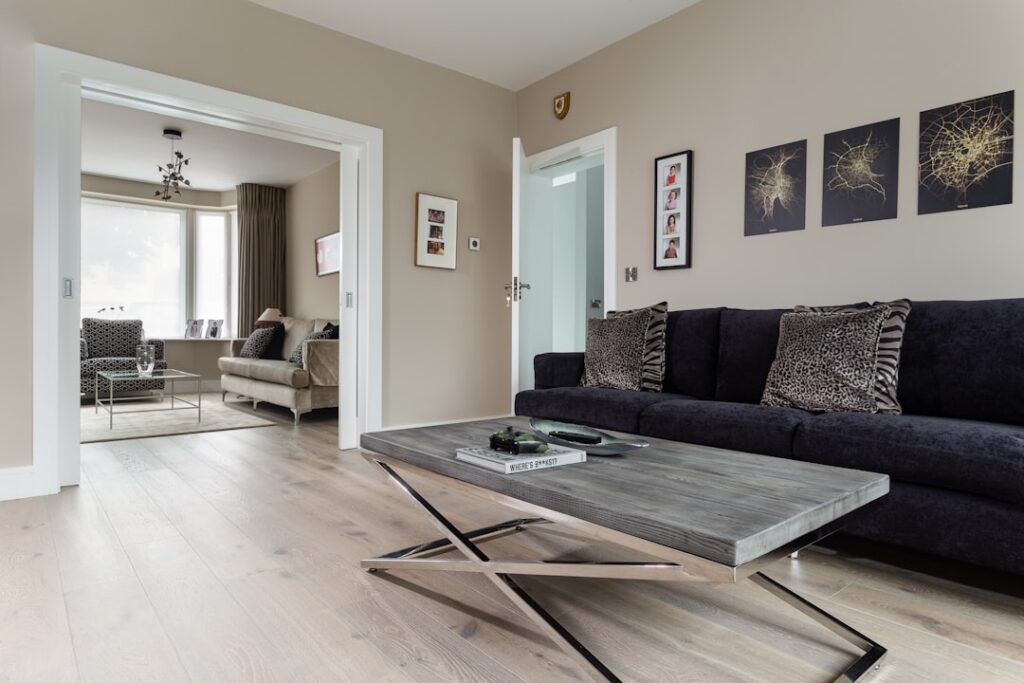
Laminate has changed more in the last five years than in the previous twenty. The cheap, plasticky boards that gave the category a bad name are still on shelves, but premium laminate flooring options now feature 12 mm cores, embossed-in-register textures that match the visual layer exactly, and water-resistant warranties that rival luxury vinyl. Knowing how to read the spec sheet is the difference between a 5-year floor and a 25-year one.
How Modern Laminate Is Built
Every laminate plank is a four-layer sandwich: a melamine wear layer, a high-resolution photographic decor layer, a high-density fiberboard (HDF) core, and a balancing back layer. The wear layer thickness, the HDF core density, and the locking system are the three specs that decide quality. A 12 mm board with HDF density above 850 kg/m³ and a Uniclic or Välinge 5G locking system will outlive a thicker board with cheap mechanics.
Thickness alone is misleading. An 8 mm Pergo Outlast+ outperforms a 12 mm warehouse-club board because the core density and locking system are dramatically better.
AC Ratings: The Spec That Matters Most
The Abrasion Class (AC) rating from the European Producers of Laminate Flooring is the most reliable durability metric. Skip anything below AC3 unless it is going in a guest bedroom that sees almost no traffic.
- AC3: Moderate residential, bedrooms and dining rooms, $1.50-$2.50/sq ft
- AC4: Heavy residential and light commercial, kitchens and hallways, $2.50-$4/sq ft
- AC5: Heavy commercial, retail and offices, $4-$6/sq ft
- AC6: Extreme commercial, rare in residential, $6-$9/sq ft
For most homeowners, AC4 hits the sweet spot. It handles dogs, kids, and dropped pans without the price jump to AC5.
Water-Resistant vs Waterproof Laminate
The biggest improvement in modern laminate flooring options is water performance. Pergo TimberCraft+WetProtect, Mohawk RevWood Plus, and AquaGuard Performance carry up to 30-hour or even lifetime spill warranties. They use a treated HDF core, wax-sealed locking edges, and tighter milling tolerances that keep moisture out of the seams.
Waterproof claims are still oversold. Standing water on any laminate seam for more than 24 hours risks core swelling. For full bathrooms and laundry rooms, luxury vinyl plank remains the safer choice. For kitchens, mudrooms, and basements above grade, current waterproof laminate is genuinely viable.
Top Brands Worth Buying
After installing roughly 200,000 square feet of laminate over the last decade, these are the brands that consistently deliver:
- Pergo (TimberCraft+WetProtect, Outlast+): Best all-around, wide selection, $3-$5/sq ft
- Mohawk RevWood Plus: Excellent water performance, lifetime residential warranty, $3-$5/sq ft
- Quick-Step Studio and NatureTEK Plus: Most realistic visuals, premium texture, $3.50-$6/sq ft
- Shaw Repel: Strong mid-tier with 24-hour spill protection, $2.50-$4/sq ft
- AquaGuard (Floor & Decor): Best value waterproof, $2-$3.50/sq ft
Off-brand laminate from membership clubs is a coin flip. The board itself is often fine, but the locking system tolerances vary batch to batch, which causes installation headaches and seam gaps.
Texture and Visual Quality
Embossed-in-register (EIR) texture, where the surface bumps align exactly with the printed wood grain, is the dividing line between laminate that looks real and laminate that does not. EIR adds about 25 percent to the cost but is worth every dollar. Smooth or random-emboss laminate from a distance gives away that it is not wood.
Beveled edges (V-grooves on all four sides, called 4V) make installation imperfections invisible and give the floor a plank-by-plank look. 2V (only the long sides beveled) is acceptable. Square edges hide nothing and look dated; skip them.
Underlayment Is Not Optional
Many laminate flooring options ship with attached IXPE or EVA foam underlayment. If yours does not, budget $0.30 to $0.80 per square foot for separate underlayment. For concrete subfloors, you need a 6-mil vapor barrier built into the underlayment or laid separately. Skipping this is the leading cause of cupping and core failure in basement laminate.
Premium underlayments like QuietWalk Plus add sound dampening that drops impact noise by 20 to 25 decibels, a meaningful upgrade for upstairs rooms and condos.
Installation Cost and DIY Reality
Professional installation runs $2 to $4 per square foot, bringing total installed cost to $4 to $9 per sq ft for most quality laminate. DIY installation is genuinely doable for any reasonably handy homeowner; modern click systems lock without glue and most rooms are floored in a weekend. Plan for these tools: tapping block, pull bar, miter saw, and a $40 jamb saw for door casings.
The most common DIY mistake is failing to leave a 3/8-inch expansion gap around the perimeter and at every fixed object (door jambs, kitchen islands, fireplaces). Without that gap, the floor buckles within the first humid summer.
What to Skip
Avoid laminate under 8 mm, AC ratings of AC2 or lower, and any board without a documented warranty above 15 years for residential use. Avoid attached padding made of cheap polyethylene foam under 2 mm; it compresses to nothing within a year. And avoid the absolute bottom of the price range, where boards are often discontinued runs that you cannot match if you damage a section three years from now.
Plank Width and Length Trends
Wider, longer planks dominate current laminate flooring options. Standard widths have moved from 5 inches to 7.5 inches, with premium product reaching 9 inches. Lengths now run 48 to 60 inches in mainstream lines and up to 72 inches in upmarket products. The wider and longer the plank, the more realistic the wood-look reads, especially in larger rooms. The trade-off is that wider planks telegraph subfloor imperfections; flatness within 3/16 inch over 10 feet matters more on a 9-inch plank than on a 5-inch one.
Maintenance That Maximizes Lifespan
Modern laminate is low-maintenance, not no-maintenance. Use a microfiber dust mop daily in entry areas and weekly elsewhere. Damp-mop with a laminate-specific cleaner like Bona Pro Hard-Surface or Method Squirt + Mop. Avoid steam mops; the heat plus moisture combination causes core swelling at seams over time. Place felt protectors under furniture legs, especially dining chairs that drag across the surface dozens of times per week. With this routine, a quality AC4 floor reaches the high end of its 20 to 25 year lifespan range.
Prefer to explore on your own?
See how new flooring looks in your actual room in seconds — free, no signup.
Try the free Floor Studio →