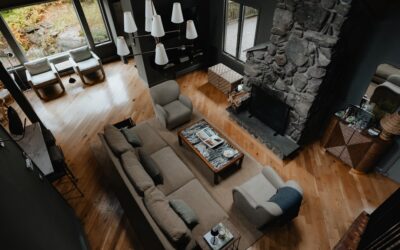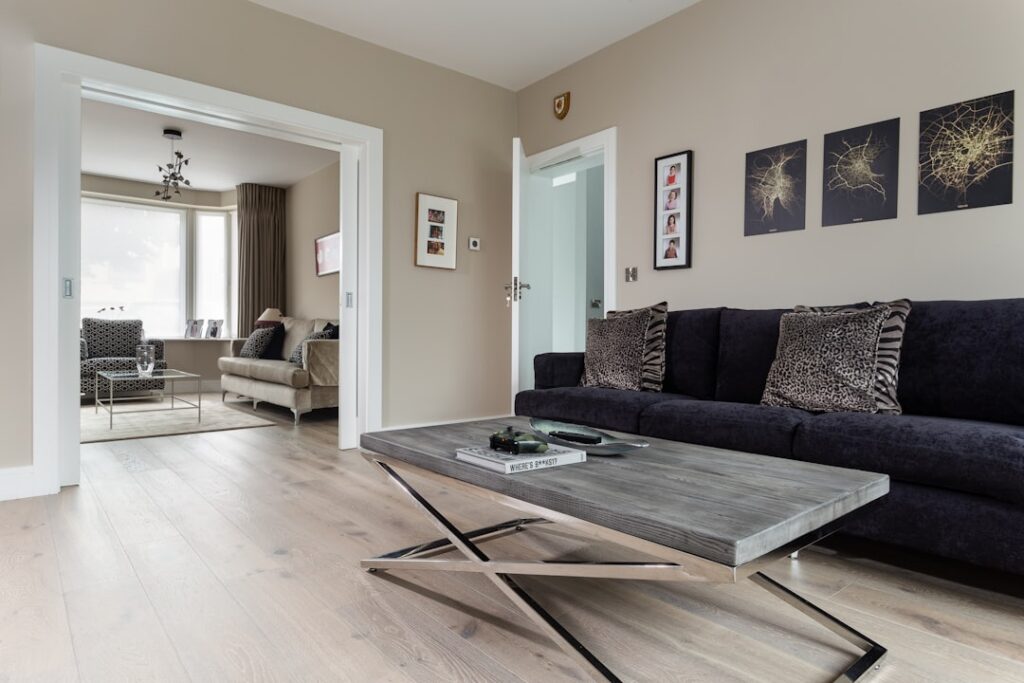
Walk into a model home in any new development and you’ll often see floors that look like wide-plank European white oak but actually cost the builder $3 per square foot. That’s high end laminate flooring doing its job, delivering near-hardwood realism at a fraction of the price thanks to embossed-in-register textures, beveled edges, and AC5-rated wear layers. After installing premium laminate in dozens of clients’ homes alongside genuine hardwood, here’s the honest breakdown of what separates the good stuff from the disposable big-box product.
What Makes Laminate “High End”
Three specs separate budget laminate from premium product. Wear-layer rating is the first: AC4 minimum for residential, AC5 for high-traffic areas, AC6 for commercial. Plank thickness matters too: 10-12mm boards feel solid underfoot, while 7-8mm budget boards sound hollow.
The third spec is texture. Premium laminate uses embossed-in-register (EIR) technology, where the surface texture aligns perfectly with the printed wood grain image below. Cheaper laminate uses a generic embossing pattern that looks fake on close inspection. Hand it the “shoe test”: if you can feel knots and grain when you slide a sock across it, it’s high end.
Top Brands and What They Offer
Five brands consistently sit at the top of the premium laminate market, each with its own strength.
- Quick-Step (Belgium): widest plank options, deepest EIR texture, $3.50-$6.00/sq ft
- Pergo TimberCraft+ WetProtect: fully waterproof, lifetime warranty, $3.50-$5.00/sq ft
- Mannington Restoration Collection: extra-wide planks, distressed looks, $4.00-$6.50/sq ft
- Mohawk RevWood Plus: water-resistant, attached underlayment, $3.00-$5.00/sq ft
- Kronotex (Germany): very dense HDF core, AC5 standard, $2.80-$4.50/sq ft
Avoid no-name brands sold only at warehouse clubs. The wear layer often peels within 5 years and replacement product becomes impossible to find.
How High End Laminate Differs From LVP
Both products click together and float over the subfloor, but laminate uses an HDF (high-density fiberboard) core while LVP uses PVC or SPC. Laminate feels and sounds more like real wood underfoot, with crisper edge details and warmer feel in winter.
LVP wins on waterproofing. Even premium laminate can swell if standing water sits for hours, while LVP shrugs off floods. If your priority is bathroom or basement install, choose LVP. For living rooms, bedrooms, and dining rooms, premium laminate often looks and feels more upscale.
Realistic Lifespan and Wear
AC4-AC5 rated premium laminate carries 25-30 year residential warranties. In real homes with kids, dogs, and grit tracked in from outside, expect 20-25 years before the wear layer thins enough to show. The image layer below typically holds up longer than the protective coating.
Premium laminate cannot be refinished. When the wear layer fails, you replace the floor. That said, 20-25 years per install is competitive with engineered hardwood that gets refinished twice in its lifespan.
Plank Width and Length Trends
Standard laminate boards measure 5×48 inches. The premium category has shifted to wider, longer planks: 7-9 inches wide by 60-72 inches long. The bigger format reduces the number of seams, looks more like solid plank flooring, and feels more substantial.
Wide planks need a flatter subfloor (within 3/16 inch over 10 feet) and benefit from acclimation periods of 72 hours instead of 48. Skipping this step causes peaking at seams within 6 months.
Installation Specifics
Most premium laminate uses a click-lock floating system that drops over a 2-3mm foam underlayment. Some lines (Mohawk RevWood, Pergo Extreme) come with attached pad, eliminating one step.
- Acclimate boxes flat-stacked in install room for 48-72 hours
- Check subfloor flatness with an 8-foot straightedge, fill low spots
- Roll out moisture barrier or use attached underlayment
- Lay first row with tongue facing wall, leaving 3/8 inch expansion gap
- Stagger seams a minimum of 12 inches between adjacent rows
- Use a tapping block, never hammer directly on plank edges
- Reinstall trim, add T-molding at doorways and rooms over 40 feet
Professional installation runs $2.50-$5.00 per square foot depending on subfloor prep. DIY install on a clean subfloor saves significantly without compromising results.
Price Compared to Hardwood and LVP
Premium laminate ranges from $3.00-$6.50 per square foot for materials, $5.50-$11.00 installed. Compare that to engineered hardwood at $7-$15/sq ft installed, solid hardwood at $10-$20/sq ft installed, and premium LVP at $5-$10/sq ft installed.
For homeowners who want the look of $14/sq ft European white oak without the cost, premium laminate from Quick-Step or Mannington delivers visually for $4-$6/sq ft. The savings can fund a kitchen backsplash or bathroom upgrade in the same renovation.
Common Failures and How to Avoid Them
Three issues account for nearly all premium laminate complaints. Subfloor moisture above 3% causes warping and edge swelling; always test concrete with a calcium chloride kit before install. Inadequate expansion gaps cause peaking when the floor expands in summer humidity. Cleaning with a wet mop instead of a damp microfiber pad lets water seep into edges and swells the HDF core.
Use only manufacturer-approved cleaners (Bona Stone Tile & Laminate or Quick-Step Cleaner). Skip steam mops entirely; they push moisture into seams and void warranties.
Frequently Asked Questions
How long does premium laminate flooring last?
AC4-AC5 rated premium laminate lasts 20-30 years in residential use, with manufacturer warranties matching the upper end of that range. Lifespan depends on traffic, cleaning habits, and humidity control.
Is high end laminate waterproof?
Some lines like Pergo TimberCraft+ WetProtect and Mohawk RevWood Plus are fully waterproof. Standard premium laminate is water-resistant but not waterproof; standing water for several hours can cause damage.
Can you tell the difference between premium laminate and real wood?
Visually, premium laminate from 5 feet away is almost indistinguishable from hardwood. Up close, the embossed-in-register texture and beveled edges convince most people. The hollow sound and slightly cool feel give it away on inspection.
Can high end laminate be refinished?
No. The decorative image layer cannot be sanded. When the wear layer fails after 20-30 years, you replace the floor. Engineered or solid hardwood is the only option if refinishing matters.
Prefer to explore on your own?
See how new flooring looks in your actual room in seconds — free, no signup.
Try the free Floor Studio →