
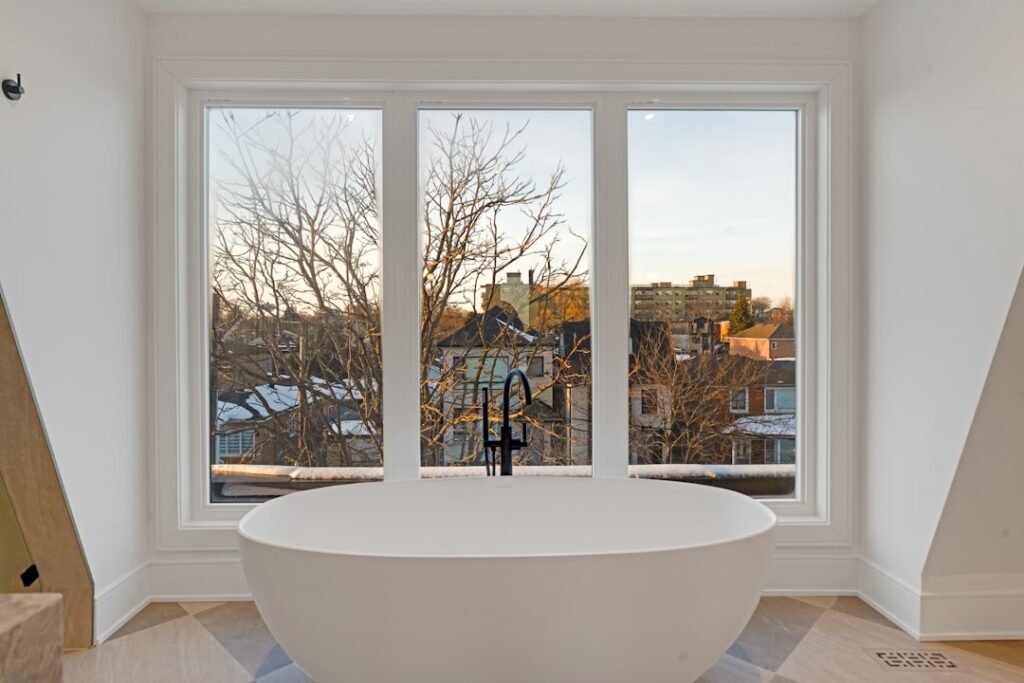
Designers love hardwood in bathrooms for the warmth and continuity it brings from adjacent rooms — and most flooring contractors quietly hate installing it there. A wood floor bathroom can absolutely work, but only when you choose the right species, the right finish system, and accept that even the best installation needs annual attention. Solid 3/4 in red oak in a kid’s bathtub bathroom is asking for cupping by year three.
Part of our Bathroom Remodeling & Flooring guide — explore the full guide →
I have inspected wood-floor bathrooms ranging from 1920s Craftsman powder rooms with original quarter-sawn oak still pristine to brand-new $80,000 master baths with engineered hickory failing in 18 months. The pattern is always the same: success or failure tracks back to material choice and how the perimeter was sealed.
- Solid Hardwood vs Engineered: The Real Answer
- Best Wood Species for Bathroom Use
- Finish Systems That Actually Work
- The Most Important Step: Perimeter Sealing
- Installation Method Matters
- Wood-Look Alternatives Worth Considering
- Cost Breakdown
- Maintenance Schedule
- Common Failure Modes
- Frequently Asked Questions
Solid Hardwood vs Engineered: The Real Answer
Solid hardwood expands and contracts up to 1/4 inch across a 6 ft span as humidity swings between 30% and 70%. A bathroom routinely hits 80-90% humidity during showers. That movement causes cupping, gapping, and finish failure at board edges.
Engineered hardwood with a plywood or HDF core moves about a third as much. For wet rooms, it is the only hardwood option I will recommend, and only with a wear layer of at least 3 mm so it can be refinished if water damage occurs.
- Powder rooms (no shower or tub): solid hardwood acceptable with proper sealing
- Full bathrooms with tubs: engineered only, 5-7 mm wear layer preferred
- Master bathrooms with steam showers: skip wood, use wood-look porcelain instead
Best Wood Species for Bathroom Use
- White oak: tight grain, naturally rot-resistant tyloses cells, dimensionally stable
- Hickory: highest hardness rating (1820 Janka), takes finish well
- Teak: naturally water-resistant, used on boat decks for centuries
- Brazilian walnut (ipe): extremely dense, pricey at $9-$14 per sq ft
- Bamboo (strand-woven): stable, hard, more affordable around $4-$7 per sq ft
Avoid: maple, beech, and most softwoods — too prone to swelling. Walnut and cherry look beautiful but show every water spot.
Finish Systems That Actually Work
The wear layer is what stops moisture from reaching the wood. For bathroom installations, choose one of these:
- Aluminum-oxide UV-cured factory finish on engineered planks (Mirage, Lauzon, Mercier): 25-year warranty common
- Hard wax oil like Rubio Monocoat 2C or Pallmann Magic Oil: penetrates the wood, easy spot repair
- Two-component water-based polyurethane (Bona Traffic HD): toughest site-finished option, 8-9 hardness
Skip oil-based polyurethane in bathrooms — the amber tone shows water rings and the long cure makes recoating awkward.
The Most Important Step: Perimeter Sealing
Water never destroys a wood floor from the top down. It seeps in at the perimeter — under the toilet flange, behind the vanity kickplate, where the tub meets the floor — and rots the wood from below. The fix is not glamorous but it works.
- Run a continuous bead of polyurethane sealant (Sika 1A, NP1, or 100% silicone) where flooring meets the tub, shower, and toilet flange
- Install a wax ring with a flange extender to prevent toilet leaks at the seal
- Use silicone caulk between the vanity toe kick and the floor
- Apply a finish-matched penetrating sealer to all cut ends before installation
If your installer skips this, find a different installer.
Installation Method Matters
Floating engineered floors with a click-lock joint perform worst in bathrooms because the joints are the weak point for moisture. Glue-down with a moisture-cure urethane adhesive (Bostik Best, Mapei Ultrabond ECO 995) creates the equivalent of a waterproof membrane under each board.
Always install over a 6-mil polyethylene moisture barrier on slab, or directly on a fully bonded waterproofing membrane like Schluter Ditra-Heat or Laticrete Hydro Ban Sheet Membrane.
Wood-Look Alternatives Worth Considering
If the install location is high-risk, these products give the look without the failure modes:
- Wood-look porcelain plank tile: 6×36, 8×48, 9×60 sizes from Daltile, Marazzi, and Florim — $3-$8 per sq ft
- Luxury vinyl plank with a stone-plastic composite core (SPC): COREtec Pro Plus, Karndean LooseLay — $4-$7 per sq ft, 100% waterproof
- Marmoleum sheet linoleum in wood patterns: natural, 25-year wear life
Cost Breakdown
- Engineered white oak (5/8 in, 4 mm wear layer) installed: $11-$18 per sq ft
- Hand-scraped hickory installed: $13-$22 per sq ft
- Site-finished solid oak in a powder room: $9-$14 per sq ft
- Wood-look porcelain plank: $9-$16 per sq ft installed
- Premium SPC luxury vinyl plank: $7-$12 per sq ft installed
Maintenance Schedule
- Daily: shake out bathmats, wipe water off hardwood within 15 minutes
- Weekly: damp-mop with Bona Hardwood Floor Cleaner or pH-neutral wood cleaner
- Quarterly: inspect perimeter caulk and re-bead any cracks
- Annually: recoat with Bona Refresher or appropriate hard-wax oil maintenance product
- Every 8-12 years: light sand and full recoat
Common Failure Modes
Cupping (boards rising at edges) is moisture from below. Crowning (boards rising in the middle) is moisture from above followed by drying. Black staining at toilets means the wax ring failed and water has been wicking for months. Each of these means pulling boards and addressing the source before refinishing.
Frequently Asked Questions
Is hardwood OK in a bathroom?
In powder rooms and half baths, yes, with proper sealing. In full bathrooms with showers, only engineered hardwood with a robust finish system. Skip it entirely in steam-shower spaces.
What is the most water-resistant wood?
Teak, white oak, and ipe lead the list. Strand-woven bamboo is also highly stable and budget-friendly.
Can engineered wood handle a leaking toilet?
A short leak caught quickly can dry out. A leak running for days will cause swelling and require board replacement. Always use a flange extender and inspect the wax ring annually.
Do I need radiant heat under a bathroom wood floor?
Not required, but it dramatically reduces moisture issues by keeping the floor 4-6 degrees warmer than ambient. Use a low-watt mat (Schluter Ditra-Heat or Warmly Yours TempZone) rated for wood floors.
How long does a properly installed wood bathroom floor last?
Engineered with a 4 mm wear layer: 25-30 years with one mid-life refinish. Solid hardwood in a powder room: 50+ years. Both depend entirely on perimeter sealing and prompt water cleanup.
Prefer to explore on your own?
See how new flooring looks in your actual room in seconds — free, no signup.
Try the free Floor Studio →

