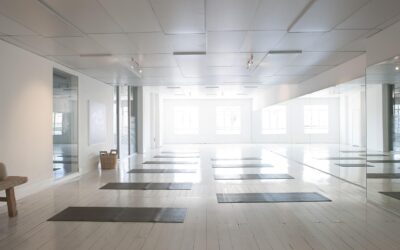
The first studio I helped build had gorgeous reclaimed maple floors. They photographed beautifully, and the owner regretted them within six months — sweat soaked the seams, downward dog turned slippery, and a 1,200 sq ft refinish three years in cost more than installing the right surface from day one. Choosing yoga studio flooring is less about looks and more about how the surface behaves when wet, when bare feet pivot under load, and when 30 students drop into chaturanga at the same time. The right floor pays for itself in fewer injuries and longer service life.
- What a Yoga Floor Actually Has to Do
- The Top Five Surfaces Compared
- The Pros of Each Material in Practice
- The Cons That Trip Up New Studio Owners
- Slip Resistance Numbers That Matter
- Installation Tips That Save Headaches
- Cost Reality for a Typical Studio
- Maintenance Schedule
- Acoustic and Sound Considerations
- Final Take
What a Yoga Floor Actually Has to Do
The performance bar is specific. The surface needs a coefficient of friction high enough to prevent slipping in warrior poses, low enough to allow controlled pivots in twists, and consistent when wet from sweat or hot yoga humidity. It also needs joint cushion — typically 1.5-3 mm of compressible underlayment — to protect knees and wrists during repetitive vinyasa flows.
Beyond performance, hot yoga (95-105°F at 40% humidity) eats most flooring within 5 years. Mat-borne sweat at those volumes finds every seam, and any organic underlayment turns into a mold farm. Material choice has to assume worst-case humidity from day one.
The Top Five Surfaces Compared
- Cork — naturally antimicrobial, warm underfoot, excellent grip wet or dry. $5-$9 per sq ft installed. Best all-around option for non-heated studios
- Engineered bamboo — harder than oak, stable in humidity, needs polyurethane finish with anti-slip additive. $7-$11 per sq ft
- Sheet vinyl with cushion backing — seamless, waterproof, 6-12 ft wide rolls. $4-$8 per sq ft. Industry standard for hot yoga
- Rubber sport flooring — best impact absorption, terrible aesthetics, smells for months. $4-$7 per sq ft. Used mostly in fusion studios with weights
- Hardwood (maple or oak) — beautiful, gym-grade, requires regular refinishing and is risky for hot yoga. $9-$14 per sq ft
The Pros of Each Material in Practice
Cork wins on comfort. The natural cellular structure compresses about 1.5 mm under bodyweight then rebounds, which feels noticeably gentler on knees during pigeon and child’s pose. Cork also resists mold without chemical additives, which matters in studios that lean into eco branding.
Sheet vinyl wins on practicality. A 12 ft roll heat-welded at the seams creates a single waterproof membrane across the entire room. Sweat puddles wipe up. There is no joint, no sub-surface mold path, no swelling. For hot yoga, this is the only material that survives a decade without major repair.
Bamboo and hardwood win on aesthetics and resale of the building. Studios in retail-heavy neighborhoods often choose hardwood specifically because Instagram and brand photography demand it. Just budget for refinishing every 5-7 years at $3-$5 per sq ft.
The Cons That Trip Up New Studio Owners
Every material has a failure mode. Cork dents under sharp props and free weights — restrict yoga blocks to soft EVA versions. Bamboo can finish too glossy from the factory; insist on a matte sport-grade urethane with measured slip rating (R10-R11). Rubber off-gasses for 4-8 weeks, which is brutal in a studio that markets clean breathing. Hardwood cups in hot yoga rooms within two seasons.
Underlayment is the second trap. A $0.40 per sq ft foam pad feels great on day one but compresses permanently within 18 months. Spec a closed-cell rubber or cork underlayment at $0.80-$1.50 per sq ft. The difference is invisible but you only buy it once.
Slip Resistance Numbers That Matter
Look for surfaces tested to DIN 51130 R10 or R11, or with a wet pendulum test value (PTV) of 36 or higher. These ratings translate directly to safe barefoot grip when sweat is present. A surface that meets only R9 is essentially polished tile and will cause falls in a heated room.
Reps will sometimes quote dry friction values that look great. Always ask for the wet number. If they cannot produce one, the floor was never tested under realistic conditions and you should move on.
Installation Tips That Save Headaches
- Vapor barrier first — 6-mil polyethylene over concrete subfloors, taped seams, regardless of finish material
- Acclimate cork and bamboo for 7 days at studio operating temperature and humidity
- Heat-weld vinyl seams rather than cold weld; thermal welds last 3-4x longer
- Cove vinyl up the wall 4 inches in hot yoga rooms to keep mop water out of the wall cavity
- Avoid floating installations in heated studios — glue down for stability
Cost Reality for a Typical Studio
For a 1,500 sq ft single-room studio, expect total flooring spend in these ranges: cork $9,000-$13,500, sheet vinyl $7,500-$11,000, bamboo $11,000-$16,500, hardwood $14,000-$20,000. Add $1,500-$3,000 for proper underlayment and vapor barrier across all options. Spread over a 10-year studio lease, even the high-end choices come to $1.40-$2.00 per sq ft per year, which is rounding error against rent.
Maintenance Schedule
Daily: dry mop with microfiber. Weekly: damp mop with manufacturer-approved pH-neutral cleaner. Monthly: deep clean and inspect seams. Quarterly: spot-treat any sweat staining. Annually: reapply finish coat on bamboo or hardwood, inspect vinyl welds. Skip steam mops everywhere — they push moisture into seams faster than any sweat ever will.
Acoustic and Sound Considerations
Hard floors reflect sound, which matters when 25 students are exhaling synchronously through ujjayi breath. Cork delivers the best natural sound absorption of common yoga surfaces. Sheet vinyl on cushion underlayment runs a close second. Bamboo and hardwood reflect sound and may require additional acoustic treatment on walls and ceilings to keep the room from feeling echoey. Budget for sound panels alongside the floor selection if you choose a hard surface — the experience suffers without them.
Final Take
The right yoga studio floor depends on your style. For hot yoga and Bikram, sheet vinyl is the only real answer. For vinyasa and hatha in a non-heated room, cork delivers the best feel underfoot. For studios that double as event spaces, bamboo splits the difference with looks and durability. Spend the extra dollars on slip rating, underlayment quality, and seam treatment — that is where the floor either lasts 15 years or fails in three.
Prefer to explore on your own?
See how new flooring looks in your actual room in seconds — free, no signup.
Try the free Floor Studio →