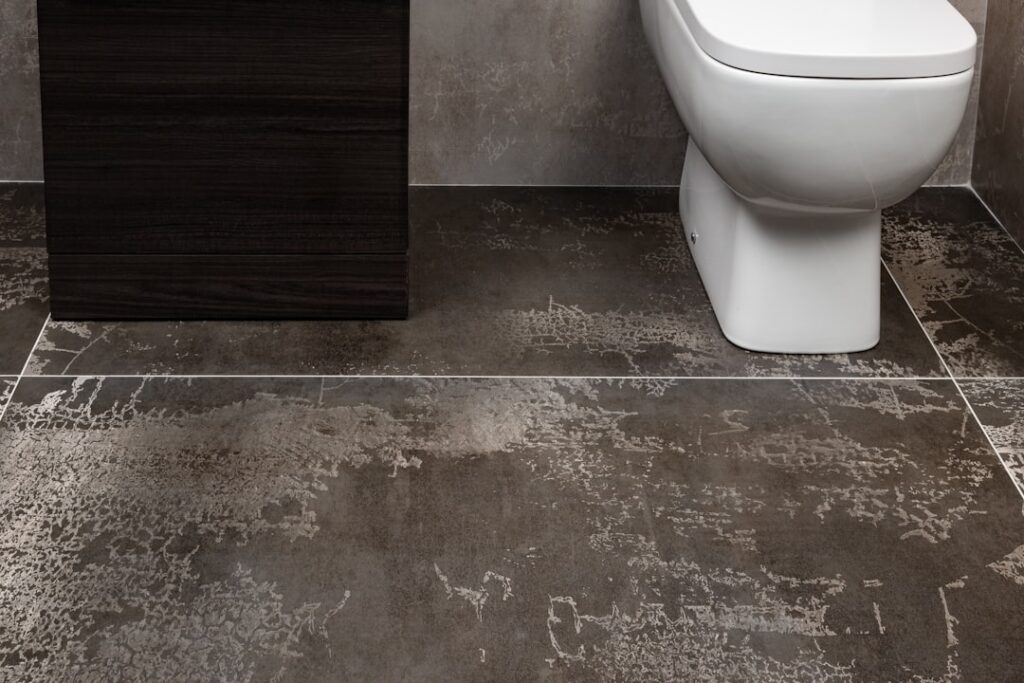
Hotel spas spend tens of thousands of dollars per bathroom to produce the calm that guests will pay $400 a night for, and most of the design moves they use translate directly to a residential primary bath. Zen bathroom decor at its core is a discipline of removing visual noise, layering natural materials, and choosing fixtures that hide the mechanical from view. The goal is a room that lowers cortisol the second the door closes behind you.
The Philosophy Behind the Look
Zen design draws on Japanese wabi-sabi, the principle that imperfect natural surfaces hold more interest than mass-produced perfection. Stone with subtle veining, wood with visible grain, and unglazed ceramic all carry that quality. The room avoids hard chrome, bright glass, and printed wallpaper in favor of textures the eye relaxes into.
Color is restrained. The most common palette is warm white, soft taupe, and one anchor color like deep charcoal or muted forest green. Saturated reds, blues, and yellows do not belong. Even the accessories follow the rule: a single linen towel, one stone soap dish, no clutter on the counter.
Foundational Materials
The materials carry the design. Pick three and let them repeat across walls, floor, and accents.
- Honed or matte tile: Daltile Marble Attache in Lavish Pearl, $12-$18 per sq ft, reads as natural stone
- Light oak wood: rift-sawn white oak vanity panels, $35-$60 per linear foot installed
- River stone or pebble shower floor: Bali Ocean Tiles, $9-$14 per sq ft
- Linen window treatments: Pottery Barn Belgian Flax curtains, $129-$179 per panel
- Live edge wood shelf: reclaimed walnut or oak slab, $80-$220 depending on size
Floors matter most because they cover the largest visible surface. Large-format porcelain tile (24 by 48 inches) in a matte light gray or warm beige creates the spa-floor look with minimal grout lines. MSI and Daltile both make porcelain that mimics travertine and limestone at a fraction of the natural-stone price.
Plumbing Fixtures That Disappear
Fixtures should look intentional but not stand out. Brushed nickel, matte black, and brushed brass all work. Polished chrome reads dated and clinical, so most spa designs avoid it. The Kohler Purist line and the Brizo Litze line are the two most-specified collections in this category, with Kohler running $400-$900 per fixture and Brizo running $700-$1,800.
For a more budget-friendly version, Moen Align and Delta Trinsic both deliver clean modern lines at $200-$450 per fixture. Pair the faucet finish with the showerhead, the towel bars, and the cabinet pulls. Mixing finishes in a zen bath is the fastest way to lose the calm look.
Lighting That Sets the Mood
Spa lighting layers three light sources. Ambient ceiling lighting on a dimmer at 2700K to 3000K warm white. Task lighting at the mirror with a 90+ CRI LED. Accent lighting along the toe-kick of the vanity or behind a floating shelf to wash light up the wall. The dimmer is non-negotiable. Bright overhead light at 6 a.m. and soft glow at 9 p.m. are different moods, and the same fixture can do both with a Lutron Caseta dimmer.
For task lighting, the Kichler Truby line and the Tech Lighting Vandor sconce both produce even shadow-free face lighting at $200-$450 per sconce. Place them on either side of the mirror, not above, to eliminate dark circles in the under-eye area.
Brand Spotlight on Toto Toilets
The toilet is the most-used fixture in any bathroom, and replacing a builder-grade two-piece with a sleek skirted one-piece is the single biggest visual upgrade in a zen design. Toto leads this category in the US market. The Toto Aquia IV WASHLET+ runs $850-$1,200 and combines a sleek tank-on-bowl with the Washlet integrated bidet seat. The Drake II 1G at $480-$560 is a budget version with the same Tornado Flush technology that pulls water in a tangential vortex.
Toto also makes the most-quoted spa-grade toilets in the industry, the Neorest line ($4,000-$8,000) which features auto-open, heated seats, and self-cleaning ceramic. Most homes do not need that level of feature, but the Aquia IV hits the sweet spot for a typical zen primary bath remodel.
Storage and the No-Clutter Rule
A spa never has clutter on the counter. To pull this off at home, the vanity needs enough drawer storage to hide every toothbrush, hair tool, and skincare product. Plan for at least 18 inches of drawer height and divide the drawers with bamboo organizers from Container Store ($30-$60). Mount toothbrush holders inside a cabinet door rather than on the counter.
A wall-mounted floating vanity creates the cleanest line. The bottom is open to the floor, which makes the room feel larger and gives the eye somewhere to rest. James Martin Furniture and Restoration Hardware both make floating vanities in the $1,200-$3,500 range with rift-sawn oak fronts.
Greenery and Sensory Layers
One or two well-placed plants transform a sterile bath into a living space. Pick species that tolerate humidity and low light. Snake plants (Sansevieria trifasciata) survive almost any neglect. Pothos in a hanging planter spills nicely over a floating shelf. A small ZZ plant in a stoneware pot on the vanity counter is hard to kill.
Add scent through one source, not three. A single eucalyptus bundle hanging on the showerhead releases oils every time hot water hits it. Alternatively, a Diptyque candle in Baies or Figuier runs $40-$78 and burns for 60 hours. Avoid plug-in air fresheners and aerosol sprays, which fight the zen palette with chemical smell.
Bringing It All Together on a Budget
A full zen bath remodel runs $25,000-$60,000 depending on the region and the existing layout. Most of the look, though, can be approximated for $2,500-$5,000 with strategic upgrades. The highest-impact moves for the money are a new vanity with hidden storage, a single accent wall in large-format tile, updated lighting on a dimmer, and one bold towel-and-bath-mat refresh in linen and stone tones.
Resist the urge to add accessories over time. The discipline of removing things is what produces the calm. A zen bath looks finished when there is less in it than you expect, not more.