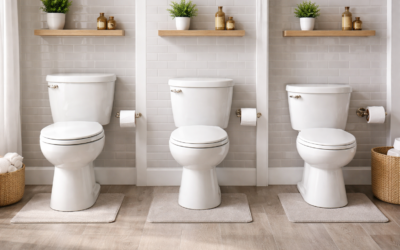
Buy a standard toilet for the wrong bathroom and it simply will not sit flat against the wall. A 10-inch rough-in toilet is built for floors where the drain center sits about 10 inches from the finished wall instead of the usual 12. You find it most often in older homes, small bathrooms and spots where a beam or joist forced the drain closer to the wall. The good choice is a toilet made specifically for 10 inches, and yes, elongated and one-piece versions exist. A 12-inch toilet will not fit, because its tank would hit the wall before the outlet lines up with the drain.
Part of our Bathroom Remodeling & Flooring guide — explore the full guide →
The selection is narrower than for standard toilets, so knowing what to measure and what trade-offs to expect saves you from a return trip. Here is how to confirm your rough-in, which styles are available and how to pick one that flushes well and fits the room.
- What a 10-Inch Rough-In Toilet Means
- Why Older Homes Have a 10-Inch Rough-In
- How to Measure Your Rough-In
- Why a 12-Inch Toilet Will Not Fit
- Elongated vs Round Bowl Options
- One-Piece vs Two-Piece
- Other Features Worth Comparing
- Installing a 10-Inch Rough-In Toilet
- Troubleshooting Fit and Leaks
- Cost and When to Call a Plumber
- Frequently Asked Questions
What a 10-Inch Rough-In Toilet Means
Rough-in is the distance from the finished wall behind the toilet to the center of the drain flange in the floor. Most toilets are made for a 12-inch rough-in, which became the common standard over decades of home building. Ten-inch and 14-inch rough-ins are the less common alternatives.
A toilet built for 10 inches places the outlet at the bottom of the bowl closer to the back of the tank. The tank itself is often slimmer front to back, or the bowl is shaped so that the tank clears the wall. The difference looks small on paper, but 2 inches is enough to keep a standard toilet from seating.
Why Older Homes Have a 10-Inch Rough-In
Several situations lead to a shorter rough-in:
- Older construction: Homes built before rough-in standards settled often used a variety of distances, and 10 inches shows up regularly in houses from the early and middle twentieth century.
- Framing conflicts: A floor joist, beam or girder sometimes sits where a 12-inch drain would go, so the plumber moved it closer to the wall.
- Thick finished walls: Adding furring strips, tile backer board and tile to the wall behind a toilet can shrink a 12-inch rough-in to about 11 inches. That case is a gray area with its own options.
- Tight bathrooms: In very small half baths, builders sometimes chose 10 inches to free up floor space in front of the bowl.
How to Measure Your Rough-In
Measure before you shop. It takes two minutes and prevents the most common mistake.
- If the old toilet is still installed, measure from the finished wall (not the baseboard) to the center of one of the bolt caps at the base of the toilet. Those bolts sit at the flange center.
- If the toilet is removed, measure from the finished wall to the center of the drain opening.
- Round to the nearest standard size. A reading between 9.5 and 10.5 inches means you need a 10-inch model. Between 11.5 and 12.5 means a standard 12-inch.
- Note any baseboard thickness and check whether the tank on your new toilet will clear it. Some tanks have a flat back and need a little gap.
If your measurement reads about 11 inches, you have options. Many 12-inch toilets have a tank that sits slightly away from the wall and will fit with an 11-inch rough-in, while a 10-inch model will leave a 1-inch gap behind the tank. Check the product’s spec sheet for the minimum clearance before choosing.
Why a 12-Inch Toilet Will Not Fit
It is tempting to assume a couple of inches does not matter. It does. On a 12-inch model, the outlet horn is set 12 inches forward of the tank back. Put that on a 10-inch drain and the tank presses into the wall while the outlet is still 2 inches short of the flange. You cannot compress the tank or shift the bowl, and the wax ring will not seal off-center.
Offset toilet flanges can move the drain connection forward by roughly an inch or two, and some plumbers use them to convert a 10-inch rough-in to accept a 12-inch toilet. They reduce the effective drain opening and can be more prone to clogs, though, and they only work if the floor and pipe layout allow. For most homeowners, buying a toilet made for the actual rough-in is the simpler and more reliable path.
Elongated vs Round Bowl Options
Both bowl shapes are available in 10-inch rough-in models, though the selection is smaller than for standard toilets.
Elongated bowls
A 10 rough in toilet elongated design adds about 2 inches of bowl length compared with a round bowl, typically around 18 to 19 inches from wall to bowl front at a 12-inch rough-in, and a bit less at 10 inches since the whole toilet sits closer to the wall. Most adults find elongated bowls more comfortable, and they are popular for primary bathrooms. Check that you still have the clearance your local code requires in front of the toilet, commonly at least 21 inches of clear space, and more is better.
Round bowls
Round bowls are shorter front to back, which helps in tight powder rooms. Because a 10-inch rough-in already brings the toilet closer to the wall, pairing it with a round bowl gives you the most free floor space. Round bowls also cost a little less on average.
If you are torn, measure from the wall to any door swing, vanity or opposite wall. If an elongated 10 inch rough in toilet still leaves comfortable knee room and the door clears it, choose comfort. If not, round is the practical pick.
One-Piece vs Two-Piece
A 10 inch rough in toilet one piece model fuses the tank and bowl into a single casting. That means no tank-to-bowl gasket and bolts to leak, and fewer crevices to clean. One-piece toilets often have a sleek, low profile and tend to cost more. They are also heavier and bulkier, which makes installation a two-person job.
Two-piece toilets are more common in the 10-inch category and offer the widest choice of flush systems and prices. If a part fails, you can replace the tank or bowl separately. For most budget remodels, a quality two-piece toilet gives the best value, while one-piece suits a bathroom where easy cleaning and a modern look matter most.
Other Features Worth Comparing
- Bowl height: Standard height is around 15 inches to the rim, while comfort or chair height runs about 17 to 19 inches and is easier for many adults to use.
- Flush performance: Look for independent flush testing scores, often listed as a gram rating for waste removal. Higher is better.
- Water use: Modern toilets use 1.6 gallons per flush or less, and high-efficiency models use about 1.28 gallons. Dual-flush options offer a smaller flush for liquids.
- Trapway: A fully glazed, larger-diameter trapway helps reduce clogs.
- Skirted design: A concealed trapway gives smooth sides that are easier to wipe down.
- Seat: Many toilets ship without a seat. A slow-close seat is a small upgrade that prevents slamming.
Installing a 10-Inch Rough-In Toilet
The installation process is the same as any floor-mount toilet. Shut off the water at the supply valve, flush to drain the tank, and sponge out the rest. Disconnect the supply line, remove the nuts at the base and lift the old toilet off. Scrape away the old wax ring and inspect the flange. If the flange is cracked, loose or below the finished floor, repair it or use a flange spacer before setting the new toilet.
Set new closet bolts, place a fresh wax ring or wax-free seal, and lower the toilet straight down so the bolts pass through the base. Press down evenly, then tighten the nuts alternately a little at a time. Overtightening can crack the porcelain. Attach the tank if it is a two-piece model, connect the supply line, turn the water on and check for leaks. Caulking around the base is common practice, though many installers leave a small gap at the back so any future leak becomes visible.
Troubleshooting Fit and Leaks
- Tank touches the wall: The rough-in is shorter than the toilet is rated for. Confirm your measurement and the model’s spec.
- Toilet rocks on the floor: Uneven flooring. Use plastic toilet shims, then caulk. Never rely on the bolts to pull a rocking toilet flat.
- Water at the base: Usually a failed wax seal or flange problem. Remove the toilet and reseat it with a new ring.
- Weak flush: Check the water level in the tank, the flapper seal and the rim jets for mineral buildup.
Cost and When to Call a Plumber
Expect 10-inch models to cost somewhat more than comparable 12-inch toilets because fewer are made. Budget two-piece versions may start in the low hundreds of dollars, while one-piece and premium flush models can climb considerably higher. Professional installation typically adds a few hundred dollars depending on your area.
Hire a licensed plumber if the flange is damaged, the drain needs to be moved, you suspect rot in the subfloor around the toilet, or you want to convert the rough-in with an offset flange. Moving a drain usually means opening the floor or ceiling below and may require a permit.
Frequently Asked Questions
Can I install a 12-inch toilet on a 10-inch rough-in?
Not directly. The tank will hit the wall before the outlet reaches the drain. An offset flange may help in some layouts, but buying a toilet made for 10 inches is usually the better solution.
Are elongated toilets available in a 10-inch rough-in?
Yes. Several elongated bowl designs are made for a 10-inch rough-in, though the selection is smaller than for standard toilets.
Can I put a 10-inch toilet on a 12-inch rough-in?
It will connect, but it leaves about a 2 inch gap behind the tank. It works functionally, though many people find the gap looks odd and collects dust.
How do I know if I have a 10-inch rough-in?
Measure from the finished wall to the center of the bolt caps or drain opening. A reading near 10 inches means you need a 10-inch model.
Do one-piece toilets come in a 10-inch rough-in?
Yes, a few one-piece models are made for this rough-in. They are easier to clean but usually cost more than two-piece options.