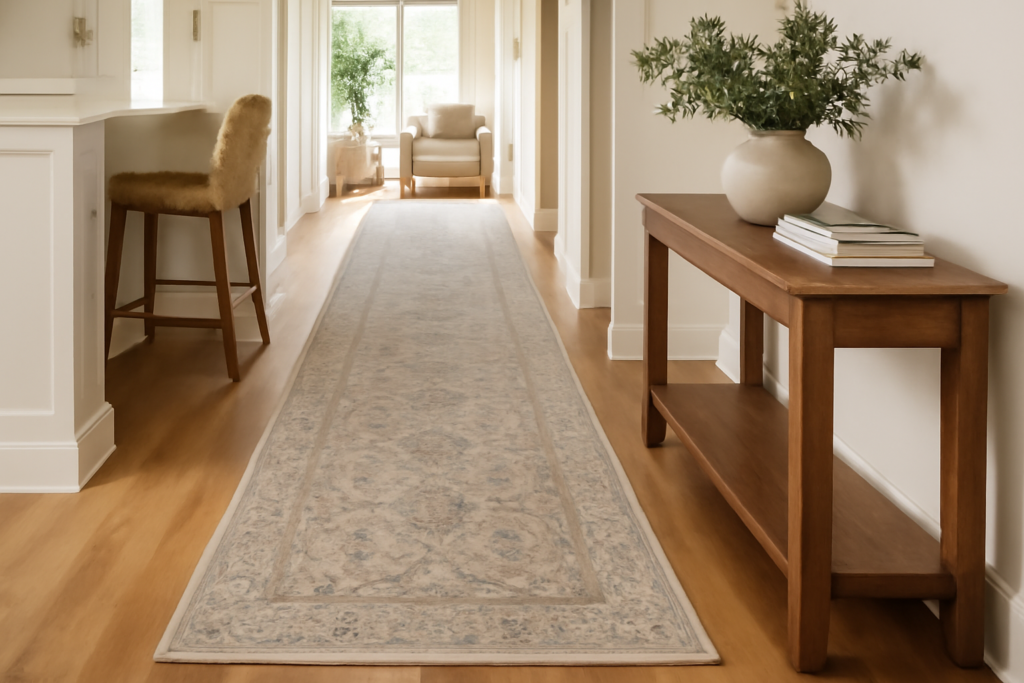
A 12 foot runner rug is one of the most practical decor pieces for long, narrow spaces, turning an empty hallway or kitchen galley into a warm, finished part of your home. At roughly the length of a typical hallway, this size strikes a balance between coverage and proportion that shorter runners often miss.
Choosing the right one means thinking about width, material, padding, and style together. This guide walks through where a 12-foot runner works best, how to size it correctly, and how to keep it looking good for years.
What a 12 Foot Runner Rug Is
A runner rug is a long, narrow rug designed for passageways rather than open rooms. The 12-foot length refers to the long dimension, while widths usually fall between about 2 and 3 feet. The most common sizes you will see are roughly 2 feet 6 inches by 12 feet and 3 feet by 12 feet, though exact measurements vary by maker.
The long, slim shape is what defines a runner. It is built to guide the eye and your steps down a corridor, soften footsteps, and add color to a space that furniture cannot fill. Twelve feet is a popular length because it covers a standard hallway without leaving large stretches of bare floor at either end.
Where a 12 Foot Runner Works Best
Hallways are the classic home for this size, especially longer corridors where a 6 or 8 foot runner would look stranded. The length also suits long entryways, mudrooms, and the path between rooms in an open layout.
In the kitchen, a 12-foot runner fits nicely down a galley or in front of a long run of counter and sink, where you stand most. It also works alongside a bed or down the center of a narrow den. The key is matching the runner to a space that is genuinely long and narrow, because in a wide or square room a runner can look undersized and out of place.
Getting the Size and Fit Right
Before buying, measure the space carefully. A runner should leave a border of bare floor on all sides so it frames the path rather than wall-to-wall carpeting it. A common guideline is to leave roughly 4 to 5 inches of floor visible on each long side and several inches at each end.
- Measure the length and width of the hallway or area at its narrowest point.
- Subtract about 8 to 10 inches from the width to find your ideal runner width.
- Confirm the 12-foot length leaves a few inches to a foot of clearance at each end.
- Account for doors that swing into the space so the rug does not block them.
If your hallway is longer than 12 feet, you can place two runners end to end with a small gap, or look for a longer custom length. If it is shorter, a 12-foot runner may bunch or curl at the ends, so size down instead.
Choosing the Right Material
Because runners live in busy, high-traffic zones, durability matters more than in a formal living room. Wool is a premium natural choice, resilient and naturally stain-resistant, though it costs more. Synthetic fibers like polypropylene and nylon are affordable, tough, and easy to clean, which makes them well suited to entryways and kitchens where spills and grit are common.
Flat-woven and low-pile rugs are easier to vacuum and let doors clear them, while a slightly higher pile feels softer underfoot. For kitchens and entries, consider a machine-washable runner or an indoor-outdoor synthetic that shrugs off moisture. Natural fibers like jute and sisal add texture but can be rough and harder to clean, so weigh comfort against the look you want.
Padding and Keeping It in Place
A long runner in a high-traffic hallway will shift and bunch without a rug pad. A non-slip pad cut to size grips the floor, prevents slipping hazards, cushions each step, and extends the life of the rug by reducing wear. Choose a pad type suited to your flooring, since some materials can mark or discolor certain finishes over time.
For extra hold on hard floors, double-sided rug tape at the corners and along the edges helps, and it is especially worth using at the ends where toes tend to catch. On carpet, a pad designed for carpet-over-carpet use keeps the runner from creeping. Re-straighten the rug periodically and rotate it end to end every few months so it wears evenly.
Styling a Long Runner
A 12-foot runner is a chance to add pattern and color to a space that is often plain. In a narrow hallway, a busy pattern hides everyday dirt and footprints better than a solid color, which is a practical bonus. Stripes running lengthwise can make a corridor feel even longer, while a bold medallion or vintage pattern adds character.
Tie the runner to nearby colors, such as wall paint, trim, or an adjacent room’s rug, so the space feels cohesive. In an open layout, repeating a color from a larger area rug links the spaces together. Keep scale in mind: a small repeating pattern reads as texture from a distance, while a large motif makes a statement underfoot.
Care and Maintenance
Regular care keeps a hallway runner looking fresh despite constant foot traffic. Vacuum at least weekly, and more often in entryways where grit gets tracked in, since dirt grinds against fibers and wears them down. Blot spills promptly rather than rubbing, and follow the manufacturer’s cleaning guidance for the specific fiber.
Many synthetic and washable runners can be spot-cleaned or laundered, while wool and natural fibers may need gentler treatment or occasional professional cleaning. Rotating the rug and using a quality pad both slow wear in the spots that get the most steps. With the right material, a good pad, and routine care, a 12 foot runner rug stays a comfortable, attractive feature of your home for many years.
Budget and Buying Tips
Prices for a 12-foot runner span a wide range depending on fiber and construction. Machine-made synthetic runners are the most affordable, often the right pick for kitchens and entries where the rug takes a beating and may need replacing every few years. Hand-knotted wool runners sit at the top of the range and can last decades with care, so think about how long you want the piece to last and how much traffic it will see.
When you shop, check the actual listed dimensions rather than relying on the rounded “12 foot” label, since some runners measure 11 feet 6 inches or 12 feet 6 inches. Read the pile height if door clearance is tight, and look for a low-VOC or washable label if the runner is going in a kitchen or a home with kids or pets. Buying a matching rug pad at the same time saves a return trip and ensures the pad is cut slightly smaller than the rug so it stays hidden. A little planning up front means the runner fits, lies flat, and earns its place from the day it arrives.