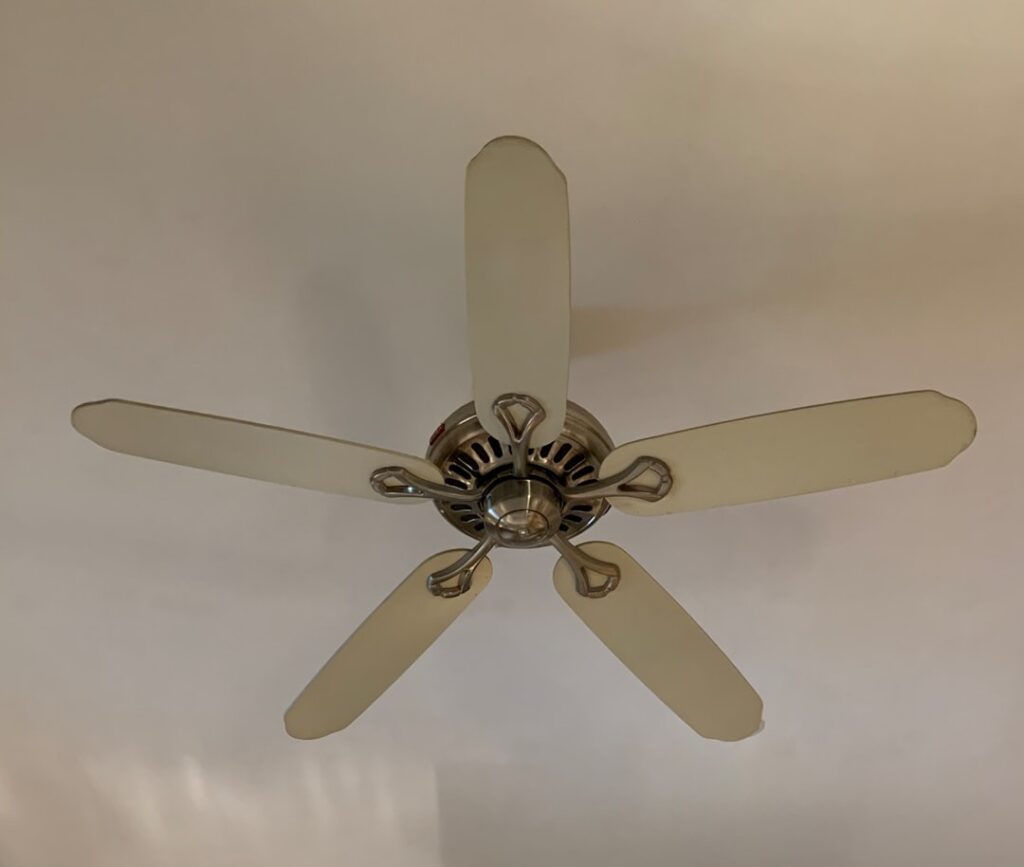
Fan sizing mistakes run in both directions: a 52-inch fan crammed into a 10×10 office looms like a helicopter, while a 42-inch fan lost in a great room just stirs the air politely. The 42 inch ceiling fan is the small-room specialist — the right tool for bedrooms, offices, kitchens, and nurseries up to roughly 144 square feet — and this guide covers exactly which rooms it fits, what airflow you can realistically expect, the picks worth buying, and how to pair it with the right downrod for your ceiling height.
Where 42 Inches Actually Fits
Fan size is measured as blade sweep — the diameter of the circle the blades cut. The industry sizing ladder:
| Room size | Typical rooms | Recommended fan |
|---|---|---|
| Under 50 sq ft | Hall nook, walk-in closet, powder room | 29–36″ |
| 50–75 sq ft | Small office, nursery | 36–42″ |
| 75–144 sq ft | Bedrooms to ~12×12, kitchens, home offices | 42–48″ |
| 144–225 sq ft | Master bedrooms, living rooms | 50–54″ |
| 225–400 sq ft | Great rooms | 56–72″ |
So the 42-inch sweet spot is the 10×10 to 12×12 room. Beyond square footage, check clearances: blades need 18 inches minimum (24 preferred) from walls and sloped-ceiling surfaces, which is often what forces a 42 over a 52 in rooms with closets, bump-outs, or angled walls. In galley and small kitchens where a full-size fan would fight cabinet doors and pendants, the 42 class is usually the answer — our kitchen ceiling fans guide covers that room’s quirks, including grease and airflow over cooktops.
CFM: What to Expect and What to Demand
CFM (cubic feet per minute on high) is the number that matters more than diameter, and 42-inch fans span an enormous quality range:
- Budget 42″ fans: 1,500–2,500 CFM. Adequate for a nursery or office where you want gentle circulation, marginal for actually cooling a sleeping adult in July.
- Good 42″ fans: 2,500–4,000 CFM. The target zone. This genuinely cools a 12×12 bedroom — a fan’s wind-chill effect makes a room feel 4°F cooler or more at the same thermostat setting.
- Exceptional small fans (DC motors): 4,000+ CFM. Modern DC-motor compacts punch far above their sweep and sip 20–30 watts on high versus 60–75 for old AC motors.
Every fan sold in the US publishes CFM and efficiency (CFM/watt) on its Energy Guide label — read it, and be suspicious of any listing that hides it. Also check blade pitch: 12–15° pitch moves air; the 8–10° pitch on decorative bargain fans is why they spin fast and cool nothing.
Top Picks in the 42-Inch Class
- Best overall value — Hunter 42″ Dempsey (~$150–190). Low-profile or standard mount, DC-ish quiet AC motor, handsome minimal design, remote included, roughly 3,000 CFM. Hunter’s warranty support is the quiet advantage.
- Budget pick — Harbor Breeze Mazon 44″ or Armitage 42″ (~$60–100). Lowe’s house brand; the Mazon’s flush-mount design is a small-room staple. Airflow is modest (about 1,900–2,200 CFM) but the price is right for guest rooms. Note that parts and remotes are proprietary — our Harbor Breeze ceiling fan parts guide is worth bookmarking if you go this route.
- Performance pick — Minka-Aire or Modern Forms 42–44″ DC smart fans (~$250–400). 4,000+ CFM from a compact sweep, 6-speed DC motors, app/voice control, and near-silence. The pick for the master-adjacent office or a hot-climate small bedroom.
- Style pick — 42″ caged or windmill designs (Hunter, Progress, ~$180–300). Farmhouse looks scaled to small rooms; verify CFM, as some style-first models dip below 2,500.
- With light kit: most of the above offer integrated dimmable LED versions — in a small bedroom the fan usually is the main light, so insist on dimmable and 2700–3000K.
Downrod Pairing: The Height Math
Blade height above the floor drives both safety and performance: code minimum is 7 feet, and the airflow sweet spot is 8–9 feet. Work backward from your ceiling:
| Ceiling height | Mount style | Downrod length |
|---|---|---|
| 8 ft | Flush/hugger mount | None |
| 9 ft | Standard mount | Included 3–6″ |
| 10 ft | Downrod | 12″ |
| 11 ft | Downrod | 18″ |
| 12 ft | Downrod | 24″ |
| Sloped/vaulted | Angled canopy + downrod | Sized to clear the slope |
Two cautions. First, hugger mounts trade airflow for clearance — blades tight to the ceiling can’t pull air from above, costing roughly 15–25% of effective circulation, so only go flush when 8-foot ceilings force it. Second, downrod threading and diameter are brand-specific; buy the same brand as the fan. Our full ceiling fan downrod guide covers sloped-ceiling angles and extra-long runs.
Installation Notes for Small Rooms
- Fan-rated box, always. The existing light’s plastic box is not rated for a rotating 15–20 lb appliance. A $20 retrofit fan brace installs through the existing hole in 20 minutes.
- Balance matters more in small rooms — you’re closer to the fan, so a 1/8″ blade-height mismatch you’d never notice at 56″ reads as wobble at 42″. Use the included balancing kit; it takes ten minutes.
- Remote vs. pull chain: in bedrooms, pay the $20–30 for a remote or wall control. Nobody wants to stand up under a spinning fan at midnight to change speeds.
- Reverse switch for winter: run blades clockwise on low in cold months to push warm ceiling air down the walls — a real thermostat saver in rooms with 9-ft-plus ceilings.
Mistakes to Avoid
- Buying by looks and skipping the CFM line. The prettiest 42″ fan at 1,600 CFM will disappoint every July night.
- Upsizing “to be safe” in a tight room. A 52″ fan with 19 inches to the nearest wall is both a code-clearance problem and a visual one.
- Flush-mounting under a 9-foot ceiling. You’re giving away airflow for clearance you don’t need.
- Ignoring sound ratings for bedrooms. AC motors hum on speed controls; DC motors are effectively silent. Light sleepers should pay the DC premium.
- Forgetting the light lumens: if the fan light is the room’s only fixture, you want 1,500+ lumens dimmable — check before buying, because fan light kits vary wildly.
Operating Cost and the Thermostat Payback
A 42-inch fan is one of the cheapest appliances in the house to run. At the national average of about 16 cents per kWh:
| Motor type | Watts on high | Cost per 8-hour night | Cost per cooling season (nightly use) |
|---|---|---|---|
| Typical AC motor | 50–65 W | 6–8 cents | $8–12 |
| DC motor | 15–25 W | 2–3 cents | $3–5 |
The payback comes from the thermostat: because moving air feels roughly 4°F cooler on skin, running the fan lets you set the AC 3–4 degrees higher at equal comfort, and each degree of setback trims cooling costs by roughly 3%. A household that raises the summer setpoint from 72 to 75 with fans running typically saves $10–20 a month — meaning even a $250 DC fan pays for itself over a few summers, and a $150 fan almost immediately.
The corollary rule most people miss: fans cool people, not rooms. The wind-chill effect only works on skin, so a fan spinning in an empty room is pure waste. Turn it off when you leave — or buy one of the smart models with occupancy timers that do it for you. Used that way, the 42-inch fan is arguably the highest-ROI comfort purchase in a small room’s entire budget.
FAQ
What size room is a 42 inch ceiling fan good for?
Rooms from about 75 to 144 square feet — up to roughly 12×12. Smaller than that, consider 36″; larger, step up to 50–52″.
How many CFM should a 42 inch fan have?
Aim for 2,500–4,000 CFM on high. Under 2,000 is circulation, not cooling; DC-motor models above 4,000 are the class overachievers.
Can a 42 inch fan cool a bedroom?
Yes — in a typical 11×12 bedroom, a good 3,000+ CFM 42″ fan produces enough wind-chill to feel several degrees cooler, letting you raise the AC setpoint a few degrees.
Do 42 inch fans come with lights?
Most models offer an integrated LED version. Choose dimmable 2700–3000K kits for bedrooms; add a wall dimmer-compatible control or remote for real usability.
Measure the room, demand the CFM number, mount the blades at 8–9 feet, and the 42-inch class will quietly out-perform every oversized fan wedged into a room it never fit.