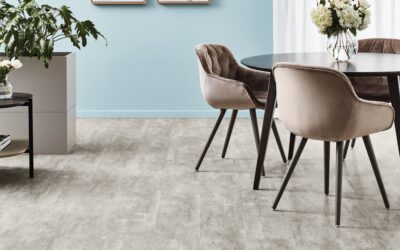
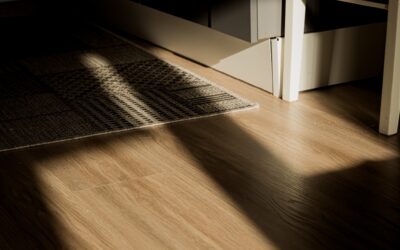
Walk a Floor & Decor aisle and the cheapest click planks on display are almost always 4mm thick. 4mm vinyl flooring is the entry point of rigid LVP, sitting between flexible 2mm glue-down and the 5mm to 8mm SPC and WPC products that dominate mid-tier sales. At $1.50 to $3 per sq ft, it’s the budget that makes whole-house vinyl projects fit a $4,000 cap, but the thickness comes with trade-offs that matter for some rooms and not others.
What 4mm Actually Means
4mm refers to total plank thickness, not the wear layer. A typical 4mm plank breaks down as 0.3mm wear layer, 0.5mm decorative film, and 3.2mm rigid core (either SPC or WPC). The wear layer is the only part that resists scratches and scuffs; the core handles dent resistance and dimensional stability. Many 4mm budget products include a thin 1mm IXPE foam underlay attached to the back, which makes total stack 5mm but doesn’t change the structural performance.
Compared to 5mm or 6mm rigid vinyl, the 4mm version uses less raw PVC, less stone or wood-plastic composite filler, and a thinner click joint. Each of those compromises shows up somewhere in real-world performance.
Realistic 4mm Vinyl Flooring Pricing
Big-box brands like LifeProof, TrafficMaster, and Home Decorators Collection offer 4mm SPC at $1.50 to $2.40 per sq ft. Floor & Decor stocks NuCore Performance and similar lines at $1.79 to $2.99. Online sellers like Build Direct and LL Flooring carry 4mm products from $1.49 to $2.69. Installed pricing through retailers runs $4 to $6 per sq ft including basic prep, glue if applicable, and trim. DIY install adds $0.20 to $0.40 per sq ft for underlay, transitions, and tools.
For a 1,000 sq ft project, expect $1,500 to $2,800 in materials, $200 to $400 in extras and underlay, and another $2,500 to $4,000 in labor if hired out. DIY total: $1,800 to $3,200.
Pros That Hold Up in Real Use
For its price point, 4mm vinyl flooring delivers more than expected. The rigid core makes it 100% waterproof; spills, mop water, and pet accidents wipe up without any subfloor risk. Click-lock installation is genuinely DIY-friendly; a homeowner with a tapping block, pull bar, and patience can lay 250 sq ft in a long Saturday. Modern decorative films print convincing wood and stone visuals that look indistinguishable from $5 per sq ft products at three feet of viewing distance. And replacement is straightforward; one damaged plank can usually be popped out and swapped without disturbing surrounding boards.
- Waterproof: rigid core handles flooding and standing water
- DIY-friendly: click systems install without nails, glue, or staples
- Affordable: $1.50 to $3 per sq ft fits tight budgets
- Pet-tolerant: resists scratches better than laminate at the same price
Where 4mm Falls Short
The thinner core telegraphs subfloor imperfections more than thicker products. A 1/8-inch hump or dip that 6mm SPC bridges will show through 4mm and create visible flex underfoot. Click joints on 4mm planks are smaller and more fragile; aggressive snap-together installation can chip the locking edge and create gaps that won’t reseal. Sound transmission is louder than thicker products; expect noticeable hollow tap when walking in socks. And the thin wear layer (often 6 mil to 12 mil) wears through faster in commercial-traffic environments.
Refinishing isn’t possible. When the wear layer scuffs through, the only fix is replacement. That’s true of all vinyl flooring, but the timeline arrives sooner with thinner wear layers.
Best Rooms for 4mm Vinyl
Bedrooms, closets, dens, and home offices are ideal. Foot traffic is moderate, sound transmission matters less, and the budget savings free up money for thicker flooring elsewhere. Rental properties and flips also benefit; the cost-per-year math works as long as the floor lasts 8 to 12 years between turnovers. Basement family rooms work if the slab is dead flat and dry; otherwise, step up to 5mm or 6mm with thicker underlay.
Skip 4mm in kitchens with frequent appliance moves (refrigerators on rollers chew up thin click joints), entryways with grit traffic, and any space where a chair gets dragged across the floor regularly. The wear layer simply isn’t built for that abuse.
Subfloor Prep for Thinner Planks
Flatness tolerance for 4mm vinyl flooring is tighter than for thicker products. Aim for less than 3/16 inch deflection over a 10-foot span, ideally less than 1/8 inch. Use self-leveling compound on concrete, sand high spots, and replace deteriorated plywood. Skip the temptation to put 4mm vinyl over old vinyl or ceramic tile without verifying flatness with a 6-foot straightedge; old grout lines and tile lippage will telegraph through within months.
Underlay is critical. Many 4mm products include 1mm of pre-attached IXPE foam, which is enough on a flat slab. Adding a separate underlay creates double-cushion and voids most warranties. Verify the manufacturer spec before adding any extra padding.
How 4mm Compares to Thicker Vinyl
5mm SPC ($2.50 to $4 per sq ft) adds dent resistance, better sound dampening, and slightly larger click joints. 6mm to 8mm WPC and SPC ($3 to $6 per sq ft) deliver real-feel underfoot, full-thickness embossing, and warranty terms up to 30 years. The price step from 4mm to 5mm is small (often $0.50 per sq ft) but the performance improvement is significant. If your budget can stretch, 5mm hits the sweet spot for whole-house projects.
Against laminate at the same price, 4mm vinyl wins on water resistance and ease of replacement but loses on sound (laminate feels firmer underfoot) and on visual depth in some patterns.
Smart Buying Tips for 4mm Vinyl
Always grab three samples and live with them in the room for a week. Lighting changes everything; an oak that reads warm in the showroom can look orange under cool LEDs. Check the wear-layer mil rating (10 mil minimum, 12 mil ideal for residential), the warranty length (15-plus years for residential, 5 to 10 for light commercial), and the F-rating for formaldehyde emissions if you’re sensitive to indoor air quality. Order 8% to 10% extra for waste; 4mm planks chip during cuts more than thicker products, raising the actual usable yield.
Time purchases around major sales (Black Friday, Memorial Day, Labor Day). Discounts run 15% to 25% on national chains during those windows. Check clearance bins for discontinued patterns; the wear layer and core are the same on a discontinued plank as on the current-line equivalent, but the price often drops 30% to 40%.
Prefer to explore on your own?
See how new flooring looks in your actual room in seconds — free, no signup.
Try the free Floor Studio →