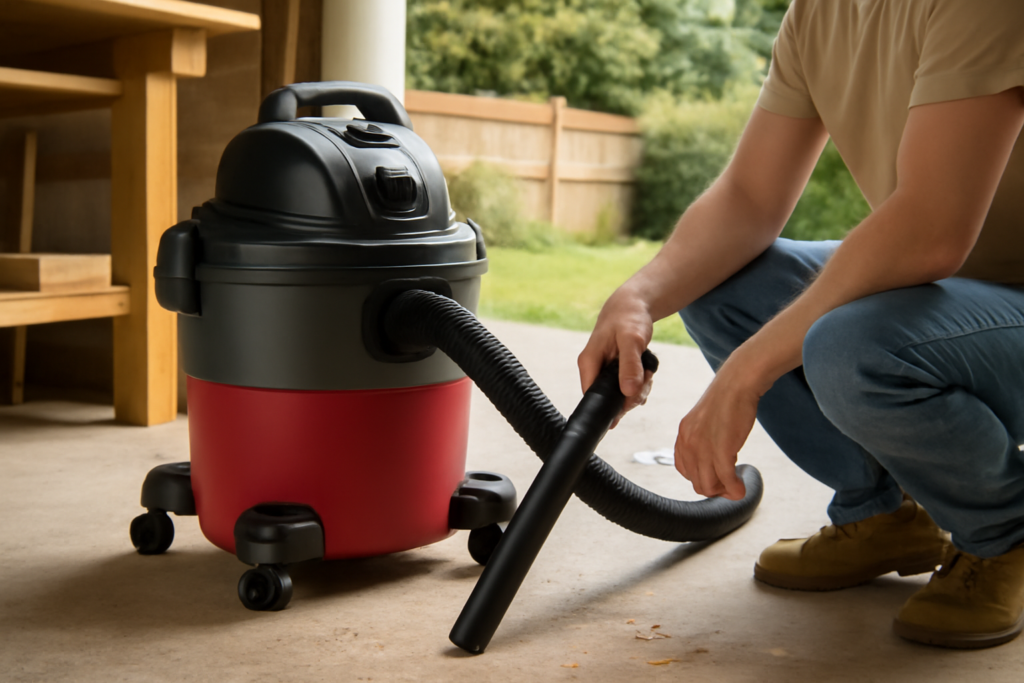
Plenty of homeowners buy the biggest wet/dry vacuum on the shelf and then leave it in the garage because it is too bulky to drag up the stairs. A 5 gallon shop vac sits in the sweet spot for most households: large enough for a flooded laundry room, a car interior or the dust from a small tile job, yet light enough to carry with one hand and store on a shelf.
For typical home use, 5 gallons is big enough. It handles spills, car and stair cleanup, workshop sawdust and small demolition debris without constant emptying. Where it falls short is large water removal, whole-room drywall or flooring tear-outs, and all-day jobsite work. Those are the jobs that justify a 12 or 16 gallon tank.
- What a 5 Gallon Shop Vac Handles Well
- Tank Size Comparison: 2.5 vs 5 vs 12 vs 16 Gallons
- Reading the Specs: Peak HP, CFM and Water Lift
- Filters and Accessories That Make It Work Better
- Home Jobs That Outgrow a 5 Gallon Tank
- Troubleshooting Weak Suction and Other Problems
- Typical Cost Ranges
- When to Call a Pro
- Frequently Asked Questions
Next come tank size comparisons, explains what the numbers on the box mean, and lists the home jobs that outgrow a compact unit.
What a 5 Gallon Shop Vac Handles Well
The real capacity is less than the label. A 5 gallon tank holds a bit less than 5 gallons of usable liquid because the float shutoff trips before the tank is completely full, and a filter full of fine dust reduces airflow long before the drum is packed. Still, that is plenty for most tasks around a house.
- Spills and small leaks: an overflowing washing machine, a leaking water heater drain pan or a spilled bucket usually amounts to a few gallons at most.
- Car cleaning: seats, floor mats, trunk liners and door pockets. The small footprint fits in a garage bay next to the car.
- Stairs and tight spaces: light enough to carry step by step, with a short hose that reaches corners.
- Workshop sawdust: cleanup after cutting trim, sanding a small table or drilling into masonry.
- Small demo: pulling one bathroom’s worth of old floor tile, scraping thinset, or cleaning up after cutting a vanity countertop.
- Seasonal chores: fireplace ash (only when completely cold and with a fine-dust filter), window tracks, gutters reached from a ladder with a gutter kit, and dryer vent lint.
People searching for the best compact shop vac are often after exactly this range of chores. A 5 gallon vacuum is the most practical middle ground between a tiny 2.5 gallon unit and a garage-bound drum.
Tank Size Comparison: 2.5 vs 5 vs 12 vs 16 Gallons
| Tank size | Best for | Main tradeoff |
|---|---|---|
| 2.5 gallons | Car detailing, quick spills, small apartment storage | Fills fast; usually lower suction |
| 5 gallons | General home use, stairs, small projects | Frequent emptying on big water jobs |
| 12 gallons | Garage and workshop, mid-size remodels | Heavier, bigger to store |
| 16 gallons | Flooded basements, whole-room demo | Bulky, hard on stairs |
2.5 Gallon Units
These are handheld or shoulder-strap models. They are fine for a car or a quick spill but can fill in one pass on a larger mess, and many have smaller motors. If you own one and keep running out of room, stepping up to 5 gallons is a noticeable upgrade without giving up portability.
12 and 16 Gallon Units
Big drums move more air and hold much more, which matters when you are pulling water out of a basement or clearing construction debris from several rooms. A 16 gallon unit full of water weighs over 100 pounds, though, so you empty it with a drain port rather than by lifting. They also take a lot of floor space and are awkward on stairs.
Reading the Specs: Peak HP, CFM and Water Lift
The box usually leads with peak horsepower, which is the least useful number. It reflects a momentary motor rating, not sustained performance. Two specs tell you more:
- Airflow (CFM): cubic feet per minute of air moved. Higher airflow picks up light, bulky debris like sawdust and leaves. Many 5 gallon models land roughly in the 70 to 110 CFM range.
- Water lift (sealed suction): measured in inches, it shows how hard the vacuum pulls. Higher water lift helps with heavy debris and pulling water out of carpet. Figures around 45 to 70 inches are common in this class.
Hose diameter matters as well. A 1.25 inch hose is flexible and fits crevice tools, while a 1.875 or 2.5 inch hose passes larger debris without clogging. Many compact vacuums ship with a 1.25 or 1.5 inch hose; check whether a larger hose is available if you plan any demo work.
Noise is worth noting. Shop vacuums commonly run in the 75 to 90 decibel range, so hearing protection is a good idea for longer sessions, and the smallest units are not always the quietest.
Filters and Accessories That Make It Work Better
A compact vacuum lives or dies by its filter. The right setup keeps suction strong and keeps fine dust in the tank instead of blowing it around the room.
- Cartridge filter: the standard pleated filter for general dry debris. Tap it clean often.
- Fine-dust or HEPA-rated filter: use this for drywall dust, concrete dust, ash and sanding. Standard filters let fine particles pass through.
- Collection bag: a bag inside the tank captures fine dust, protects the filter and makes emptying much cleaner.
- Foam sleeve for wet work: remove the paper cartridge before picking up water, or it will turn to mush. A foam sleeve protects the motor.
- Cyclone or bucket separator: a lid that sits on a separate bucket catches most heavy debris before it reaches the vacuum, stretching the usable capacity of a small tank a great deal on dusty jobs.
For concrete, tile or grout work, fine silica dust is a health hazard. Use a fine-dust filter with a bag, wear an N95 or better respirator, and prefer wet cutting so less dust becomes airborne in the first place.
Home Jobs That Outgrow a 5 Gallon Tank
Some projects will have you emptying the tank every few minutes. That is the sign to rent or buy bigger:
- Flooded basements or crawlspaces: anything more than a few gallons of standing water. A 5 gallon unit can take a lot of trips; a submersible pump or a large wet vacuum is faster.
- Carpet or flooring tear-outs across multiple rooms: pad crumbs, staples and old underlayment fill a small tank quickly.
- Drywall demolition: bulky chunks and huge volumes of dust. Use a larger drum with a separator and bag.
- Whole-floor sanding cleanup: refinishing hardwood produces far more dust than a compact tank can hold between emptying.
- Daily contractor use: tank size, hose diameter and motor duty cycle all favor larger machines.
Many households own a 5 gallon unit for everyday use and rent a larger machine for the one or two big projects each year. That combination costs less and takes up less space than owning a 16 gallon drum you seldom use.
Troubleshooting Weak Suction and Other Problems
- Suction drops quickly: the filter is clogged. Tap it clean outside, use a bag for fine dust, or swap to a spare filter.
- Motor shuts off during wet pickup: the float has risen and closed. Empty the tank; the float is doing its job.
- Dust blowing out the exhaust: the filter is torn, not seated, or not rated for fine dust.
- Hose clogs: the debris is too large for a 1.25 inch hose. Pick up big pieces by hand or switch to a wider hose.
- Bad smell: the tank was stored wet. Rinse the tank, wash or replace the foam sleeve, and let everything dry fully with the lid off.
For safety, never vacuum flammable liquids, gasoline vapors or hot ash, and keep the cord and motor away from standing water. Plug into a GFCI-protected outlet when working around water, and unplug before changing filters.
Typical Cost Ranges
Compact 5 gallon wet/dry vacuums generally cost from the mid double digits to around a couple hundred dollars, depending on motor size, noise level, hose diameter and included accessories. Replacement filters and bags are a modest ongoing cost; plan to keep one spare filter on hand so a clogged cartridge does not stop the job. Renting a large wet vacuum or water extractor for a day typically costs less than buying a big drum you will use once.
When to Call a Pro
A shop vacuum is a cleanup tool, not a water mitigation system. Call a water damage restoration company if standing water covers more than a small area, if water has soaked into drywall, subfloor or insulation, or if the source is sewage. Wet materials left more than a day or two can start growing mold, and a professional crew brings pumps, moisture meters and drying equipment. For suspected asbestos in old flooring or ceiling material, do not vacuum debris at all; have it tested and handled by a licensed abatement contractor.
Frequently Asked Questions
Is a 5 gallon shop vac big enough for home use?
Yes, for most households. It covers spills, cars, stairs, workshop dust and small demo. Larger water removal and multi-room tear-outs are where a bigger tank pays off.
How much water can a 5 gallon vacuum actually hold?
Somewhat less than 5 gallons, because the float shutoff stops suction before the tank is completely full. Expect to empty it after roughly 3 to 4 gallons of water.
Should I get a 5 gallon or 12 gallon shop vac?
Choose 5 gallons if you carry it around the house and store it on a shelf. Pick 12 gallons if it stays in the garage and handles frequent remodel or workshop debris.
Can I use a 5 gallon shop vac for drywall dust?
For small patches, yes, with a fine-dust filter and a collection bag. For large drywall jobs, a bigger tank with a dust separator works much better.
Do I need to remove the filter to pick up water?
Remove a paper cartridge filter before wet pickup, and use a foam sleeve if the manual calls for one. Let everything dry before reinstalling the cartridge for dry work.
Is CFM or peak horsepower more important?
Airflow (CFM) and water lift tell you far more about cleaning ability than peak horsepower, which is a momentary rating.