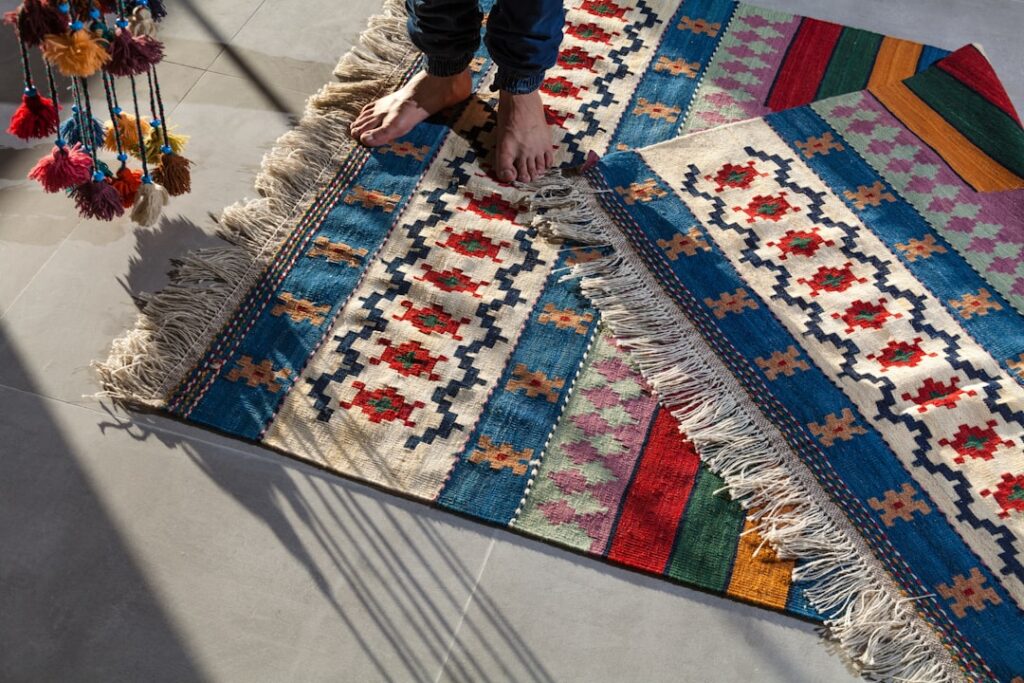
Big rooms swallow standard rugs. Drop a common 8-by-10 into a 20-foot great room and it floats in the center like an island, leaving your furniture stranded on bare floor. An 8×13 rug solves that awkward scale problem, measuring a full 8 feet wide by 13 feet long, which is roughly 104 square feet of coverage, enough to anchor a large sectional, a generous dining set, or an open-concept living zone that shorter rugs leave looking unfinished.
This guide covers the exact dimensions, where the size works, how to place your furniture on it, and what to spend so you buy the right rug once.
Exactly How Big Is an 8×13 Rug
The name is literal: 8 feet on the short side and 13 feet on the long side, or 96 inches by 156 inches. That elongated proportion, close to a 1-to-1.6 ratio, suits rooms that are longer than they are wide, like a rectangular living room or a combined living-and-dining space.
Before you buy, measure your room and mark the rug footprint with painter’s tape on the floor. Leave 12 to 18 inches of bare flooring between the rug edge and the walls so the room still breathes. In a tight space, an 8×13 rug can crowd the walls and make the floor look smaller, so this size rewards rooms of at least 12 by 17 feet.
Where an 8×13 Rug Fits Best
This size earns its keep in a handful of specific rooms. Knowing where it shines saves you from ordering something too large for the space.
- Large living rooms — big enough to slide the front legs of a full sofa and two chairs onto the rug, tying the seating group together.
- Formal dining rooms — a rectangular table that seats eight to ten sits comfortably, with room to pull chairs back without catching the edge.
- Open-concept great rooms — defines a seating zone within a larger space so the furniture reads as one intentional grouping.
- Primary bedrooms — runs under a king bed and extends past the foot, giving warm footing on three sides.
Furniture Placement That Works
The size only looks right if your furniture relates to it correctly. There are three placement approaches, and the one you pick depends on the room.
- All legs on — every piece of furniture sits fully on the rug. This is the most luxurious look and needs the most space around the grouping.
- Front legs on — the front legs of sofas and chairs rest on the rug while the backs sit on the floor. This is the most common and forgiving arrangement for living rooms.
- Floating — used mainly under coffee tables or beds, where the rug frames a central piece.
For a dining room, the rule is simpler. Make sure the rug extends at least 24 inches beyond every side of the table so chair legs stay on the rug even when guests push back to stand. With an 8×13 rug, a table up to about 44 inches wide and 9 feet long fits that rule.
Choosing the Right Material
Material drives durability, feel, and price more than any other factor. Match it to the room’s traffic and your tolerance for maintenance.
Wool is the premium natural choice, naturally stain-resistant, springy underfoot, and good for 20-plus years in a living room. Expect it to sit at the top of the price range. Synthetic fibers like polypropylene and polyester cost far less, shrug off spills, and clean easily, which makes them smart for homes with kids, pets, or a busy dining room where food lands on the floor. Natural fibers like jute and sisal bring texture and a casual look but scratch underfoot and struggle with spills, so keep them out of dining zones.
Pile height changes both the look and the practicality of a large rug. Low-pile rugs, under 1/4 inch, let dining chairs slide easily and vacuum in seconds, which is exactly what you want under a table. High-pile and shag styles, 3/4 inch and up, feel plush in a bedroom or a lounge but trap crumbs and fight chair legs, so save them for low-traffic rooms.
For a versatile 8×13 rug that covers a living room, a medium pile around 1/4 to 1/2 inch strikes the balance, soft enough to enjoy barefoot and shallow enough to clean without a struggle.
Don’t Skip the Rug Pad
A rug this large will creep and wrinkle without a pad underneath, and the pad does more than stop slipping. It cushions the rug, protects your floor from grit, and extends the rug’s life by absorbing foot traffic. Buy a pad cut about 1 inch smaller than the rug on each side, so an 8×13 rug takes roughly a 7-foot-10 by 12-foot-10 pad.
On hard floors, choose a felt-and-rubber pad for grip and cushion. Over carpet, a thin, firm pad keeps the rug from shifting. Budget $40 to $120 for a quality pad in this size, and never reuse a cheap foam one that will crumble and stain the floor within a year.
What an 8×13 Rug Costs
Prices swing widely with material and construction. Machine-made synthetic rugs in this size start around $150 to $400, which is a sensible pick for a family room or a rental. Hand-tufted wool typically runs $600 to $1,500, and hand-knotted or designer pieces can climb past $3,000.
Because this is a large, room-anchoring investment, factor in delivery and the near-certainty that you will keep it for a decade or more. Order a swatch or check the return policy before committing, since a rug this size is a chore to ship back. Measure twice, tape out the footprint, and an 8×13 rug will pull a big room together in a way that no smaller size can.
Caring for a Large Rug
Keeping a rug this big looking good comes down to a simple routine. Vacuum weekly in high-traffic areas, but drop the beater bar or switch to a suction-only setting on wool and delicate weaves, since aggressive brushing frays the fibers over time. Rotate the rug 180 degrees every six months so foot traffic and sunlight wear it evenly rather than carving a path down one side.
Blot spills immediately with a clean cloth, working from the outside in so you do not spread the stain, and skip harsh cleaners that strip natural fibers. For a deep clean, most wool and synthetic rugs benefit from professional cleaning every one to three years. A quality rug pad underneath does a lot of quiet work here too, letting air circulate and grit fall through instead of grinding into the backing.
Common Sizing Mistakes to Avoid
The biggest error is buying by the number instead of the room. An 8×13 rug is generous, and in a space under 12 by 17 feet it can swallow the floor and leave no breathing room at the edges. Always tape out the footprint first.
Another frequent slip is choosing a rug too small for the furniture it anchors, which happens when people default to an 8×10 out of habit. If your sofa and chairs leave the rug looking like a postage stamp, size up. Finally, resist matching the rug too tightly to the wall color; a little contrast defines the space, while a rug that blends into the floor makes the whole room read flat. Get the scale right and the rest of the room falls into place around it.