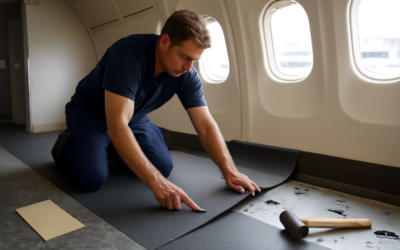
Picking aerospace flooring is nothing like picking a kitchen tile. Hangar floors face dropped wrenches, hot brake debris, jet fuel spills, and rolling jacks loaded with multi-ton airframes. Cleanroom and avionics floors layer in static dissipation, particle control, and chemical resistance to solvents like MEK and trichloroethylene. The right system can run 25 years; the wrong one fails inside 18 months and grounds revenue. This guide covers the categories, certifications, and pricing that actually matter when specifying flooring for hangars, MROs, and aerospace cleanrooms.
- Where Aerospace Flooring Gets Used
- Material Categories That Meet Aerospace Specs
- FAA, NFPA, and Industry Standards
- Pros of a Properly Specified System
- Cons and Common Failure Modes
- Top Manufacturers in the Sector
- Installation Steps and Timelines
- Maintenance Best Practices
- Common Specification Mistakes
- Realistic Project Pricing
- Bottom Line
Where Aerospace Flooring Gets Used
Three primary environments dominate. Hangars and MRO bays need impact resistance, fluid containment, and slip resistance under hydraulic fluid. Cleanrooms and avionics labs need ESD or static-dissipative properties (resistance between 10⁶ and 10⁹ ohms) plus low-particulate surfaces. Manufacturing floors for composite layup, machining, and assembly need chemical resistance plus durable line striping for AGV traffic.
Each calls for a different product family. Putting a cleanroom epoxy in a hangar will crack within a year; putting hangar epoxy in a cleanroom will fail particle counts on day one.
Material Categories That Meet Aerospace Specs
- Epoxy resin systems: $4-8 per sq ft — workhorse for hangars and MRO bays, 100% solids formulations preferred
- Polyurethane cement: $7-12 per sq ft — best chemical and thermal resistance, common in engine test cells
- Methyl methacrylate (MMA): $10-15 per sq ft — fast cure (2-4 hours), used where downtime is not optional
- ESD vinyl tile: $5-10 per sq ft — Tarkett or Armstrong static-dissipative tile for avionics labs
- ESD epoxy with copper grid: $9-14 per sq ft — bonded grounding system for sensitive electronics labs
- Polished concrete: $4-8 per sq ft — economical for warehousing but not chemical-resistant
FAA, NFPA, and Industry Standards
The FAA does not directly certify floor coverings, but it does enforce NFPA 409 for aircraft hangars, which dictates fire ratings, drainage, and slip resistance for fueling and maintenance areas. ASTM F2170 governs concrete moisture testing — standard cap is 75% RH for most coatings, 85% for moisture-tolerant cementitious urethane. ASTM D3389 abrasion resistance and ASTM D4060 Taber abrasion ratings show wear performance.
For ESD and cleanroom floors, ANSI/ESD S20.20 sets the resistance window (1.0 x 10⁶ to 1.0 x 10⁹ ohms for static-dissipative). IEST recommended practices govern particle counts. Mil-Spec MIL-PRF-22750 sometimes shows up on military hangar projects for chemical-resistant coatings.
Pros of a Properly Specified System
- Lifecycle costs 30-50% lower than commercial-grade systems thanks to longer service life
- Chemical resistance across hydraulic fluid, jet fuel (Jet A, JP-8), Skydrol, MEK, and lubricants
- Seamless surface eliminates cracks that trap FOD (foreign object debris)
- Slip-resistance additives keep surfaces safe even when wet with fluids
- High visual contrast for safety striping and aircraft tow paths
Cons and Common Failure Modes
Cost upfront is steep — a hangar floor system can run $100,000 for a single 10,000 sq ft bay. Installation requires shutdowns of 5-14 days for full cure on most epoxy systems, which translates to revenue loss for active MROs. Cure-time-sensitive products like MMA reek of methacrylate vapor during install; HVAC isolation is mandatory. Skydrol-resistant systems are a niche; specifying the wrong epoxy in a Boeing maintenance bay using Skydrol LD-4 leads to surface attack within 6 months.
Substrate failure is the silent killer. If concrete is not shot-blasted to CSP 3-4 per ICRI, the coating delaminates within 24 months regardless of brand.
Top Manufacturers in the Sector
Industry-recognized brands include Sika ArmorFloor and Sikafloor PurCem (Sika), Stonhard Stonblend resin systems, BASF Master Builders Ucrete (cementitious urethane), Sherwin-Williams General Polymers, Tnemec Series 250 plus various decorative quartz systems, and Tarkett or Armstrong for ESD vinyl tile. For cleanroom-grade ESD epoxy, look at SelfLevel ESD or DexElectroStatic systems.
Installation Steps and Timelines
- Substrate evaluation: moisture testing, soundness, contamination assessment
- Surface prep: shot blasting to CSP 3-4 plus diamond grinding for edges and around bolts
- Crack and joint repair using a low-viscosity epoxy crack fill (Sika 31 or Roklin FloorPro)
- Primer application — solids-content matched to slab moisture and porosity
- Body coat application — typically 60-100 mils for hangar systems, 20-40 for ESD lab floors
- Optional broadcast of quartz or aluminum oxide for slip resistance in fluid-exposed zones
- Topcoat application and ESD ground bonding (where applicable)
- Cure period of 5-14 days for full chemical resistance and load capacity
Maintenance Best Practices
Sweep daily with auto-scrubbers using neutral-pH cleaners. Avoid alkaline strippers — they degrade epoxy topcoats over time. Spot-repair scratches and impact damage within 30 days using compatible patch kits from the original manufacturer; mismatch products cause delamination at the patch boundary. For ESD floors, test resistance quarterly with a Trek 152 or equivalent megohmmeter and replace topcoat zones that drift outside the spec window.
Common Specification Mistakes
Specifying a 100% solids epoxy in a moisture-rich slab without a moisture mitigation primer like Koster VAP I — fails within a year. Mixing ESD topcoats from one brand over a body coat from another — incompatible fillers cause inconsistent resistance. Using a hangar floor product in a cleanroom — ASHRAE compliant cleanrooms need particle-shedding test data the standard hangar epoxy cannot provide. Cutting corners on shot-blasting — by far the leading cause of premature failure in aerospace flooring jobs.
Realistic Project Pricing
- 10,000 sq ft hangar epoxy with quartz slip-resistant body: $80,000-130,000
- 5,000 sq ft cementitious urethane in engine test cell: $50,000-90,000
- 2,000 sq ft ESD epoxy in avionics lab including grid: $25,000-45,000
- 15,000 sq ft polished concrete with sealer for storage: $60,000-90,000
Bottom Line
Aerospace flooring is one of the few areas where over-specifying is cheaper than under-specifying. A hangar floor that lasts 25 years at $8 per sq ft beats one that lasts 5 years at $4 per sq ft three times over once you include downtime, replacement, and FOD risk. Match the chemistry to the actual fluid exposure, prep the substrate properly, and pick a manufacturer with a documented aerospace install track record before you sign the PO.
Prefer to explore on your own?
See how new flooring looks in your actual room in seconds — free, no signup.
Try the free Floor Studio →