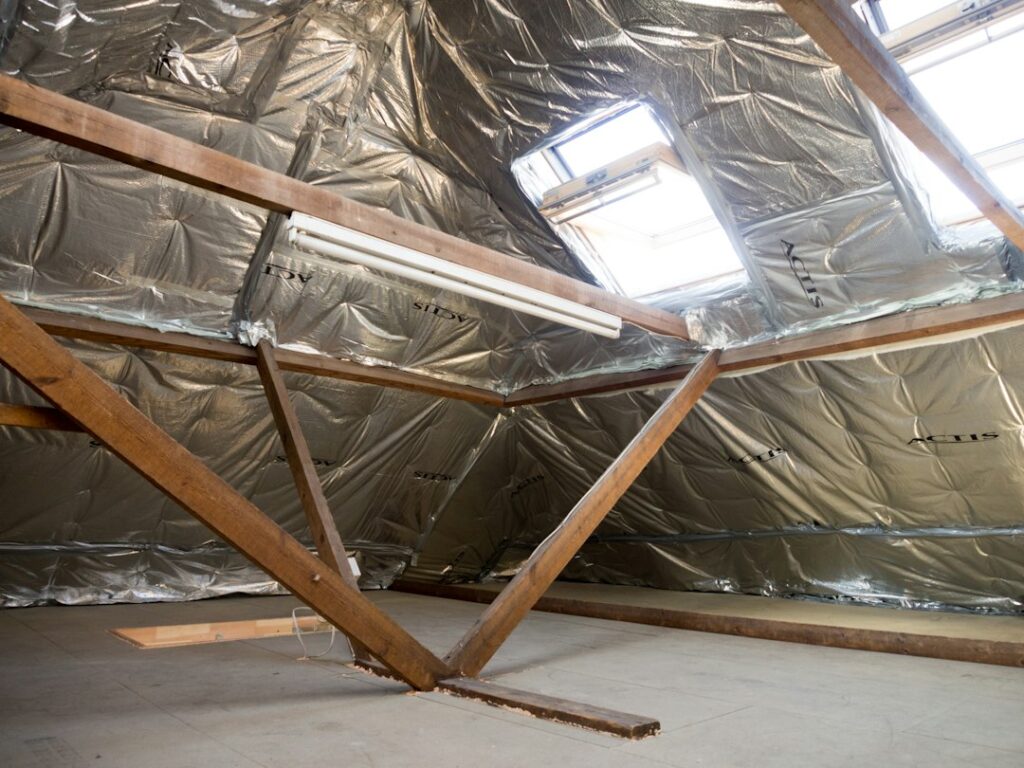
Still air is an excellent insulator. Fiberglass, mineral wool, foam and even down jackets work mostly by trapping tiny pockets of it. So it seems logical that a big empty space inside a wall should insulate well too. It does not. The air gap insulation value of a typical enclosed space in a wall is only about R-1, roughly what you get from a quarter inch of foam board, because air in a large cavity does not stay still.
The short answer: an ordinary enclosed air space contributes around R-0.7 to R-1.0, no matter whether it is three-quarters of an inch or three and a half inches deep. Add a low-emissivity foil surface facing the gap and the value can rise to roughly R-2 to R-3 for walls, and higher for downward heat flow under floors. Without the gap, foil does almost nothing. That interaction is the whole story behind reflective insulation, radiant barriers and double-pane windows.
What Is the Real Air Gap Insulation Value?
Heat crosses an air space three ways: conduction through the air, convection as air circulates, and radiation between the two facing surfaces. Air conducts heat poorly, which is why tiny trapped pockets insulate well. In a larger gap, though, air near the warm side rises, air near the cold side sinks, and a slow loop forms that carries heat across. Meanwhile, ordinary building materials such as wood, drywall, brick and paper radiate heat freely across the space.
Testing by engineering and building standards groups has measured these effects for decades. For a vertical wall air space with ordinary surfaces, the result lands near R-1 across a wide range of thicknesses. Making the gap deeper barely helps, because convection increases as fast as the conduction path lengthens. Beyond about three-quarters of an inch, you gain almost nothing.
| Air space condition | Approximate R-value |
|---|---|
| Vertical gap, ordinary surfaces | R-0.7 to R-1.0 |
| Vertical gap, one foil surface facing it | R-2 to R-3 |
| Horizontal gap, heat flowing up, foil facing it | R-1.5 to R-2.5 |
| Horizontal gap, heat flowing down, foil facing it | R-4 to R-8 or more |
These are representative figures; exact numbers depend on gap depth, temperature and surface emissivity. The pattern is what matters for estimating air gap insulation value in your own house. Downward heat flow is the best case because warm air at the top of the gap stays there and convection stalls, leaving radiation as the main path, which a foil surface blocks.
Why Foil Only Works Facing an Air Gap
Radiant heat transfer depends on emissivity, a measure of how readily a surface gives off or absorbs infrared energy. Most building materials have emissivity around 0.9, meaning they radiate almost as well as a perfect emitter. Polished aluminum foil sits near 0.03 to 0.05. A foil face toward an air space cuts radiant transfer across that space by around 90 percent.
The catch is that radiation needs space to travel. If foil is pressed directly against drywall, wood or foam, heat simply conducts through the contact, and the low emissivity is irrelevant. This is why a reflective foil insulation roll stapled flat against studs with drywall installed directly over it adds very little. The same product installed on furring strips, so a three-quarter-inch gap sits between the foil and the drywall, can add R-2 or more to that assembly.
Dust also matters. Dust settling on an upward-facing foil surface raises its emissivity over time, which is why radiant barriers in attics are usually installed foil side down or draped under the rafters where dust cannot collect.
Where Air Gaps Matter in a House
Walls and rain screens
Many walls include air spaces on purpose. Brick veneer has a 1-inch gap behind it, and modern rain-screen siding sits on furring strips over the weather barrier. These gaps exist to drain water and let the wall dry, not to insulate. Their thermal contribution is small, and if the gap is ventilated to outside at top and bottom, building scientists typically assign it no insulating value at all. The air insulation value of a vented cavity is effectively zero.
Empty stud cavities
Older homes often have uninsulated walls. Each empty 2×4 bay contributes only about R-1 of air space, and air leaking through the cavity can make even that disappear. Filling the bay with dense-pack cellulose or batts raises it to around R-13. That single comparison shows why “dead air space” walls feel cold.
Windows
Double-pane windows are the most familiar air gap application. Two glass panes with a sealed space between them reach about R-2, compared with R-1 for single glass. Gap width matters here: around half an inch is close to the sweet spot for air; wider spacing invites convection. Manufacturers boost performance by filling the gap with argon or krypton, which conduct heat less than air, and by applying a low-e coating on one glass surface facing the gap. That coating does exactly what foil does in a wall, cutting radiant transfer.
Attics and radiant barriers
In hot climates, a radiant barrier stapled under roof rafters with the reflective face toward the attic air reduces the heat radiated from a scorching roof deck down onto the attic floor insulation. Studies in the Sun Belt have shown meaningful cooling savings, especially where ducts run through the attic. In cold climates the benefit is much smaller, since the heat-loss problem is conductive and convective, not radiant.
Under floors
Reflective insulation under a floor, facing an enclosed air space in the joist bay, takes advantage of downward heat flow, the best orientation for an air gap. Combined with a sealed rim and a reflective surface, this can add meaningful resistance under radiant floor heating, although bulk insulation still does most of the work.
How to Use an Air Gap Correctly
If you want a reflective product to deliver its rated value, follow these steps:
- Read the rating carefully. Reflective insulation ratings are assembly ratings, assuming a specific gap and heat-flow direction. The product by itself has a value near zero.
- Create a sealed gap. Install furring strips (typically 3/4 inch) over the foil before drywall or paneling. The gap should be closed at the top and bottom so air does not circulate freely.
- Face the foil into the gap. The shiny side must look across open air, not against another material.
- Seal the seams. Tape all joints with foil tape so the layer also acts as an air barrier.
- Mind moisture. Foil is a vapor barrier. On the interior of a cold-climate wall that can be appropriate; on the exterior side, or in hot, humid climates, it can trap moisture. Check with your local building department about vapor control for your climate zone.
- Combine with bulk insulation. Fill the stud cavities first, then add the foil and gap as a bonus layer. A foil-and-gap layer is a supplement, never a substitute for real insulation in heating climates.
Troubleshooting Air Gap Performance
No noticeable improvement after adding reflective insulation. Most often the foil is in direct contact with another material, or the gap is open to outside air. Either way, the radiant benefit is lost.
Condensation behind paneling. Foil on the interior side in a humid climate or a basement can allow moisture to collect against cold surfaces. Remove it and use a vapor-open insulation approach suited to the space.
Foggy double-pane windows. A failed seal lets moist air into the gap and argon out. The insulating value drops back toward that of single glass plus a little. Replacing the insulated glass unit restores performance.
Attic still hot. A radiant barrier helps, but only with adequate attic ventilation and a solid layer of bulk insulation on the attic floor. Check that soffit vents are not blocked.
Cost Considerations
Reflective foil rolls are inexpensive per square foot, often comparable to or cheaper than a thin foam board, which makes them tempting. The real cost is labor for furring strips and the room depth you lose. In most cases, a quality bulk insulation delivers more R-value per dollar in heating climates, while radiant barriers earn their keep in hot attics. Replacing a failed insulated glass unit in a window is usually far cheaper than replacing the entire window.
When to Get Professional Advice
Consult an insulation contractor or energy auditor before covering large areas with reflective products, especially in basements, crawl spaces or cold-climate exterior walls where vapor control matters. A pro can tell you whether a radiant barrier makes sense for your attic and climate, and whether your old wall cavities should be dense-packed instead. If you are re-siding, a builder familiar with rain-screen details can make sure the drainage gap works as intended without being mistaken for insulation. Homes built before 1978 may have lead paint on siding or trim, so test before sanding or demolition.
Frequently Asked Questions
Is an air gap a good insulator?
A small, sealed pocket of still air is, but an open air space in a wall is not. A typical enclosed wall gap is worth only about R-1 because convection and radiation carry heat across it.
Does a bigger air gap insulate better?
Not beyond about three-quarters of an inch in walls. Deeper gaps allow more air circulation, which cancels most of the benefit of the extra distance.
What is the air insulation value of a double-pane window?
A basic double-pane window with air between the panes is roughly R-2. Low-e coatings and argon fill can push that to R-3 or more, and triple-pane units go higher.
Does reflective insulation work without an air gap?
No. The foil must face an open air space to reflect radiant heat. Pressed against another surface, it conducts heat and adds almost no R-value.
Should I add a radiant barrier in a cold climate?
Usually it is not the best use of money in cold climates. Air sealing and adding bulk insulation to the attic floor save more energy there.