
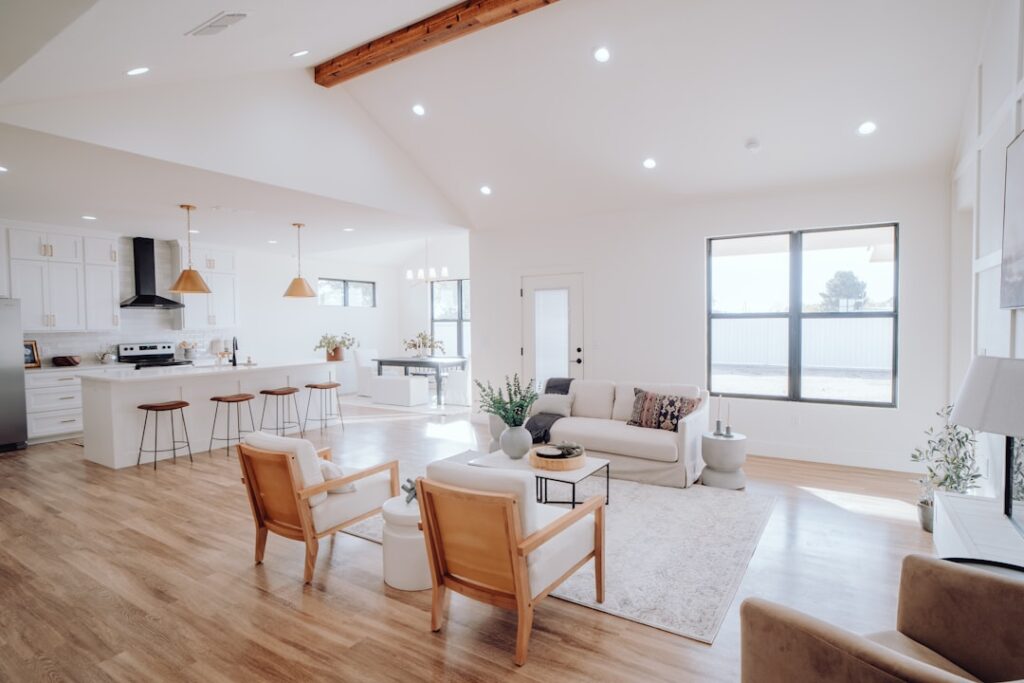
Walk into a magazine-quality home and you can usually pinpoint why a room feels different within ten seconds. It is almost always the floor. Amazing flooring is not about price tag or trend; it is about a surface that looks intentional, holds up to daily life, and ages without looking dated five years later. This guide breaks down the categories that consistently deliver that “wow” reaction, the realistic costs, and the brands that earn the praise.
What Makes a Floor Look High-End
Four design elements separate forgettable flooring from the kind that stops guests at the doorway. The first is scale: wide planks (7 to 12 inches) and large-format tiles (12×24 or 24×48) read as luxury because builder-grade goods rarely use them. The second is variation. Floors with multiple plank lengths, color variation across boards, and visible character (knots, sapwood, mineral streaks) photograph beautifully because the eye keeps finding new detail.
The third is finish. Wire-brushed and hand-scraped textures catch light at different angles, while ultra-matte sheens hide micro-scratches that high-gloss surfaces amplify. The fourth is the seam. Tight, perfectly aligned joints in tile and consistent overwood-free transitions in hardwood signal that the floor was installed by someone who cared.
Wide-Plank European White Oak
If a single category dominates the “amazing flooring” conversation right now, it is wide-plank European white oak. Brands like Stuga Studio, DuChateau, Madera, and Carlisle build engineered planks in 8 to 12 inch widths, 6 to 12 foot lengths, with hand-applied oil finishes from Rubio Monocoat or Loba.
Pricing ranges $9 to $22 per sq ft for the material and another $6 to $10 per sq ft for skilled install. A 1,500 sq ft project lands $25,000 to $48,000 finished. The look is the reason custom builders specify it in $1 million-plus homes from Austin to Aspen.
Large-Format Porcelain
The 24×48 and 32×32 porcelain category went from rare to readily available in the past five years. Brands like Daltile, MSI Stile, Florim, and Crossville offer marble looks (Statuario, Calacatta), travertine looks, and concrete looks in slabs that hide grout lines with rectified edges and 1/16 inch joints.
Material runs $4 to $12 per sq ft. Install requires a specialist with a vacuum suction frame and a 1/2 inch trowel because the panels are too large for one person to set without bowing. Installed pricing typically lands $14 to $22 per sq ft. The payoff is a seamless stone look at a quarter of the price of real Calacatta marble.
Premium LVP Worth the Hype
Not all luxury vinyl plank is created equal. The amazing-tier products share a few specs:
- 22 mil or higher wear layer (versus 6 to 12 mil for builder grade)
- 9×60 or 9×72 plank dimensions instead of standard 6×36
- Painted, embossed-in-register surface that aligns texture with print
- SPC core 5 to 7 mm thick with attached cork or IXPE underlayment
COREtec Originals Premium XL, Karndean Korlok, Mannington ADURA Max APEX, and Shaw Floorte Pro Endura Plus all hit those marks. Expect $5 to $9 per sq ft for material and a finished look that fools guests into asking if it is real wood.
Exotic Hardwoods and Reclaimed Wood
For pure conversation-starter floors, exotic species and reclaimed lumber stay in a class of their own. Brazilian cherry (Jatoba, Janka 2,820), Cumaru (Janka 3,540), and Santos mahogany (Janka 2,200) bring deep reds and chocolate browns that domestic species cannot match.
Reclaimed antique heart pine, chestnut, and oak from Pioneer Millworks, Elmwood Reclaimed Timber, or TerraMai run $14 to $35 per sq ft for the material alone. The history (saw marks, nail holes, century-old patina) is impossible to fake.
Statement Tile Patterns
Even a small entry or powder room can deliver amazing flooring with the right pattern. Herringbone and chevron in marble or porcelain immediately elevate a space. Encaustic cement tiles from Cle Tile, Granada Tile, or Zia Tile turn floors into focal points with hand-painted patterns at $12 to $28 per sq ft.
For a budget version of the same effect, peel-and-stick vinyl from Quadrostyle and FloorPops mimics encaustic looks at $3 to $5 per sq ft, though it lacks the depth and longevity of true cement.
Honest Drawbacks
Every premium category carries trade-offs. Wide-plank oak shows seasonal gaps in dry winter months. Large-format porcelain is unforgiving of subfloor variation; a deflection of 1/8 inch over 10 feet will crack a 24×48 tile. Exotic woods have huge color shift under UV exposure, with Brazilian cherry darkening from honey to deep red within 6 months.
Encaustic cement requires sealing every 6 to 12 months and stains easily until it patinas in. Premium LVP, while easier to live with, will not add resale value the way real wood or stone does in higher-end markets.
How to Get the Look on a Tighter Budget
You do not need a $40,000 budget for amazing flooring. Buy fewer materials at higher quality. A 250 sq ft entry and dining room in 12-inch wide-plank oak costs $5,000 to $8,000 and reads as luxury, while filling adjacent bedrooms with mid-grade carpet keeps total spend reasonable.
Splurge in the rooms guests see, save in the rooms they do not. A herringbone marble entry, a wide-plank kitchen, and standard carpet in upstairs bedrooms is the formula used by most builders pricing in the $750K to $1.2M range.
Final Verdict
Amazing flooring is achievable in nearly every product category if you focus on scale, character, finish, and tight install detail. White oak in 9 inch planks, large-format porcelain, premium SPC with 22 mil wear layer, or reclaimed antique pine all deliver the effect. Choose the category that fits your climate, traffic, and budget, hire a contractor who has installed at least 10 jobs in that material, and the floor will look intentional for decades.
Prefer to explore on your own?
See how new flooring looks in your actual room in seconds — free, no signup.
Try the free Floor Studio →

