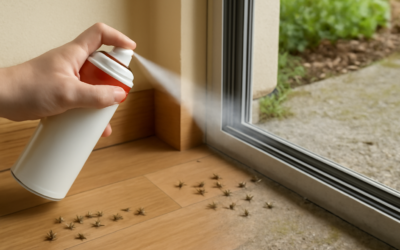
Killing the ants you see on your patio provides about 10 minutes of satisfaction before the next wave arrives from the colony. Effective ant spray outdoor products work differently — they create invisible chemical barriers that ants walk through unknowingly and carry back to the nest, or they kill on contact and leave a residual that continues working for weeks to months. Choosing the right spray depends on whether you are treating a visible nest, creating a perimeter barrier, or managing ants across the entire yard.
Part of our Windows & Doors guide — explore the full guide →
Best Outdoor Ant Sprays
- Ortho Home Defense Insect Killer ($10-$15 for 1.33 gal): Ready-to-use perimeter spray with a comfort wand. Creates a barrier that kills ants on contact and provides residual protection for up to 12 months. Apply around the foundation, doors, windows, and patio edges. The most popular residential ant spray for good reason
- Raid Ant & Roach Barrier ($8-$12 for 22 oz): Spray that kills on contact and leaves a residual barrier lasting 4 weeks. Good for spot treatment of ant trails and entry points. Smaller volume suits targeted application rather than full perimeter treatment
- Suspend SC ($25-$35 for 16 oz concentrate): Professional-grade deltamethrin concentrate. Mix with water per label. Provides 90-day residual protection. One bottle makes 16-32 gallons of spray — enough for multiple full-perimeter applications. The best value for large properties
- Terro Outdoor Liquid Ant Killer ($8-$12 for 6 stations): Not a spray but pre-filled bait stations placed outdoors. Workers carry the borax-based bait to the colony. Kills the entire colony in 3-14 days. More effective than contact sprays at eliminating the source
- EcoSMART Ant & Roach Killer ($8-$10): Plant-based spray using rosemary and peppermint oils. Kills on contact with no chemical residual. Safe around children, pets, and food gardens. Reapply every 2-3 days. Best for organic-focused households
Perimeter Barrier Application
The most effective use of ant spray outdoor is creating an unbroken chemical barrier around your home’s foundation. Spray a continuous band 6-12 inches wide along the base of the foundation, extending 6-12 inches up the wall and 6-12 inches out onto the ground. Also spray around:
- All exterior door thresholds
- Window frames and sills at ground level
- Where utility pipes and wires enter the building
- Garage door perimeter
- Patio edges and deck post bases
Apply on a dry day when no rain is forecast for 24 hours — water washes away fresh spray before it bonds to surfaces. Reapply after heavy rainfall or as directed on the product label (typically every 1-3 months during ant season). One gallon of ready-to-use spray covers approximately 200 linear feet of perimeter — enough for most homes in a single application.
Treating Ant Mounds
Visible ant mounds in the yard require direct treatment. For fire ant mounds, apply a granular bait (Amdro Fire Ant Bait, $8-$12) in a circle around the mound without disturbing it. Workers collect the bait and share it with the colony — the queen dies within 1-2 weeks. For non-fire-ant mounds, drench the mound with diluted liquid insecticide (Suspend SC, Bifen IT) — pour 1-2 gallons of diluted solution directly into the mound opening.
Do not spray the mound surface with contact killer — this kills only the workers you can see and alerts the colony to relocate. A relocated colony does not die; it rebuilds 10-20 feet away and resumes activity within days. Bait and drench methods kill the colony at its source by reaching the queen deep underground where contact sprays cannot penetrate.
When to Apply Outdoor Ant Spray
Begin perimeter treatment in early spring (March-April) when ant activity first becomes visible. Queen ants emerge from overwintering sites in spring and establish new colonies — early treatment interrupts this cycle before populations build. Reapply monthly or as directed through fall (September-October). Most ant activity peaks in June-August when colonies are at maximum population and workers forage most aggressively.
Apply spray in the early morning or late evening when temperatures are between 50-80°F. Ants are most active during these cooler periods and more likely to cross treated surfaces. Midday heat above 90°F reduces ant surface activity and causes spray products to evaporate faster, reducing their residual effectiveness.
Safety Considerations
Keep children and pets away from treated areas until the spray has dried completely (typically 30-60 minutes). Most consumer ant sprays are low-toxicity to mammals once dry but can cause skin or eye irritation during application. Wear gloves and avoid inhaling spray mist. Do not spray near fish ponds, bird baths, or bodies of water — pyrethroids (the active ingredient in most ant sprays) are highly toxic to aquatic organisms.
For yards where children play frequently or pets roam, consider bait stations instead of spray barriers. Enclosed bait stations (Terro, Amdro) contain the active ingredient inside a housing that children and pets cannot easily access. Stations placed along fence lines, next to the foundation, and near ant trails target ants specifically without broad surface contamination. This approach is both safer for households with small children and more effective at colony elimination than contact spray alone.