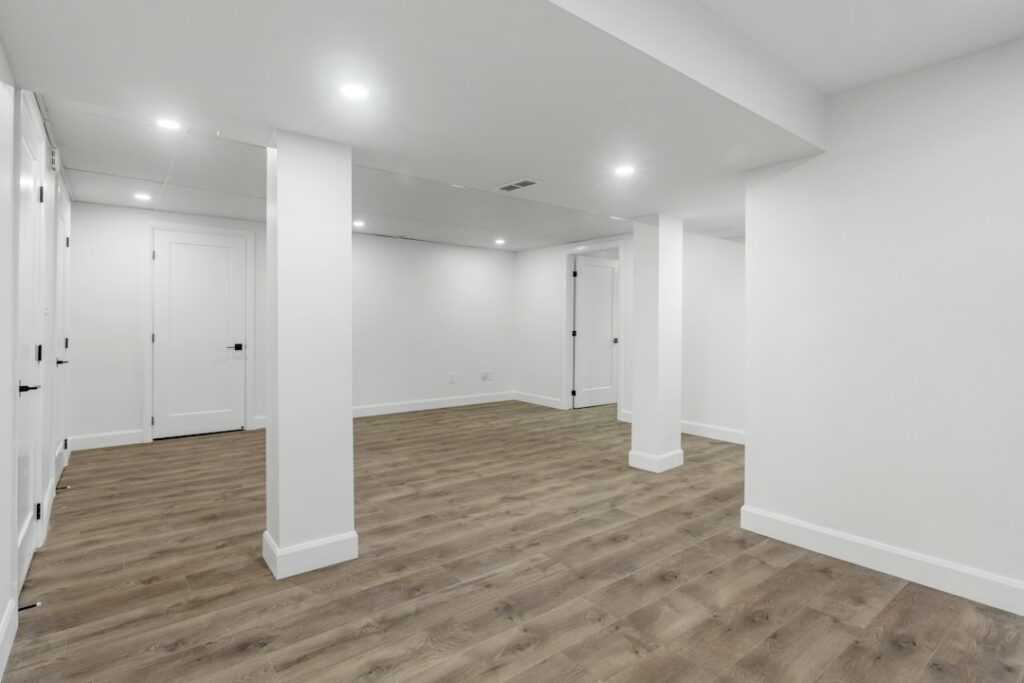
A cold basement is rarely just a comfort problem. It usually signals air leaking in around the rim joists, heat escaping through bare concrete, and moisture condensing on surfaces you cannot see. Basement spray foam insulation tackles all three at once by insulating and air-sealing in one application, which is why it has become a go-to choice for foundation walls and band joists. It is also more expensive than other options and comes with chemical and fire-safety rules that matter. Here is how to decide whether it is the right fit for your basement.
- Why Basement Spray Foam Insulation Works So Well
- Closed-Cell vs. Open-Cell Foam
- Where to Apply Spray Foam in a Basement
- How Much Insulation Do You Need?
- Moisture Problems to Fix First
- Fire Safety and Thermal Barriers
- DIY Kits vs. Professional Installation
- Cost of Basement Spray Foam Insulation
- Alternatives Worth Comparing
- Is Spray Foam the Right Choice for Your Basement?
Why Basement Spray Foam Insulation Works So Well
Basements lose heat in ways that make traditional fiberglass batts a poor match. Concrete walls wick ground moisture, and when warm, humid indoor air hits cool concrete behind fiberglass, it can condense. The result is damp insulation, mold on framing, and that familiar musty smell. Fiberglass also does little to stop air movement, so drafts through gaps in the rim joist continue unchecked.
Spray foam adheres directly to concrete and wood, filling cracks, gaps, and irregular surfaces as it expands. That continuous layer stops air leaks and, with closed-cell foam, keeps humid air from ever reaching the cold concrete surface. Homeowners often notice warmer floors on the level above, fewer drafts, and less humidity in the basement after the work is done.
Closed-Cell vs. Open-Cell Foam
Choosing the right foam type is the most important decision in a basement.
Closed-Cell Spray Foam
Closed-cell foam is dense, rigid, and delivers roughly R-6 to R-7 per inch. At about 1.5 to 2 inches thick, it typically functions as a vapor retarder, meaning it limits moisture diffusion from the concrete into the living space. It also adds some rigidity to the surface it covers. For below-grade walls and rim joists, closed-cell is usually the recommended choice.
Open-Cell Spray Foam
Open-cell foam is softer, lighter, and cheaper, at roughly R-3.5 to R-3.8 per inch. It is an excellent air barrier and sound absorber but allows water vapor to pass through. Against cool, damp concrete, that vapor openness can let moisture reach the foundation surface and condense. Open-cell foam is generally better suited to above-grade walls and interior sound control than to basement foundation walls.
| Property | Closed-Cell | Open-Cell |
|---|---|---|
| R-value per inch | About 6-7 | About 3.5-3.8 |
| Vapor permeability | Low at 1.5-2 in. | High |
| Best basement use | Foundation walls, rim joists | Interior partitions, sound control |
| Relative cost | Higher | Lower |
Where to Apply Spray Foam in a Basement
Rim Joists
If you only insulate one area, make it the rim joist, the band of framing that sits on top of the foundation wall. It is often the leakiest part of the entire house, with gaps around sill plates, wires, pipes, and vents. Closed-cell foam sprayed into each joist bay seals and insulates this area far better than stuffed fiberglass. Many homeowners start here because the cost is modest and the comfort payoff is noticeable.
Foundation Walls
Foam can be sprayed directly on concrete or block walls, typically between or behind a stud wall that will later hold drywall. Many installers frame the wall with a gap of about an inch from the concrete and spray foam that fills behind the studs, reducing thermal bridging through the framing.
Basement Ceilings
Insulating the basement ceiling instead of the walls turns the basement into unconditioned space. That can make sense in a vented crawlspace-style basement, but in most homes with ducts, a water heater, or plans to finish the space, insulating the walls and rim joists is the better approach because it keeps the basement within the conditioned envelope.
How Much Insulation Do You Need?
Energy codes set minimum basement wall insulation levels that vary by climate zone. In many colder US climate zones, codes call for roughly R-10 continuous insulation or R-13 to R-15 in a framed cavity for basement walls, with milder zones requiring less or none. Your local building department adopts a specific version of the energy code, so confirm requirements before planning thickness.
For closed-cell foam, 2 inches gives roughly R-12 to R-14, which meets or approaches common requirements in many regions. Some homeowners add more thickness for colder climates, while others combine 1 to 2 inches of closed-cell foam with fiberglass or mineral wool in a framed wall, a hybrid approach that controls moisture at the concrete while keeping costs down.
Moisture Problems to Fix First
Spray foam is not waterproofing. If water actively leaks through cracks, seeps at the floor-wall joint, or shows up after heavy rain, fix that first. Foam sprayed over wet concrete may not adhere well, and liquid water trapped behind it can cause lingering problems.
- Clean gutters and extend downspouts at least 4 to 6 feet away from the foundation.
- Grade soil so it slopes away from the house.
- Seal visible cracks and address hydrostatic pressure with drainage improvements when needed.
- Run a dehumidifier to bring relative humidity down to roughly 50 percent or less before and after insulating.
A simple test: tape a 2-by-2-foot piece of plastic sheeting to the wall for a few days. Moisture on the wall side points to water coming through the concrete; moisture on the room side points to indoor humidity.
Fire Safety and Thermal Barriers
Spray foam is combustible, and building codes generally require it to be separated from living space by an approved thermal barrier, most commonly 1/2-inch gypsum drywall. In basements that stay unfinished, some foam products are approved for exposure with an ignition barrier coating or a specific tested formulation, but the rules depend on the product and how the space is used. Ask your installer which barrier applies and make sure the foam’s evaluation report supports that approach.
Keep foam a safe distance from chimneys, flue pipes, and other heat sources as specified by the manufacturer and code, and do not spray over electrical boxes or cover junction boxes in a way that blocks access.
DIY Kits vs. Professional Installation
Two-component DIY foam kits are sold for small jobs such as rim joists, typically covering somewhere around 200 to 600 board feet per kit (a board foot equals 1 square foot at 1 inch thick). They can work for a patient homeowner on a limited area, but they have real drawbacks: temperature-sensitive chemicals, inconsistent mixing, a steep learning curve, and the need for proper respiratory protection.
Whole-wall basement work is usually better left to a professional crew with a proportioner rig, heated hoses, and experience controlling pass thickness. Closed-cell foam is applied in lifts, typically no more than about 1.5 to 2 inches per pass, because thick single passes generate excessive heat and can lead to poor curing, shrinkage, or cracking.
When to Call a Licensed Professional
Spray polyurethane foam involves isocyanates and other chemicals that are respiratory and skin sensitizers during application. Professional installers use supplied-air respirators, full skin protection, and ventilation, and occupants are typically asked to stay out of the home during spraying and for a period afterward as specified by the manufacturer, often around 24 hours. Hire a trained, insured spray foam contractor for anything beyond a small rim joist project, and involve a licensed contractor or engineer if you see bowing or cracked foundation walls, active water intrusion, or signs of structural movement. Confirm permits with your local building department.
Cost of Basement Spray Foam Insulation
Spray foam is typically priced per board foot. Approximate installed costs as a planning guide:
- Closed-cell: roughly $1.00 to $2.00 per board foot installed, so 2 inches runs about $2.00 to $4.00 per square foot of wall.
- Open-cell: roughly $0.45 to $0.80 per board foot installed.
- Rim joists only: many homes fall in the $500 to $1,500 range, depending on perimeter length and access.
- Full basement walls: a typical 1,000-square-foot basement with about 1,000 square feet of wall area might run roughly $2,500 to $5,500 or more for 2 inches of closed-cell foam.
Prices vary by region, access, and job size, and drywall or a thermal barrier adds cost on top. Utility rebates or energy efficiency incentives are sometimes available for air sealing and insulation; check with your utility and local programs, since eligibility and amounts vary.
Alternatives Worth Comparing
Rigid foam board, such as XPS or polyiso, glued or fastened to the concrete with seams taped and edges sealed with canned foam, can achieve similar moisture and thermal results at a lower cost for a careful DIYer. Many building-science guides recommend this approach for finished basements. Mineral wool in a framed wall over a foam layer is another option. Spray foam’s main advantages are speed, seamless air sealing, and its ability to handle irregular surfaces like fieldstone walls and crowded rim joists.
Is Spray Foam the Right Choice for Your Basement?
Basement spray foam insulation is a strong option when you want to finish the space, stop drafts, and control condensation in one step, especially on rim joists and uneven foundation walls. Choose closed-cell foam for below-grade surfaces, fix water problems first, plan for a code-approved thermal barrier, and let trained installers handle large applications. Done correctly, the result is a drier, warmer basement and a more comfortable floor above it.