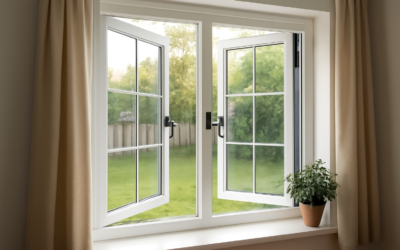
Homeowners comparing quotes ask me this constantly, so let’s settle it with numbers: yes, are casement windows more expensive is a question that almost always gets answered with a 10 to 30 percent premium over a comparable double-hung. If you’re wondering are casement windows more expensive enough to change your project budget, the answer depends on window count — on a whole-house job of 15 windows, that premium can add $2,000 to $6,000 to the total.
Part of our Windows & Doors guide — explore the full guide →
A mid-grade vinyl double-hung installed typically runs $450 to $750. The same size casement from the same manufacturer lands at $550 to $950 installed. Step up to fiberglass or wood-clad and the spread widens: a wood casement from Andersen or Marvin can hit $1,200 to $2,000 per opening, while the equivalent double-hung stays closer to $1,000 to $1,600. Those aren’t sticker-shock outliers — they’re the pattern I see on quote after quote.
- Typical Price Ranges by Material
- Why Casements Cost More: It's the Hardware
- Casement vs Double-Hung vs Slider: Head-to-Head Cost
- Where Casements Earn Their Premium Back
- When the Premium Isn't Worth Paying
- Long-Term Ownership Costs
- How to Keep Casement Costs Down
- What About Resale and Appraisal Value?
- Bottom Line
Typical Price Ranges by Material
Material drives cost more than style does, but within each material the casement premium holds. Here’s what installed pricing looks like per window in 2026, assuming standard sizes around 28×54 inches:
- Vinyl casement: $550 to $950 installed; comparable double-hung $450 to $750
- Fiberglass casement: $850 to $1,400; comparable double-hung $700 to $1,150
- Wood or wood-clad casement: $1,200 to $2,000; comparable double-hung $1,000 to $1,600
- Aluminum casement: $600 to $1,000; comparable double-hung $500 to $850
Budget lines compress the gap. A builder-grade vinyl casement from a regional fabricator might only cost $75 more than the matching double-hung. Premium lines stretch it, because the crank hardware on a high-end casement is a genuinely engineered mechanism, not a $12 latch.
Why Casements Cost More: It’s the Hardware
Pull the sash off a double-hung and you’ll find balance shafts or coil springs — cheap, simple parts that cost the manufacturer a few dollars. Now open a casement and look at the operator: a geared crank mechanism, a scissor or dual-arm linkage, multi-point locks that pull the sash tight at two or three positions along the frame, and heavy-duty hinges rated to hold a 40-pound sash cantilevered in the wind.
Truth-brand operators (the industry standard used by Andersen, Pella, and most quality lines) run $40 to $120 as replacement parts alone. Multi-point lock assemblies add another $30 to $80. The sash itself also needs stiffer construction because it hangs from one side rather than riding in a track, so manufacturers use thicker extrusions and reinforced corners. All of that lands in the retail price.
Installation adds a small premium too. Casements demand a square, plumb opening — an out-of-square rough opening that a double-hung would tolerate will cause a casement sash to bind or leave a corner gap. Installers spend more time shimming, and some charge $25 to $50 extra per opening for it.
Casement vs Double-Hung vs Slider: Head-to-Head Cost
Sliders are the cheapest operating style because they’re mechanically the simplest — two panels in a track. For a standard 36×48 vinyl unit installed, expect roughly:
- Slider: $400 to $700
- Double-hung: $450 to $750
- Casement: $550 to $950
- Awning (casement’s top-hinged cousin): $500 to $900
Picture windows undercut all of them at $350 to $650 because there’s no hardware at all. On large projects I often spec a mix: casements where ventilation and egress matter, fixed picture units where they don’t. Swapping four operating casements for two casements flanking two fixed units on a big living-room wall can save $800 to $1,200 without changing the look much.
Where Casements Earn Their Premium Back
Efficiency is the honest answer. A casement sash cranks shut against a compression seal on all four sides, and the multi-point locks squeeze it tighter as wind pressure rises. Double-hungs seal with sliding weatherstripping that has to allow movement, so they leak more air by design. Independent testing routinely shows casements at 0.01 to 0.06 cfm/sq ft of air infiltration versus 0.10 to 0.30 for double-hungs of similar grade.
In a cold climate, that difference is worth real money. On a leaky 1970s house I worked on in 2023, replacing 12 double-hungs with casements dropped the blower-door number by almost 15 percent, and the owner reported heating bills down about $30 a month. Over a 20-year window life, $5,000 to $7,000 in energy savings against a $3,000 casement premium is a defensible trade.
Casements also catch side breezes like a sail — the open sash scoops air into the house — and they’re often the only operating style that meets egress code in smaller bedroom openings, since the full frame area clears when the sash swings out. A 24×48 casement can satisfy the 5.7 sq ft egress requirement where a double-hung the same size can’t.
When the Premium Isn’t Worth Paying
Skip casements over decks, walkways, and patios where an out-swinging sash becomes a head-height obstacle. Skip them behind exterior screens on a busy street — the crank-out sash collects grime on its exterior face and you’ll be cleaning it from outside anyway on second stories unless you buy a dual-arm hinge that lets the sash swing clear.
Wind zones cut both ways. Casements lock tight, but an open casement in a gust is a lever arm working against its hinges. If your site sees regular 30 mph afternoon winds, awning windows or double-hungs survive careless open-window moments better. And on a strict-budget rental or flip, the 10 to 30 percent premium rarely returns at sale — appraisers don’t credit window style.
Long-Term Ownership Costs
Factor in maintenance before you decide. Casement operators wear out; plan on replacing a crank mechanism every 15 to 20 years at $60 to $150 in parts, or $150 to $300 with a handyman doing it. Hinges and lock keepers occasionally need attention too. Double-hung balances fail as well, but replacements cost $15 to $40 a pair and take ten minutes.
Screens are a small offsetting saving: casement screens mount inside, out of the weather, so they last longer than exterior double-hung screens that take UV and hail. Wash the sash gaskets annually and lubricate the operator gears with silicone spray each spring, and a quality casement will crank smoothly for decades.
How to Keep Casement Costs Down
You don’t have to pay list price. A few tactics that consistently shave the bill:
- Order standard sizes. Custom dimensions add 15 to 25 percent; adjusting the rough opening an inch is often cheaper.
- Mix fixed and operating units. Every picture window swapped in saves $150 to $300.
- Buy mid-tier lines. Andersen 100 Series and Pella 250 Series casements deliver 80 percent of the flagship performance at 60 percent of the price.
- Get three quotes in the off-season. January and February installs routinely come in 10 percent under May pricing.
- Skip cosmetic upsells. Between-the-glass grilles and designer hardware finishes add $50 to $150 per window and nothing to performance.
What About Resale and Appraisal Value?
Window replacement in general recoups roughly 60 to 70 percent of its cost at resale according to the annual Cost vs. Value data, and style choice barely moves that number — an appraiser credits “new vinyl windows,” not “new vinyl casements.” Where casements do help is in the showing itself: buyers touring a house notice smooth-cranking sashes, unobstructed glass with no meeting rail cutting the view, and quiet rooms. On higher-end listings where the comps all have casements, matching them avoids a subtle downgrade impression. On starter homes, nobody will pay you back the premium, so let the energy math and your own comfort make the call rather than an imagined resale bump.
Bottom Line
Expect to pay 10 to 30 percent more for casements — roughly $100 to $400 extra per window depending on material and line. The premium buys measurably tighter air sealing, better ventilation, and easier egress compliance, and in heating-dominated climates it usually pays for itself over the window’s life. On budget projects or in locations where an out-swinging sash is a nuisance, a good double-hung remains the smarter spend. Price both styles from the same manufacturer’s same series when you get quotes; that’s the only comparison that tells you what the style itself really costs.