They both swarm, live in massive colonies, and chew through your home’s wood, so it’s a fair question: are termites related to ants? The surprising answer is no. Despite looking and behaving alike, termites and ants sit on completely different branches of the insect family tree. Termites are actually close cousins of cockroaches, while ants are related to bees and wasps. Understanding this distinction isn’t just trivia; correctly identifying which pest you have determines how you treat it, since termites and ants require entirely different control methods. This guide explains the science and the practical ways to tell them apart.
The Short Answer From Science
Termites and ants are not closely related. Ants belong to the order Hymenoptera, the same group that includes bees and wasps. Termites belong to the order Blattodea, which is the cockroach order. In fact, modern entomologists classify termites as a specialized lineage of social cockroaches.
That means a termite is genetically far closer to the roach scuttling under your fridge than to the ant marching across your kitchen counter. The resemblance between ants and termites is a case of convergent evolution, where unrelated species develop similar traits because they live similar lifestyles.
Why They Look So Similar
Both insects evolved to live in large, cooperative colonies with workers, soldiers, and reproductive members. This shared social structure, called eusociality, pushed both species toward similar body sizes and swarming behavior even though they arrived there independently.
Both also produce winged reproductive forms, called alates, that fly off in swarms to start new colonies. Seeing a cloud of winged insects emerge from a wall is what most often triggers the ant-versus-termite question in the first place, and the two swarms genuinely look alike from a distance.
Body Shape: The Clearest Tell
Get close enough to see the waist and you can identify the insect instantly. This is the most reliable difference of all.
- Termites: Have a broad, straight body with no defined waist. The thorax and abdomen blend together into a single thick shape.
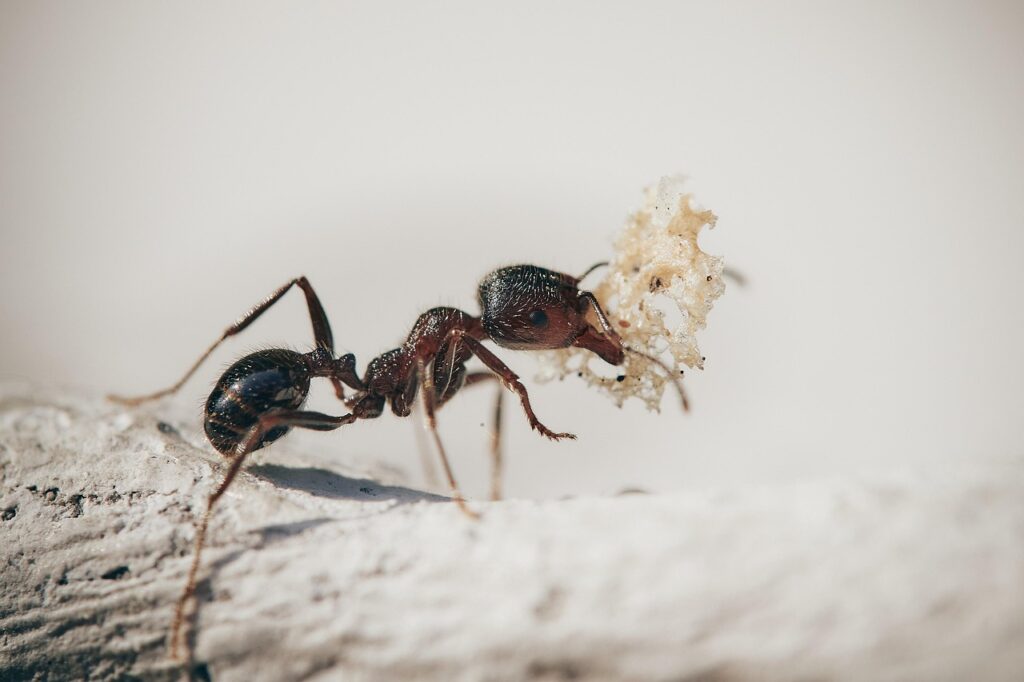
- Ants: Have a pinched, narrow waist (the petiole) that gives them an hourglass or segmented figure with a distinct head, thorax, and abdomen.
If the insect looks like a tiny grain of rice with no waist, it’s a termite. If it has an obvious cinched middle, it’s an ant.
Antennae and Wings
Two more features confirm the identification when you have the bug in front of you. Termite antennae are straight and beaded, looking like a tiny string of pearls. Ant antennae are bent or elbowed, with a clear angle partway along.
The wings are equally telling on swarmers. A termite’s four wings are all the same length and extend well past the body, and they break off easily, which is why finding discarded wings on a windowsill is a classic termite sign. An ant’s front wings are noticeably longer than its hind wings, and the wings stay attached.
Color and Behavior Differences
Color offers a quick first guess. Worker termites are pale, creamy white or translucent because they avoid light and stay inside wood and tunnels. Ants are usually darker, ranging from reddish-brown to black, and forage out in the open.
Behavior differs too. Termites actually eat the cellulose in wood, digesting it for food, which is why they cause structural damage from the inside out. Most ants, including carpenter ants, do not eat wood; carpenter ants excavate galleries to nest and push the sawdust-like debris (frass) out, but they feed on other things entirely.
Why the Difference Matters for Your Home
Correct identification changes everything about treatment. Termites typically require professional intervention with soil-applied termiticides, bait stations, or fumigation, and an active infestation can cause thousands of dollars in structural damage before you notice it.
Carpenter ants, by contrast, are often treated by locating and eliminating the nest with targeted baits and addressing the moisture problem that attracted them. Mistaking one for the other wastes money and lets the real problem grow. If you find a pile of wood-colored pellets, it’s likely drywood termites; if you find coarse sawdust mixed with insect parts, suspect carpenter ants.
What to Do If You Spot a Swarm
Don’t panic, but don’t ignore it either. Capture a few specimens in a sealed bag or take a clear close-up photo for identification. Check for the telltale signs around the swarm: discarded equal-length wings point to termites, while a trail of foraging dark insects points to ants.
If the evidence points to termites, or you simply can’t tell, call a licensed pest control professional for an inspection. Many companies offer free termite inspections, and early detection is the single biggest factor in limiting damage and cost.
Other Signs of an Infestation
Beyond spotting the insects themselves, learn the clues each leaves behind. Termites build mud tubes, pencil-width tunnels of soil running up foundation walls, and they hollow out wood so it sounds papery when you tap it. You may also find discarded wings near windows after a swarm and small piles of pellet-like droppings from drywood species.
Carpenter ants leave coarse sawdust (frass) below their galleries, often mixed with bits of dead insects, and you might hear a faint rustling inside walls at night. Both pests are drawn to moisture and damaged wood, so leaky roofs, damp crawl spaces, and wood-to-soil contact around the foundation raise your risk for either one. Reducing moisture is the best general deterrent regardless of which pest you’re facing.
The Bottom Line
So, are termites related to ants? Not at all. Termites are essentially social cockroaches, while ants are kin to bees and wasps, and the two only resemble each other because they evolved similar colony lifestyles. Remember the quick checklist: termites have no waist, straight beaded antennae, and equal-length wings, while ants have a pinched waist, elbowed antennae, and unequal wings. Knowing the difference lets you respond correctly and protect your home before either pest does serious damage.