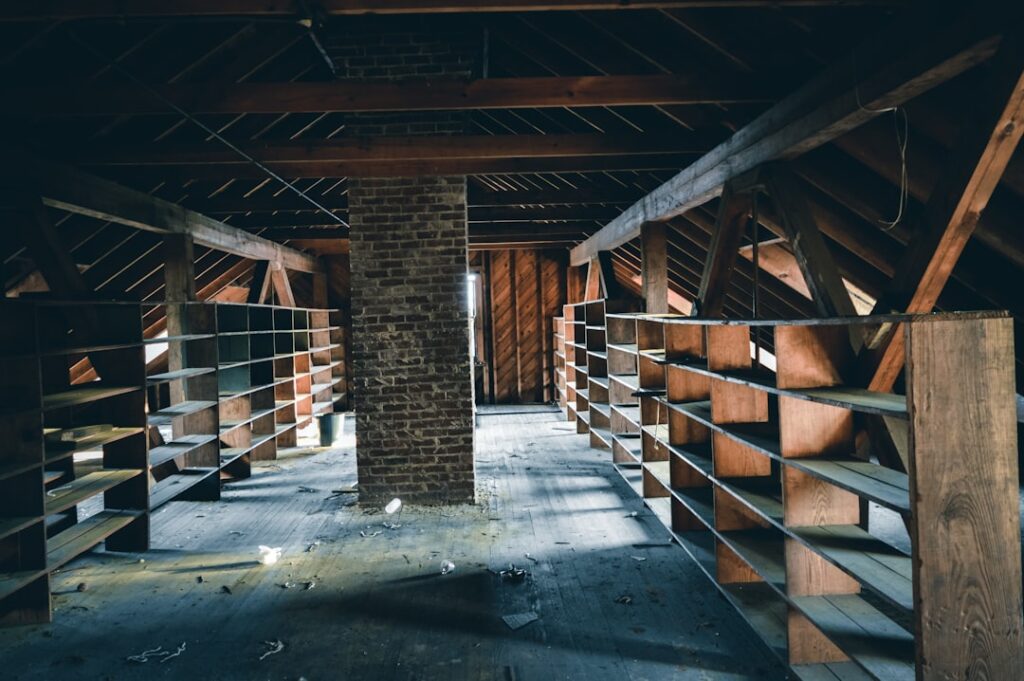
Humid attics rot sheathing, rust fasteners, and create the fuzzy black spots on rafters that home inspectors flag before a sale. An attic dehumidifier is the right answer in sealed, unvented attics and in humid Southern climates where passive ventilation cannot keep up. It is the wrong answer if your soffit vents are blocked or if you have a bathroom fan dumping into the attic instead of out the roof.
Diagnose Before You Buy
Moisture problems in attics come from three sources. Plumbing or roof leaks introduce bulk water, warm moist house air leaks past drywall gaps and ceiling fixtures, and some climates simply have outdoor air too humid for passive venting to dry the space.
Before spending $400 on a dehumidifier, climb up with a flashlight and a moisture meter. Check around plumbing vent stacks, recessed lights, attic hatches, and bath fan ducts. A reading above 18 percent moisture content in sheathing is a problem. Above 25 percent and you already have mold forming.
When a Dehumidifier Is the Right Solution
- Sealed, unvented attics with spray foam on the roof deck
- Conditioned attics in hot-humid climates like Houston, New Orleans, or coastal Florida
- Attics where adding ridge or soffit vents is impossible due to roof design
- Situations where duct leakage has already created persistent humidity you cannot fix easily
When Ventilation Is the Better Fix
If your attic has working soffit and ridge vents, the correct answer is usually better air sealing at the ceiling plane, not a dehumidifier. Seal every penetration with spray foam or caulk. Close off open wall cavities at top plates. Add or clean soffit baffles so outdoor air actually reaches the ridge.
A dehumidifier fighting a leaky ceiling just runs 24/7 and raises the electric bill without fixing the root cause. Stop the moist house air from getting up there first.
Sizing by Pints Per Day
Dehumidifier capacity is rated in pints of water removed per 24 hours at specific temperature and humidity conditions. Attic ratings matter because these spaces run hotter and more humid than the typical basement test environment.
- 500 to 1,000 sq ft attic, moderate humidity: 50 to 70 pint unit
- 1,000 to 2,000 sq ft attic: 90 pint unit
- Over 2,000 sq ft or very humid climate: dedicated whole-house style 120+ pint unit like a Santa Fe Advance2 or an Aprilaire E100
Residential vs Commercial Grade
A $250 big-box dehumidifier is built for a finished basement at 70 degrees Fahrenheit. Running it in a 120-degree attic will burn out the compressor within a season. Commercial attic-rated units from Santa Fe, Aprilaire, and Quest cost $1,200 to $1,800 but handle the heat and run for 10 to 15 years.
If budget is tight and the attic only hits high humidity for a few weeks a year, a standard unit placed near the hatch and cycled seasonally can work. Move it back to the basement when the weather cools.
Drainage Options
Nobody wants to climb into an attic weekly to empty a bucket. Set up continuous gravity drainage to a nearby waste line, or add a small condensate pump like a Little Giant VCMA-20ULS, which lifts water up to 20 feet vertically for about $75.
Run the drain line in PVC or vinyl tubing clipped along rafters, with a clean trap at the outlet if tying into a waste stack. Never drain directly onto insulation or ceiling drywall. One clogged line can soak the attic floor before you notice.
Electrical Requirements
Most residential units run on a standard 115V 15-amp outlet. Commercial attic units often require a dedicated 15 or 20 amp circuit. If there is no outlet within reach, a licensed electrician should run new wiring rather than daisy-chaining extension cords across insulation.
Check for an existing outlet near the attic hatch or bath fan. If you see one, test it under load before committing to a unit that pulls 6 to 9 amps continuously.
Target Humidity Level
Set the humidistat between 45 and 55 percent relative humidity. Below 40 percent, you are wasting energy and risk over-drying wood framing, which causes cracking and squeaks. Above 60 percent, mold starts to germinate on sheathing.
During peak summer, an attic dehumidifier may run nearly continuously for weeks. That is normal in humid climates. Spring and fall, expect cycling a few hours per day.
Filter and Coil Maintenance
Attics are dusty, and dehumidifier coils clog fast. Check the intake filter every 60 days and the evaporator coil twice a year. A clogged coil drops dehumidification capacity by 40 percent or more and eventually freezes the system into a block of ice.
Keep a record of the runtime hours if the unit displays them. Sudden changes in runtime for the same weather conditions point to a refrigerant leak or a dirty coil before the problem becomes obvious.
Cost to Run
A 90-pint unit draws roughly 700 watts while running. At $0.16 per kWh and 12 hours daily in summer, that is about $40 per month. Commercial units are more efficient per pint but draw higher continuous wattage. Budget $150 to $350 per year in electricity depending on climate and runtime, and factor that into the decision alongside the purchase price.