Not every paint job needs a $600 pro rig. For the homeowner spraying a dresser, a set of shutters, or a fence on a Saturday, an Avanti paint sprayer is the kind of budget-friendly HVLP tool that gets the job done without a big investment. It is sold as an affordable entry into spraying, and understood for what it is, it delivers a clean finish on the projects most people actually tackle.
Here is what the Avanti line offers, how to set it up, what it will and will not do well, and the technique that gets you a smooth coat instead of a spattered one.
- What an Avanti Paint Sprayer Is
- HVLP vs. Airless: Which You Actually Have
- Thinning: The Step That Makes or Breaks It
- Setting Up the Sprayer
- What an Avanti Sprayer Costs
- Spray Technique for a Clean Coat
- Cleaning and Maintenance
- Managing Expectations
- Prep and Masking Before You Spray
- Troubleshooting Common Issues
- Avanti vs. Stepping Up to a Premium Sprayer
- Is It the Right Sprayer for You?
What an Avanti Paint Sprayer Is
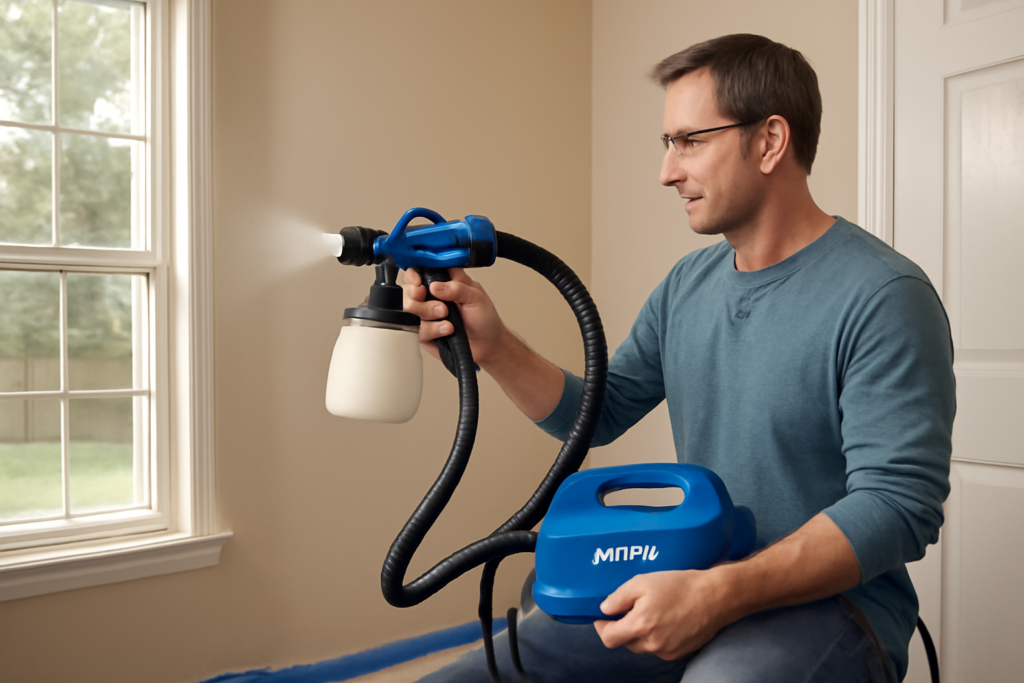
Avanti is a value-oriented brand, and its sprayers are generally HVLP-style handheld units — High Volume, Low Pressure. Instead of the high-pressure atomization of an airless pump, an HVLP sprayer uses a turbine or fan of air to push paint through a nozzle at lower pressure. The trade-off is simple: less overspray and better control, but you need to thin the paint more and work is slower on big surfaces.
That makes an Avanti sprayer a strong match for:
- Furniture, cabinets, and doors
- Trim, shutters, and small millwork
- Fences, sheds, and small exterior projects
- Stains, sealers, and thinner coatings
It is less ideal for spraying whole rooms of unthinned wall paint quickly — that is airless territory. Match the tool to the job and you will be happy.
HVLP vs. Airless: Which You Actually Have
Knowing your sprayer’s type tells you how to use it. HVLP handhelds like the Avanti favor control and finish quality on smaller pieces, with far less overspray fogging the whole room. Airless sprayers push unthinned paint fast for big areas but throw more overspray and need more masking. For furniture and cabinets — where a glass-smooth finish matters more than speed — HVLP is genuinely the better tool, which is why the Avanti’s format suits detail work.
Thinning: The Step That Makes or Breaks It
The single most common complaint about any budget HVLP sprayer is spitting or a coarse, orange-peel finish, and it almost always comes down to paint that is too thick. HVLP units need thinner paint than airless:
- Latex/acrylic: thin 10-20% with water, added a little at a time.
- Oil-based: thin with the manufacturer’s recommended solvent.
- Stains and sealers: often spray fine with little or no thinning.
Use the viscosity cup that comes with most HVLP kits, or the low-tech test: the paint should flow off a stir stick in a steady stream, not drip in blobs. Thin, strain through a mesh filter, and test on cardboard before committing to the real piece.
Setting Up the Sprayer
Most Avanti handhelds give you a few adjustments. Learn all three:
- Material flow knob: controls how much paint comes out. Start low and open it until coverage is even.
- Spray pattern (nozzle): horizontal, vertical, or round. Match the fan direction to your stroke — vertical fan for horizontal passes.
- Air/pressure (if adjustable): more air atomizes finer but increases overspray.
Dial these in on scrap first. Two minutes of testing saves a ruined coat.
What an Avanti Sprayer Costs
Avanti’s whole appeal is price. Realistic ranges:
- Basic HVLP handheld: $40-$80
- Larger-capacity or higher-wattage model: $80-$150
- Replacement nozzles/needles: $10-$25
- Viscosity cup and filters: often included, otherwise $10-$15
Compared to a $450-plus Graco cordless airless, the value is obvious. You are trading some speed, capacity, and finish refinement for a tool that costs a fraction as much — a fair trade for occasional projects.
Spray Technique for a Clean Coat
The fundamentals are the same for any sprayer, and they matter more on a budget unit:
- Hold the nozzle 6-10 in. from the surface for an HVLP handheld — closer than an airless.
- Keep the gun parallel and move your whole arm, not just your wrist, so distance stays constant.
- Move at a steady, moderate pace — HVLP lays down less per pass, so do not linger and cause runs.
- Overlap each pass 50% for even color.
- Build in light coats. Two or three thin passes beat one heavy one every time, especially on vertical surfaces.
Start your stroke off the edge of the piece, pull the trigger, sweep across, and release past the far edge. That feathering keeps the ends from getting heavy.
Cleaning and Maintenance
Budget sprayers live or die by cleanup. Dried paint in the nozzle is the number-one reason these tools get thrown out. Every single time you finish:
- Empty leftover paint back into the can.
- Run clean water (latex) or solvent (oil) through until it comes out clear.
- Disassemble the nozzle and needle and clean them with the small brush; soak stubborn buildup.
- Wipe threads and reassemble dry, or store nozzle parts in water/solvent if you will reuse them soon.
Ten minutes of cleanup keeps a cheap sprayer working for years. Skip it once and you may spend the next session chasing a clog.
Managing Expectations
An Avanti paint sprayer is a value tool, and a few honest limits come with the price:
- Smaller cup capacity means more refills on big jobs.
- More thinning required than a pro airless, so plan for it.
- Finish is good, not flawless — great for furniture and fences, not a factory automotive coat.
- Duty cycle is light — it is built for occasional projects, not all-day daily use.
Prep and Masking Before You Spray
Even a controlled HVLP sprayer produces overspray, so masking is part of every spray job. Set up in a spot you can afford to get misted — a garage, a drop-cloth-covered driveway, or outdoors on a calm day. Cover the floor with canvas or plastic, and tape off or remove hardware, hinges, and anything you do not want painted. For furniture and cabinet doors, lay them flat on sawhorses so you are spraying down onto a horizontal surface, which almost eliminates runs and gives the smoothest finish.
Wind ruins outdoor spray jobs — it carries the fine mist onto cars, siding, and plants. Check the forecast and spray in the still of the morning. Indoors, ventilate well and wear a respirator rated for paint fumes, since HVLP puts a fine mist in the air even though it oversprays less than airless.
Troubleshooting Common Issues
Budget HVLP sprayers have a handful of predictable problems, all fixable:
- Spitting or spattering: paint too thick — thin it more and strain it.
- Orange-peel texture: too thick, too little air, or holding the gun too far away — thin, increase air, move closer.
- Runs and drips: too much material or moving too slow — reduce the flow knob and speed up.
- Uneven or spotty pattern: partially clogged nozzle — stop and clean it.
- No paint coming out: clogged pickup tube or nozzle, or flow knob closed too far.
Nearly every complaint traces back to paint that is too thick or a nozzle that needs cleaning. Master thinning and cleanup and most problems never appear.
Avanti vs. Stepping Up to a Premium Sprayer
It helps to know exactly what you gain by spending more. A premium airless sprayer like a Graco or Wagner handles unthinned paint, covers large areas fast, and delivers a more refined finish with less fiddling — but it costs five to ten times more. The Avanti’s value is that it does the smaller, detail-oriented jobs well for a fraction of the price. If you paint a few pieces of furniture or a fence once or twice a year, the premium tool’s speed and capacity go mostly unused, and the Avanti is the smarter buy. If you find yourself spraying large exteriors or whole rooms regularly, or you are chasing a truly flawless furniture finish, that is the point to graduate to a better airless unit. Match the spend to the frequency and scale of your projects, and the budget Avanti earns its place in the garage.
Is It the Right Sprayer for You?
If you paint a few projects a year — furniture, cabinets, shutters, a fence — and you do not want to spend hundreds on a pro rig, an Avanti paint sprayer is a sensible pick. Thin your paint properly, dial the settings in on scrap, hold it 6-10 inches out, build in light coats, and clean it religiously. Do that and this inexpensive HVLP unit will hand you a finish that looks like you spent a lot more. For the homeowner, that is exactly the point.