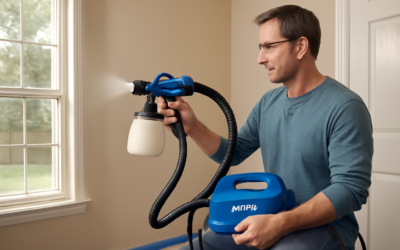
When a professional-grade Graco airless runs $400 to $1,200, the appeal of a Harbor Freight paint sprayer is obvious — you can walk out with a capable machine for a quarter of that. I’ve run these sprayers on fences, decks, cabinets, and full exterior repaints, and the honest verdict is that Harbor Freight’s paint gear punches well above its price for homeowner and light-pro use. You just have to pick the right model for the job and go in knowing where the corners were cut.
Part of our Paint & Walls guide — explore the full guide →
Here’s a straight breakdown of what Harbor Freight sells, what each one costs, and which project each one actually handles.
- The Three House Brands to Know
- Airless vs. HVLP: Pick the Right Type First
- Krause & Becker Airless: The Value Workhorse
- Bauer Airless: The Step Up
- Avanti and HVLP for Fine Finishes
- What You Get for the Money — and What You Don’t
- Setup, Tips, and Cleanup That Make or Break It
- Accessories and Coverage Rack
- Safety and Site Prep
- Which One Should You Buy?
The Three House Brands to Know
Harbor Freight sells paint sprayers under a few in-house labels, and knowing them saves confusion at the shelf:
- Bauer — the mid-to-upper tier, aimed at serious DIYers and light pros. Better pumps, longer warranties, and the airless line most people should look at first.
- Avanti — the value line, positioned below Bauer, covering budget airless and HVLP units for occasional users.
- Krause & Becker — Harbor Freight’s dedicated airless paint sprayer brand, competing directly with entry Graco and Wagner units on price.
You’ll also find generic HVLP and gravity-feed guns for compressors, but the airless machines are where these brands earn their reputation for big-job coverage.
Airless vs. HVLP: Pick the Right Type First
The type of sprayer matters more than the brand. Get this wrong and no amount of tuning will save the finish.
Airless
Airless pumps push paint through a small tip at 1,500-3,000 PSI, atomizing it without air. That means fast coverage and the ability to spray thick, unthinned latex — ideal for fences, siding, decks, and interior walls. The tradeoff is overspray and more masking. This is the type you want for anything big.
HVLP
High-volume, low-pressure guns use a turbine or compressor to atomize paint gently with far less overspray. They excel at fine finish work — cabinets, doors, furniture, trim — where control beats speed. Most need thinner-bodied materials or paint cut down to spray properly.
Krause & Becker Airless: The Value Workhorse
The Krause & Becker 1500 PSI airless is the classic Harbor Freight starter sprayer, typically priced around $180-$230. It draws paint straight from a 1- or 5-gallon bucket, handles unthinned latex, and reverses the tip to clear clogs. For a homeowner repainting a fence, a shed, or exterior siding once or twice a year, it’s plenty of machine.
Where it shows its price is duty cycle and durability — run it hard on back-to-back full-house jobs and the pump won’t last like a Graco. Flush it religiously after every use, because dried paint in the pump is what kills these units, not the price tag.
Bauer Airless: The Step Up
Bauer’s airless sprayers sit above Krause & Becker and typically run $250-$400 depending on model and whether it’s a stand or cart unit. You get higher max PSI, larger tip support for spraying heavier coatings, and better-built pumps. Bauer tools also ride Harbor Freight’s better warranty structure, and the cordless-adjacent ecosystem (Bauer is their flagship power-tool brand) means parts and support are easy to find.
If you’re repainting a whole house exterior, doing multiple decks a year, or you simply want a sprayer that’ll survive years of seasonal use, spend up for the Bauer. The extra $100 buys you a machine that won’t feel maxed out on a big job.
Avanti and HVLP for Fine Finishes
For cabinets, doors, and furniture, skip the airless and look at an HVLP unit. Harbor Freight’s Avanti and generic HVLP guns run $15-$60 for a compressor-fed gun, or more for a self-contained turbine setup. A gravity-feed HVLP gun with a 1.4mm tip sprays lacquer, thinned latex, and enamel with a glass-smooth finish and minimal overspray.
These need a compressor with enough CFM — check the gun’s requirement, often 4-9 CFM at 30-40 PSI, and match it to a compressor that can keep up, or the finish will sputter as pressure drops.
What You Get for the Money — and What You Don’t
Being clear-eyed about the tradeoffs saves you frustration:
- You get genuinely capable atomization, the ability to spray unthinned latex on the airless units, tip-reverse clog clearing, and coverage rates that turn a two-day brush job into an afternoon.
- You give up the refined pressure control, long duty cycle, and pump longevity of a $600 Graco. Included tips wear faster, and hoses can be stiffer.
For occasional-to-moderate use, that’s a trade most homeowners happily make. If you’re a full-time painter spraying every day, buy the commercial rig — but for everyone else, the value is real.
Setup, Tips, and Cleanup That Make or Break It
How you run and clean the sprayer matters more than which model you bought. A few rules:
- Match the tip to the coating. Use a 0.011-0.013 tip for stains and thin latex, 0.015-0.017 for thick exterior latex. The wrong tip either clogs or floods.
- Strain your paint. A $2 mesh strainer keeps skins and grit out of the pump and off your wall.
- Keep the gun 12 inches off the surface and move at a steady pace, overlapping each pass 50 percent for even coverage.
- Flush immediately after use. Water for latex, mineral spirits for oil. Cycle clean solvent through the pump until it runs clear, then store the pump wet with pump-saver fluid over winter. Dried paint in the pump is the number-one killer of budget sprayers.
Budget on a few gallons of paint wasted while you dial in your technique — spraying has a learning curve, and the first fence always eats more paint than you expect.
Accessories and Coverage Rack
The sprayer is only part of the kit. A few add-ons make the difference between a smooth job and a fight:
- Spare tips — tips wear out and change your spray width. Keep a couple of sizes on hand ($15-$30 each). A worn tip sprays a fatter, splotchier pattern that eats paint.
- Extension pole or tip extender — a 20-inch to 3-foot extender ($25-$60) saves your back and reaches soffits, high siding, and deck spindles without a ladder shuffle.
- Extra hose — 25 to 50 feet of airless hose lets you leave the pump parked while you move around a house.
- Pump-saver fluid — a $10 bottle that keeps seals from drying and cracking between jobs. Cheapest insurance you’ll buy.
On coverage, a homeowner airless lays down paint fast. Expect to cover an average deck or a mid-size fence in an afternoon, and a full one-story exterior over a weekend, versus days with a brush and roller. A gallon of exterior latex sprayed covers roughly 250-350 square feet per coat, similar to rolling but applied in a fraction of the time.
Safety and Site Prep
Airless pressure is no joke — 2,000-plus PSI can inject paint under your skin, which is a genuine medical emergency, so never point the gun at yourself and always engage the trigger lock when you stop. Wear a proper respirator rated for paint fumes (not a dust mask), safety glasses, and gloves, and spray with the garage door open or outdoors for ventilation.
Masking is where overspray gets tamed. Airless throws a fine mist that drifts, so tape and paper or plastic-sheet anything you don’t want painted, and pick a calm day for exterior work — even a light breeze will carry overspray onto a neighbor’s car two driveways down. Lay drop cloths well past the work area, because the mist settles farther than you’d think.
Which One Should You Buy?
Keep it simple. For a once-a-year fence, deck, or shed, the Krause & Becker airless at under $230 is the smart-money pick. For whole-house exteriors or heavier seasonal use, step up to a Bauer airless. For cabinets, trim, and furniture where finish quality is everything, get an HVLP gun and a compressor that can feed it.
A Harbor Freight paint sprayer won’t replace a contractor’s Graco on a daily job site, but for the homeowner tackling a few big painting projects a year, it delivers most of the speed and finish for a fraction of the cost — as long as you clean it out every single time.