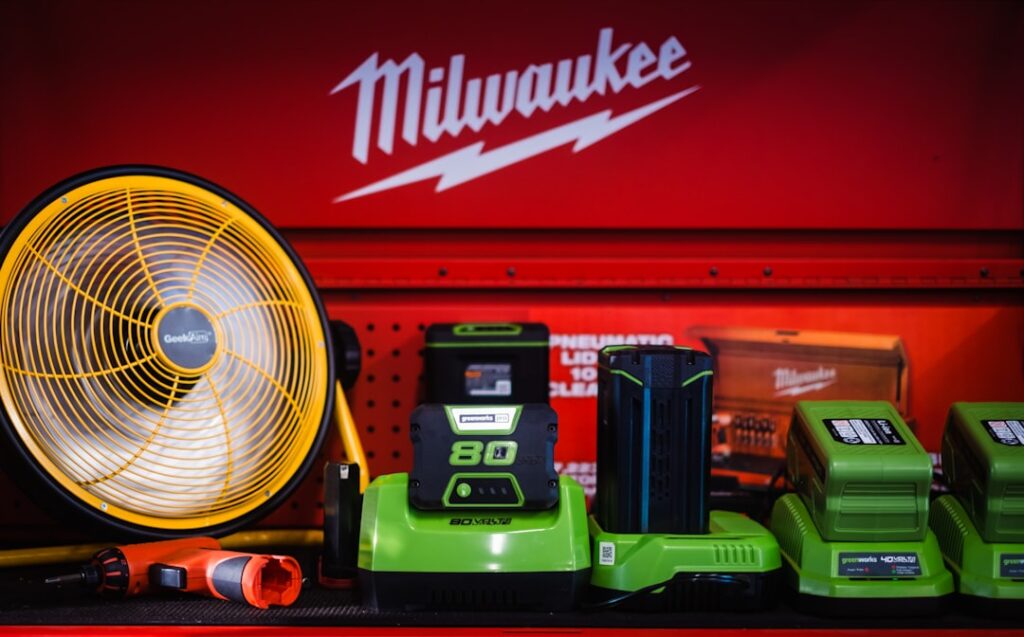
A Milwaukee paint sprayer brings cordless, airless spraying to the same M18 battery platform that already powers most of the tools in a serious DIYer’s garage. I’ve run these units on fence lines, cabinet doors, and full interior repaints, and the appeal is simple: no compressor, no cords, no dragging a bulky rig across the yard. Grab a charged battery and go.
- Why Cordless Airless Matters
- Milwaukee M18 Sprayer Models
- Understanding GPM and Tip Sizes
- What You Can Actually Paint
- Battery Life and Runtime
- Accessories Worth Buying
- Setup, Cleanup, and Maintenance
- Milwaukee vs. Corded and Competitor Sprayers
- Getting a Smooth Finish
- Is a Milwaukee Sprayer Worth It?
This guide walks through the actual models Milwaukee offers, how airless spraying works, what the GPM numbers mean for your project, and whether one of these tools makes sense over a traditional corded sprayer. By the end you’ll know exactly which unit fits your work.
Why Cordless Airless Matters
Airless sprayers pump paint at high pressure through a small tip that atomizes the coating into a fine fan. That’s how you get a smooth, brush-mark-free finish fast. Traditional airless rigs run on a corded pump or a gas engine and cost hundreds of dollars, plus you’re tethered to an outlet.
Milwaukee’s version puts that pump on an M18 battery. The trade-off is capacity: cordless units move less paint than a contractor-grade gas rig, so they shine on small-to-medium jobs rather than painting an entire two-story exterior in a day. For fences, decks, cabinets, doors, trim, and single rooms, the convenience is hard to beat.
Milwaukee M18 Sprayer Models
Milwaukee builds its sprayers around the M18 FUEL platform, and there are a few distinct tools depending on what you’re spraying.
M18 Handheld Airless Paint Sprayer
The flagship for finish work. It’s a handheld airless unit rated around 0.375 GPM, designed for cabinets, doors, trim, furniture, and small walls. You draw straight from a cup or, with the hose kit, from a 1- or 5-gallon bucket. Bare tool runs roughly $300–$350; kits with a battery and charger land around $450–$550. It handles unthinned latex, stains, and lacquers, which is rare for a handheld.
M18 Switch Tank Backpack Sprayer
Not an airless paint tool but worth knowing: this is a pressurized backpack for chemicals, water-based treatments, and pesticides with an interchangeable tank system. Don’t confuse it with the airless finish sprayer if paint is your goal.
M12 and specialty units
Milwaukee’s M12 line covers grease guns and smaller tasks, not paint. For painting, stay on the M18 airless platform.
Understanding GPM and Tip Sizes
GPM (gallons per minute) tells you how much material the pump can move. The M18 Handheld’s 0.375 GPM is plenty for finish work but modest next to a $600 corded rig pushing 0.5 GPM or more. For the projects this tool targets, that flow rate is well matched.
Tip size matters just as much. Spray tips are labeled with three digits, like 515. The first digit doubled gives the fan width in inches; the last two are the orifice size in thousandths of an inch. Match the tip to the coating:
- 210–312: thin materials like stains, sealers, and lacquers
- 313–415: latex primers and thinner wall paints
- 515–517: heavier latex and exterior paints
Use too small a tip for thick paint and the pump strains and spits; too large a tip on thin stain and you’ll waste material in overspray.
What You Can Actually Paint
Set realistic expectations and the Milwaukee paint sprayer will impress you. Here’s where each type of work lands.
- Cabinet doors and trim: ideal. The fine atomization gives a factory-smooth finish that brushing can’t match.
- Interior rooms: good for one to two rooms per session; a single M18 6.0Ah battery covers a decent stretch before a swap.
- Fences and decks: excellent with stain; the cordless design shines when there’s no outlet nearby.
- Full house exteriors: possible but slow. You’ll want a corded or gas rig for anything over 2,000 square feet.
Battery Life and Runtime
Runtime is the question every M18 owner asks. Pair the handheld sprayer with a higher-capacity pack for real work. A 5.0Ah or 6.0Ah battery will spray roughly a gallon to a gallon and a half of latex before needing a swap, and thinner stains stretch further.
Keep two batteries in rotation and a rapid charger nearby, and you’ll rarely stop working. The pump only draws power when you pull the trigger, so intermittent trim work sips battery while continuous wall spraying drains it faster. Buying the bare tool makes sense if you already own M18 batteries from a drill, saw, or impact driver.
Accessories Worth Buying
A few add-ons turn the M18 sprayer from good to genuinely versatile. Milwaukee and third-party makers offer several that pay for themselves fast.
- Suction hose kit: lets you draw straight from a 1- or 5-gallon bucket instead of refilling a small cup, essential for anything bigger than a few cabinet doors.
- Extra spray tips: keep a range on hand (312 for stain, 415 for wall paint, 515 for heavy latex) so you’re never forcing the wrong tip.
- Tip guard and extension pole: the extension reaches ceilings and high trim without a ladder shuffle.
- Extra pump filters: cheap insurance against clogs; swap them when flow drops.
- High-capacity batteries: a 6.0Ah or 8.0Ah pack stretches runtime meaningfully over the standard 5.0Ah.
Buy the suction hose and a spare battery first. Those two upgrades remove the biggest friction points, constant refilling and downtime, and make the tool feel like a proper airless rig rather than a handheld toy.
Setup, Cleanup, and Maintenance
Airless sprayers demand disciplined cleanup or they clog, and that’s true of every brand. After each session, relieve the pressure, run clean water (for latex) or the appropriate solvent (for oil-based coatings) through the pump until it runs clear, then pull and clean the tip and filter.
Budget 10 to 15 minutes of cleanup per session. Store the pump with a little pump-conditioner fluid in the system to keep seals from drying out. Skip cleanup once and you’ll spend an hour clearing a dried tip, so build it into every job. Strain your paint through a mesh filter before loading, and you’ll prevent most clogs before they start.
Milwaukee vs. Corded and Competitor Sprayers
It’s worth knowing where the Milwaukee lands against the alternatives so you buy the right tool the first time. Graco and Wagner dominate the corded airless market, and a Graco Magnum X5 or X7 ($350–$500) moves more paint per minute and won’t stop for a battery swap, making it the better pick for whole-house exteriors and back-to-back rooms.
Where Milwaukee wins is integration and portability. If your garage already runs on M18, buying the bare sprayer for around $300 means no new charger, no new batteries, and no cord hunting for an outlet. Wagner’s cordless handheld units compete on price but sit on their own battery platform, so you’re starting a second ecosystem. For an M18 owner, that convenience premium is usually the deciding factor.
Quick comparison
- Milwaukee M18 Handheld: best for cordless finish work if you own M18 batteries
- Graco Magnum X5/X7: best for full exteriors and high-volume corded work
- Wagner Flexio / cordless: budget entry point, separate battery platform
Getting a Smooth Finish
The tool only takes you so far; technique delivers the finish. Hold the sprayer 10 to 12 inches from the surface and keep it perpendicular, moving your whole arm rather than flicking your wrist, which fans the coating unevenly and causes heavy edges. Start your pass before you pull the trigger and release after you’ve moved past the edge so you don’t build up paint at the turnaround.
Overlap each pass by about 50 percent for even coverage, and thin heavy latex slightly if the pump struggles or you see spitting. Practice on a scrap of cardboard or an old door to dial in your speed before you commit to the real surface. Two thin coats always beat one heavy coat that runs and sags. Get those fundamentals down and the M18’s atomization gives you a finish that genuinely rivals a spray booth.
Is a Milwaukee Sprayer Worth It?
If you’re already committed to the M18 ecosystem, the answer is usually yes for anyone doing regular finish work. The bare-tool price is reasonable when you own batteries, and the cordless freedom genuinely changes how you approach fences, cabinets, and touch-ups.
For a one-time full-house exterior, rent a corded airless rig instead, you’ll finish faster and spend less. But for the homeowner who repaints trim, refreshes cabinets, and stains a deck every couple of seasons, the Milwaukee paint sprayer earns its place on the shelf. Match the tip to your coating, keep a spare battery charged, and clean it every time, and it’ll deliver professional-looking results for years.