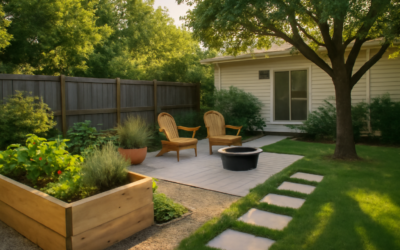
The 2025 Houzz Outdoor Trends Report found that homeowners spent a median of $14,000 on backyard upgrades, with the top earners pulling in 75-90% of project cost at resale. The yard has become an outdoor room — extended living space rather than ornamental landscaping. The strongest backyard remodel ideas blend usability with weather-resistant materials and lighting that turns a daytime patio into an evening retreat. Here are the projects worth your money in 2026, from $500 weekend builds to $50,000 transformations.
Define the Function First
Before you sketch anything, ask how the yard will get used. Cooking and dining for six people every weekend? You need a 12×14 ft minimum patio plus an outdoor kitchen. Quiet morning coffee solo? A 6×8 ft deck with shade and a hammock might do it. Kids and dogs running everywhere? Lawn space and durable pavers around play zones beat fragile gravel.
Write down three uses, rank them, and design for the top two. The biggest backyard renovation regret is a beautiful space that doesn’t match how the household actually lives.
Hardscape Foundations
Hardscape (anything not living) sets the structure. Concrete pavers from Belgard, Techo-Bloc, or Unilock run $15-30 per sq ft installed and last 25-40 years with minimal maintenance. Natural flagstone delivers more character at $20-40 per sq ft. Stamped concrete is cheaper at $12-22 per sq ft but cracks unpredictably and looks dated faster than tile or paver work.
- Patio paver expansion: $4,000-12,000 for 200-400 sq ft
- Concrete deck overlay: $1,500-4,000 to refresh existing slabs
- Travertine pool deck: $25-45 per sq ft installed
- Decomposed granite paths: $3-6 per sq ft for casual walkways
Decks and Pergolas
A second-story deck on a typical house averages $30-60 per sq ft installed for pressure-treated pine, $45-90 per sq ft for cedar, and $55-110 per sq ft for composite like Trex Transcend or TimberTech AZEK. Composite decks last 25-30 years versus 12-15 years for stained PT pine, which often closes the cost gap once you factor in two rounds of staining.
Pergolas add architecture and shade. A 12×14 ft cedar pergola runs $5,000-9,000 installed; a kit version from Costco or Yardistry is $1,800-3,500 for the DIY weekend route. Aluminum louvered pergolas (Struxure, StruXure Pergola X, Renson) hit $12,000-25,000 but rotate slats to control sun and rain — game-changing if you live somewhere with summer thunderstorms.
Outdoor Kitchens
The simplest outdoor kitchen is a $600-1,500 cart-style grill on a paver pad. Mid-range builds include a built-in 36-inch grill, a side burner, storage cabinets, and counter space — typically $8,000-18,000 with stone or stucco facing. Premium kitchens add pizza ovens, beverage centers, plumbed sinks, and refrigeration; these run $25,000-60,000 and require permits in most jurisdictions.
If you cook outdoors fewer than 8 times a year, skip the built-in. A high-quality cart grill on a paver patio delivers 90% of the experience for 10% of the cost.
Fire Features
A fire pit extends the season by 6-8 weeks in most climates. Options range from $200 portable steel bowls (Solo Stove Bonfire 2.0) to $5,000-12,000 gas-plumbed fire tables. The most popular middle ground — a 36-inch round wood-burning paver pit — costs $400-1,200 in materials for the DIY route, $2,500-5,000 installed.
Check your local burn ordinances. Many western states ban open wood fires during summer; gas fire tables are the workaround that keeps the feature usable year-round.
Water Features
A small recirculating fountain ($300-1,200 from Aquascape or Pondless) adds white noise that masks neighbor sounds, traffic, and HVAC compressors. Larger formal pools, plunge pools, and waterfalls run $30,000-100,000+ — viable when the budget allows but rarely a top ROI move.
Hot tubs split the difference. A mid-tier Jacuzzi or Hot Spring 6-person model costs $9,000-15,000 installed; a budget Costco model is $4,500-7,500. Annual operating cost runs $400-700 in electricity plus chemicals.
Outdoor Lighting
Lighting is the highest-impact, lowest-cost upgrade in this entire list. A $400-1,500 low-voltage LED system with path lights, downlights in trees, and warm 2700K accent fixtures transforms a yard at dusk. Run the wiring before you finish landscaping, not after.
- Smart controllers (Rachio, Hunter Hydrawise): $200-400 for app-controlled scheduling
- String lights overhead: $80-200 for the bulbs and a few posts to anchor them
- Pathway lights: $25-60 each, plan one every 6-8 ft along walkways
- Uplights for trees: $40-80 each, two per mature tree for symmetric coverage
Privacy and Boundaries
A 6 ft cedar privacy fence runs $25-45 per linear ft installed. Composite (Trex Seclusions) hits $50-80 per linear ft and never needs staining. For softer screens, fast-growing arborvitae (Green Giant or Emerald) at 5-6 ft tall costs $50-120 per tree and forms a hedge in 3-5 years. Bamboo (clumping varieties only — never running types like Phyllostachys) creates a tropical screen but requires root barriers.
Garden and Lawn Refresh
Smart irrigation, drought-tolerant native plants, and reduced lawn area cut water bills by 30-50% in arid regions. Replace bluegrass with buffalo grass, hardscape, or pollinator gardens. Raised vegetable beds in cedar or galvanized stock tank troughs ($150-500 each) add productive space and visual structure.
ROI Snapshot
Return at resale according to Remodeling magazine’s 2025 Cost vs Value Report:
- Wood deck addition: 89% recouped
- Composite deck addition: 71% recouped
- Landscape lighting and refresh: 100%+ in many markets
- In-ground pool: 30-50% — a lifestyle decision, not a financial one
- Outdoor kitchen: 55-70%
Phasing the Project
Most successful backyard remodel ideas come together over 2-3 phases rather than all at once. Year one: hardscape and major plantings. Year two: structures (pergola, deck additions, kitchen). Year three: lighting refinement and decorative landscape. This approach lets each phase inform the next and spreads the cash flow.
Bottom Line
Start with how you’ll use the space, anchor with quality hardscape, layer in shade and lighting, and add features the household will actually use. A well-planned backyard pays back in daily living long before resale ever enters the picture.