
A paver patio is the highest-return outdoor project most homeowners can tackle themselves, and the best backyard simple paver patio ideas prove you do not need a landscape architect or a five-figure budget to get a beautiful result. With a bag of jointing sand, a plate compactor, and a weekend or two, you can lay a clean, level patio that turns an unused patch of lawn into an outdoor room. The key is keeping the design simple and the base rock solid. Here are approachable ideas and the fundamentals that make them last.
Part of our Decks & Outdoor guide — explore the full guide →
- Why Pavers Beat Poured Concrete for DIY
- Simple Layout Ideas That Look Custom
- Choosing Your Pavers
- The Base Is Everything
- Edge Restraint Keeps It Together
- Budget-Friendly Design Touches
- Sizing the Patio for How You’ll Use It
- Handling Cuts and Curves
- Maintenance to Keep It Looking New
- What It Costs and How Long It Takes
- Adding Character With Color and Texture
- The Bottom Line
Why Pavers Beat Poured Concrete for DIY
Poured concrete looks great until it cracks, and repairing a crack means an ugly patch or a full tear-out. Pavers flex with the ground, so they resist cracking, and if one gets stained or damaged you simply lift and replace it. That forgiveness is exactly why so many backyard simple paver patio ideas are DIY-friendly; there is no pouring window to beat, no finishing skill to master, just careful base prep and patient placement.
Pavers also offer far more design flexibility. Colors, shapes, and patterns let you match your home, and you can start small and expand later without a demolition.
Simple Layout Ideas That Look Custom
You do not need an intricate herringbone to get a polished patio. These easy layouts deliver a high-end look with minimal cutting:
- Running bond: Rectangular pavers offset like brickwork. Fast, forgiving, and timeless, with very little cutting.
- Stack bond grid: Square pavers in a clean grid for a modern, tailored feel. Great with large-format concrete pavers.
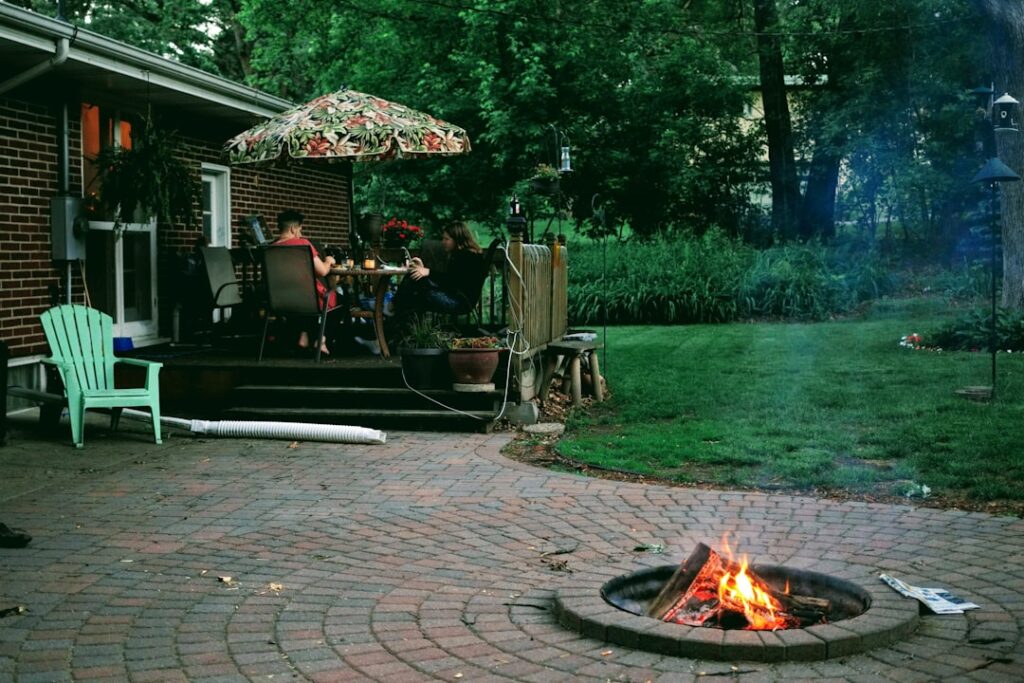
- Circle kit: Pre-packaged fan-shaped pavers that assemble into a perfect circle, ideal as a fire-pit base or dining nook.
- Random modular: A mix of two or three paver sizes laid in a repeating pattern, sold as a bundle so the math is done for you.
For a first patio, running bond with rectangular pavers is the most beginner-friendly and looks great in any yard.
Choosing Your Pavers
The paver material sets the tone and the budget:
- Concrete pavers: The most popular and affordable, roughly $2 to $6 per square foot for the pavers themselves, in endless colors and shapes.
- Brick pavers: Classic and warm, a bit pricier, with a timeless red-clay look that ages beautifully.
- Natural stone (flagstone, bluestone): The premium look at $8 to $20-plus per square foot, with irregular natural character.
- Large-format porcelain pavers: A modern, low-maintenance option that resists stains and fading.
Concrete pavers hit the sweet spot of cost, durability, and selection for most backyard projects.
The Base Is Everything
A paver patio fails or succeeds below the surface. Skimp on the base and you will get sinking, heaving, and wobbly pavers within a season. The proven build-up, from the bottom up, is straightforward:
- Excavate about 7 to 9 inches deep for the full assembly, sloping the ground away from the house at about 1/4 inch per foot for drainage.
- Lay and compact 4 to 6 inches of crushed gravel base in 2-inch lifts, wetting and tamping each layer.
- Screed a 1-inch layer of coarse bedding sand over the compacted base, perfectly level.
- Set the pavers, then sweep polymeric jointing sand into the gaps and compact with a plate compactor.
The slope for drainage is the detail beginners forget, and it is what keeps water from pooling on your new patio.
Edge Restraint Keeps It Together
Without an edge, pavers spread and drift apart over time. Install plastic paver edging around the perimeter, spiked into the base with 10-inch landscape spikes, before or after you set the field pavers. It is a small, cheap step that locks the whole patio in place for the long haul. Skip it and the outer courses will creep outward every year.
Budget-Friendly Design Touches
Simple does not mean plain. A few low-cost moves elevate a basic patio:
- Add a soldier-course border in a contrasting paver color to frame the field and hide cut edges.
- Center a circle-kit fire pit as a focal point for evening gatherings.
- Leave planting pockets at the corners for ornamental grasses or a small tree.
- Run a gravel or mulch transition strip between the patio and the lawn for a clean, finished edge.
Sizing the Patio for How You’ll Use It
Before you fall in love with a pattern, size the space around its purpose. A patio that is too small feels cramped the moment you set out furniture, and it is far cheaper to build it right the first time than to expand later. Use these rules of thumb.
- Dining for four: Plan at least a 10-by-10-foot area so chairs can pull back from the table without falling off the edge.
- Dining for six to eight: Step up to roughly 12 by 14 feet or larger.
- Conversation or lounge area: A 12-by-12-foot space holds a small sofa, a couple of chairs, and a coffee table comfortably.
- Fire-pit gathering: Allow about 7 feet of clear space around the pit on all sides for chairs and walkways.
Mark the footprint with a garden hose or spray paint and live with it for a day. Set a table and chairs in the outline to feel the scale before you dig.
Handling Cuts and Curves
Even a simple patio usually needs a few cut pavers along the borders, and knowing how to handle them separates a clean job from a ragged one. Rent or buy a masonry blade for a circular saw, or a dedicated brick splitter for cleaner breaks. Lay all your full pavers first, then mark and cut the perimeter pieces to fit, which minimizes waste and keeps the field pattern consistent.
For a gentle curve, a soldier-course border of pavers set on end follows the arc more forgivingly than trying to cut the field pavers to a radius. Keep cut edges tucked against the border where they are least visible. Wear eye protection and a dust mask whenever you cut concrete or stone; the silica dust is no joke.
Maintenance to Keep It Looking New
A paver patio is low-maintenance but not no-maintenance. Sweep it regularly and rinse off spills before they stain. Every few years, top off the polymeric jointing sand in the gaps, since it slowly washes out and its absence invites weeds and ant hills. Pull any weeds that sprout in the joints promptly. Applying a paver sealer every two to three years deepens the color and makes the surface easier to clean, though it is optional. If a single paver ever cracks or stains badly, the beauty of the system is that you pry it out and drop in a replacement in minutes.
What It Costs and How Long It Takes
A DIY paver patio typically runs $8 to $15 per square foot in materials, so a 12-by-12-foot patio lands somewhere around $1,200 to $2,000 depending on paver choice. Hiring it out doubles or triples that. Time-wise, plan two weekends for a first-timer on a modest patio: one for excavation and base, one for setting pavers and finishing. Renting a plate compactor for a day is money well spent and dramatically improves the result.
Adding Character With Color and Texture
A simple layout does not have to look plain, and small choices in color and texture give a basic patio real personality. Manufacturers blend pavers in tumbled, smooth, and textured finishes, and mixing two complementary colors adds depth without complicating the install.
- Blended color pavers: A bag that mixes two or three related tones reads as natural stone and hides minor staining over time.
- Tumbled finish: Softened edges give an aged, old-world look that suits traditional homes.
- Contrasting border: A single darker soldier course around the perimeter frames the whole patio crisply.
- Banding: A stripe of accent pavers running through the field breaks up a large expanse.
Pull your paver color from something already on the house, the roof, the brick, or the trim, so the patio feels connected rather than random. Order a few loose pavers as samples and set them out in the actual space, viewing them in both sun and shade before committing to a full pallet. These finishing choices cost little extra but elevate a weekend project into something that looks professionally designed.
The Bottom Line
The most successful backyard simple paver patio ideas pair an easy layout, running bond or a circle kit, with a properly compacted gravel base, correct drainage slope, and solid edge restraint. Choose concrete pavers for the best value, keep the pattern simple, and add a border or fire pit for character. Respect the base prep and your patio will stay level and beautiful for decades, all for a fraction of what a contractor would charge.


