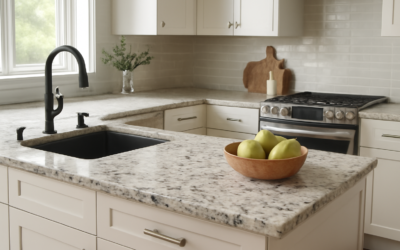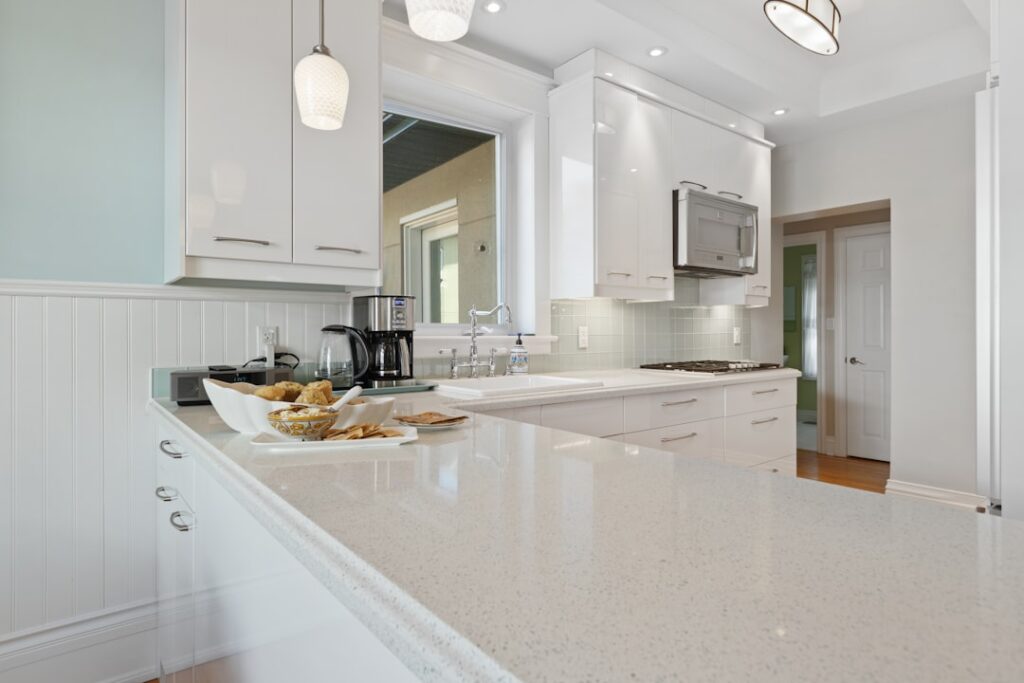
If you want the bright, airy feel of white countertops without the fragility of marble, Bengal White granite deserves a spot on your short list. Quarried in India, this natural stone pairs a creamy off-white background with scattered gray, gold, and burgundy-brown flecks that give it warmth and depth. It reads as a light, neutral surface from across the room, then rewards a closer look with subtle mineral speckling. This guide covers the color range, pricing, sealing, and design pairings so you know exactly what you are getting before it lands in your kitchen.
Part of our Countertops guide — explore the full guide →
What Bengal White Granite Looks Like
The base color falls between soft white and light cream, which is what makes this stone so flexible in kitchens and baths. Across that background you will see a fine, even scatter of specks in gray, taupe, honey-gold, and occasional deep burgundy or garnet-red. Unlike bold movement stones such as Blue Bahia or Van Gogh, Bengal White has a relatively calm, consistent pattern that works in both traditional and transitional rooms.
Because it is a natural quarried granite, no two slabs are identical. Some blocks run warmer and creamier, while others lean cooler and grayer. Always view the actual slabs your fabricator will cut rather than approving from a two-inch sample, since the speckle density and undertone can shift noticeably from one lot to the next.
Cost and What Drives the Price
Bengal White sits in the entry-to-mid price tier for imported granite. Installed, most homeowners pay between $40 and $70 per square foot, with the final number driven by slab thickness, edge profile, cutouts, and your local labor rates. A standard 40-square-foot kitchen typically lands in the $1,800 to $3,200 range fully installed.
- Material only: $8 to $20 per square foot at the slab yard
- Installed (fabrication plus setting): $40 to $70 per square foot
- Undermount sink cutout: $150 to $350 each
- Upgraded edges (ogee, mitered): $10 to $25 per linear foot extra
To stretch your budget, ask about 2-centimeter slabs with a laminated edge instead of full 3-centimeter stock, and check whether your fabricator has remnants large enough for a bathroom vanity.
Durability and Everyday Performance
Granite ranks 6 to 7 on the Mohs hardness scale, so Bengal White resists scratches from knives and cookware far better than marble or soft limestone. It also handles heat well; you can set a pot straight off a 400°F burner on a sealed slab without scorching it, though a trivet is still smart insurance against thermal shock on the seams.
The light background is more forgiving of everyday crumbs and water spots than a solid black granite, which shows every fingerprint. That said, the pale color means a deep stain from red wine, coffee, or turmeric will be more visible if the stone is not properly sealed, so sealing matters more here than it would on a busy dark stone.
Sealing and Maintenance
Like most light granites, Bengal White is moderately porous and should be sealed on installation and roughly once a year after that. Test the seal with the water-drop method: pour a tablespoon of water on the surface and wait 10 to 15 minutes. If it beads and stays on top, the seal is intact; if the stone darkens where the water sat, it is time to reseal.
- Clean the surface with a pH-neutral stone cleaner and let it dry fully.
- Apply an impregnating penetrating sealer with a clean cloth or applicator pad.
- Let it dwell 5 to 15 minutes per the product label, then buff off all residue.
- Avoid using the counter for 24 hours while the sealer cures.
For daily cleaning, skip vinegar, bleach, and abrasive pads, which can dull the polish over time. Warm water with a few drops of dish soap or a dedicated granite spray keeps the surface bright.
Design Pairings That Work
The creamy, warm-neutral tone of this stone makes it one of the easiest granites to design around. It flatters both white and wood cabinetry and bridges warm and cool palettes without clashing. Because the background carries hints of gold and burgundy, it especially loves warm-toned woods and brass or oil-rubbed bronze hardware.
- White or cream shaker cabinets for a bright, timeless kitchen
- Honey oak, walnut, or maple cabinetry to echo the gold flecks
- Navy or sage lower cabinets with white uppers for a two-tone look
- Travertine, subway, or beige tumbled-stone backsplashes
For flooring, warm-toned wood-look tile or hardwood keeps the palette cohesive, while a soft gray porcelain grounds the room without fighting the speckles.
Bengal White Compared to Similar Stones
Shoppers cross-shopping light granite often weigh Bengal White against a handful of look-alikes. Compared with Colonial White, Bengal White generally shows warmer gold and burgundy tones, while Colonial White leans cooler with gray and garnet specks. Against Alaska White, Bengal White has a softer, creamier base rather than a bright, high-contrast white with heavy black flecks.
If you prefer the look of marble but want granite durability, Bengal White is a practical alternative because it delivers a light surface that resists etching from acidic foods, something marble cannot claim. It will not mimic marble’s dramatic gray veining, so choose it when you want a speckled, textured look rather than long sweeping veins.
Is Bengal White Granite Right for You?
Choose this stone if you want a light, warm, low-drama surface that flatters a wide range of cabinet colors and stands up to real cooking. It is an excellent value for families who want the resilience of granite and the brightness of white without the premium price of Calacatta-look quartz or the maintenance headaches of true marble. The main commitment is annual sealing, which takes about 20 minutes and a $25 bottle of sealer. For most homeowners, that small chore is a fair trade for a durable, timeless surface, and Bengal White granite delivers on both counts.
Where Bengal White Works Best
This stone is most at home in kitchens, but its versatility extends well beyond the main counter run. On a large island, the calm speckled field reads as a soft neutral that anchors an open-plan space without competing with cabinetry or a bold backsplash. In bathrooms, its light tone brightens a vanity and pairs naturally with brushed nickel or brass fixtures. It also holds up on a bar top or a laundry-room counter, where durability matters more than showpiece drama.
One practical advantage worth noting: because the pattern is busy and mid-toned, Bengal White hides the small stuff that plagues solid-color surfaces. Toothpaste splatter on a bathroom vanity, coffee rings on a kitchen counter, and everyday dust all disappear into the speckle far better than they would on a jet-black or pure-white slab. For a busy household that wants a stone that looks clean between deep cleanings, that forgiveness is a real, day-to-day benefit.
Ordering and Installation Tips
When you order, insist on hand-selecting the exact slabs your fabricator will cut, and ask them to lay out the seams before cutting so any joints fall in low-visibility spots rather than across the middle of the island. Confirm the edge profile, sink type, and backsplash height in a written quote so nothing is a surprise on install day. A reputable fabricator will template after your cabinets are set and level, then return to install roughly one to two weeks later. Budget a day for the install itself and hold off on heavy use for 24 hours while the seam adhesive and first coat of sealer cure fully.