Red paint has a reputation for being hard to live with, and most of that comes from picking a red that is too bright or too pink. Benjamin Moore Heritage Red avoids both. Listed as HC-181 in the brand’s Historical Colors collection, it is described by the manufacturer as a very classic shade of red that infuses a space with energy and personality. Its light reflectance value (LRV) is listed at 10.26.
That low LRV tells you it is a deep color that absorbs most of the light hitting it. On a front door, shutters or a barn-style shed, it reads as a confident, traditional red. Indoors, it works best as an accent: a dining room, a library wall, an island, or built-in cabinetry where a rich color adds character without covering an entire open floor plan.
- Benjamin Moore Heritage Red Specs at a Glance
- Undertones: How Heritage Red Reads
- Where Heritage Red Works Best
- Coordinating Trim and Accent Colors
- Heritage Red vs Similar Reds
- How to Paint With a Deep Red
- Troubleshooting Red Paint Problems
- Cost and Effort
- When to Call a Pro
- Benjamin Moore Heritage Red FAQ
If you want a heritage look, think colonial homes, red barns or a classic front door, it is one of the more versatile choices because it sits close to a true red rather than leaning strongly toward orange or purple.
Benjamin Moore Heritage Red Specs at a Glance
The values here come from the color’s page on the manufacturer’s website. Always confirm with a current physical sample, since reds shift a lot on screens.
| Spec | Value | What it means |
|---|---|---|
| Color code | HC-181 | Use the code when ordering so the mix is exact |
| Collection | Historical Colors | A palette inspired by traditional American architecture |
| LRV | 10.26 | A deep color that reflects only about a tenth of light |
| Color family | Red | Reads as a fairly balanced red; also sold premixed as PM-18; check your sample for warmth in your light |
| Coordinating colors listed | Ashley Gray (HC-87), Fossil (AF-65), Balboa Mist (OC-27), Flint (AF-560) | Manufacturer-suggested partners for trim, walls and accents |
| Typical sheen picks | Satin or semi-gloss for doors and trim; matte or eggshell for walls | Sheen options depend on the product line |
Undertones: How Heritage Red Reads
The manufacturer does not publish a specific undertone, and on most walls the color reads as a classic, fairly balanced red. In warm, low afternoon light it can look a touch warmer and closer to brick. In cool north light and under daylight bulbs it can deepen and look slightly cooler, nudging toward a cranberry feel. It does not read pink, and it is not a strongly orange fire-engine red.
Because the color is so deep, undertone matters most where it touches other colors. Next to a stark blue-white it looks bolder and more saturated. Next to warm creams or mid-tone taupes it looks more traditional and settled. That makes trim choice a real lever for changing the overall mood.
Where Heritage Red Works Best
Front doors
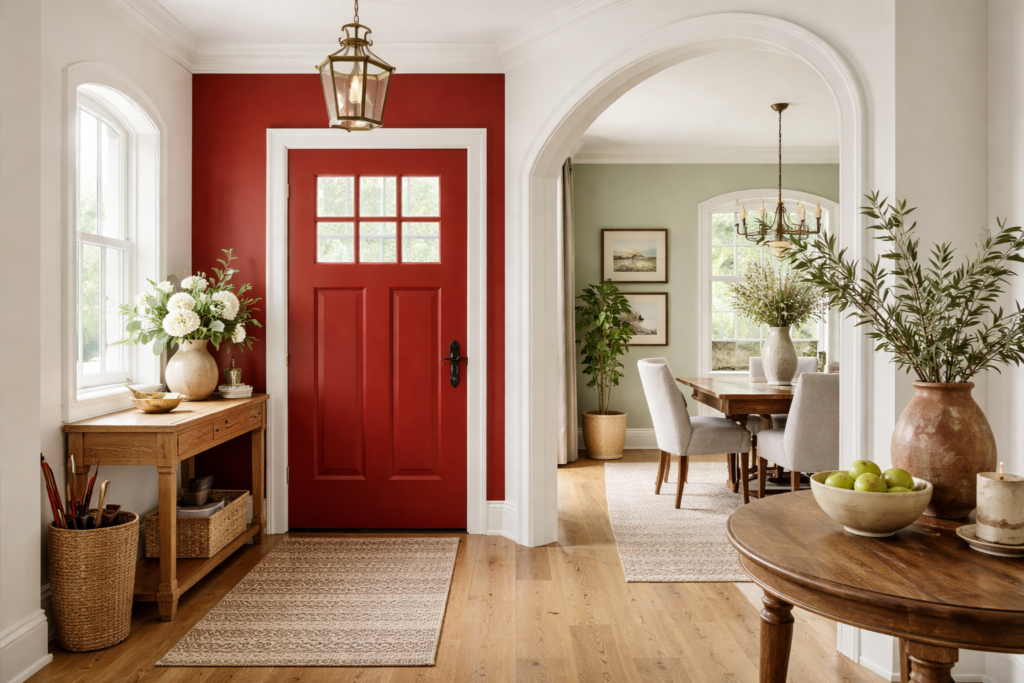
This is the most common use, and for good reason. A deep, classic red door suits white, gray, navy and tan siding, and it pairs well with black hardware. Use an exterior-rated door paint, and check that your chosen product line is offered in the color for exterior use.
Shutters, sheds and barns
On shutters with white or light gray siding, it gives a crisp traditional look. On outbuildings, it reads as an updated barn red. Deep colors on south and west elevations get strong sun, so expect to recoat more often than with lighter colors.
Dining rooms and libraries
Rich red has a long history in dining rooms because it feels warm and inviting under evening lamplight. With an LRV around 10, it makes a room feel more enclosed, which suits formal dining rooms and dens better than small, dark spaces.
Cabinets, islands and furniture
A kitchen island or a painted hutch in this red adds a focal point without overpowering the room. A satin or semi-gloss finish holds up to handling and cleaning.
Accent walls
One wall behind a bed, a fireplace or open shelving is often enough. Keep the other walls in a soft neutral so the red reads as deliberate.
Coordinating Trim and Accent Colors
The manufacturer lists four coordinating colors, and they cover the main directions you might want to go.
- Balboa Mist (OC-27): A pale gray with a slightly warm cast and an LRV of 65.53. It works on walls next to a red accent or on trim when you want softer contrast than white.
- Fossil (AF-65): A quiet beige with an LRV of 71.59. It gives a warm, traditional backdrop for red doors and red cabinetry.
- Ashley Gray (HC-87): A mid-toned color with adaptable taupe undertones and an LRV of 33.45. It suits siding with a red door, or lower cabinets with a red island.
- Flint (AF-560): A cool charcoal with an LRV of 11.96. Pair it with red for a dramatic, modern look on doors, trim or exterior accents.
For classic white trim, a clean white such as White Dove (OC-17), listed at an LRV of 83.16, gives crisp contrast around a red door or a red dining room. Black hardware, aged brass and natural wood also suit this color well.
Heritage Red vs Similar Reds
- Heritage Red vs Caliente (AF-290): Caliente is the brand’s other well-known classic red, described as charismatic, radiant and full of energy. At an LRV of 8.82 it is slightly deeper than Heritage Red’s 10.26, and many people find it reads a bit more saturated. Sample both side by side on your door or wall.
- Heritage Red vs barn reds: Traditional barn reds lean more brown and orange. Heritage Red usually looks cleaner and brighter next to them, while barn reds look more rustic.
- Heritage Red vs burgundy and oxblood shades: Burgundies lean purple and look deeper and moodier. Heritage Red reads more cheerful and traditional.
How to Paint With a Deep Red
- Sample on site. Peel-and-stick paint sample swatches or painted boards are more reliable than small chips, especially for deep reds.
- Prep the surface. Clean, sand glossy surfaces lightly, and fill dents. Deep colors highlight surface flaws.
- Use a tinted primer. A gray or color-matched primer helps a deep red cover in fewer coats. Ask the paint desk which primer tint suits the color.
- Choose quality paint. Deep reds rely on a lot of colorant. Better paint lines generally cover more evenly.
- Plan on two or three coats. Reds often need more coats than neutrals for full, even color. Let each coat dry fully.
- Keep a wet edge. Work in sections and finish each one without stopping to avoid lap marks.
A quart is usually enough for a standard front door. A gallon typically covers about 350 to 400 square feet per coat on a smooth wall, though deep colors may need extra coats.
Troubleshooting Red Paint Problems
Patchy or streaky coverage. Usually caused by skipping tinted primer or applying too few coats. Add another coat with a quality roller or brush.
Looks too bright. Strong daylight and cool white trim can make red look louder. Try a warmer trim or use the red on a smaller surface.
Looks too dark indoors. Low light deepens the color. Add lamps with warm bulbs or limit it to one wall.
Fading outside. Deep colors on sunny exposures can fade over time. Use an exterior product rated for the conditions and plan periodic recoats.
Cost and Effort
Painting a front door yourself usually costs the price of a quart of exterior door paint, a primer and basic supplies, often well under $100. A professional painter commonly charges a few hundred dollars for a door. An accent wall is an easy weekend project; a full dining room in a deep red takes longer because of the extra coats.
When to Call a Pro
Deep reds are less forgiving than neutrals, so hire a painter for a large room, high walls, or exterior work above the first floor. A pro is also worth it for cabinets, where a smooth sprayed finish makes a big difference. For a front door or a single wall, careful prep and patience usually give good results with Benjamin Moore Heritage Red.
Benjamin Moore Heritage Red FAQ
What is the LRV of Heritage Red?
The manufacturer lists Heritage Red (HC-181) at an LRV of 10.26, which makes it a deep color that absorbs most light.
Is Heritage Red warm or cool?
It reads as a classic, fairly balanced red. Warm light can make it look slightly warmer, and cool light can make it look a little deeper.
What trim color goes with Heritage Red?
A clean white gives classic contrast. The manufacturer also lists Balboa Mist, Fossil, Ashley Gray and Flint as coordinating colors.
Is Heritage Red good for a front door?
Yes, it is a traditional front door red that suits white, gray, navy and tan siding. Use an exterior-rated door paint in a satin or semi-gloss finish.
How does Heritage Red compare to Caliente?
Both are classic reds. Caliente has an LRV of 8.82, slightly deeper than Heritage Red, so sample them side by side.