
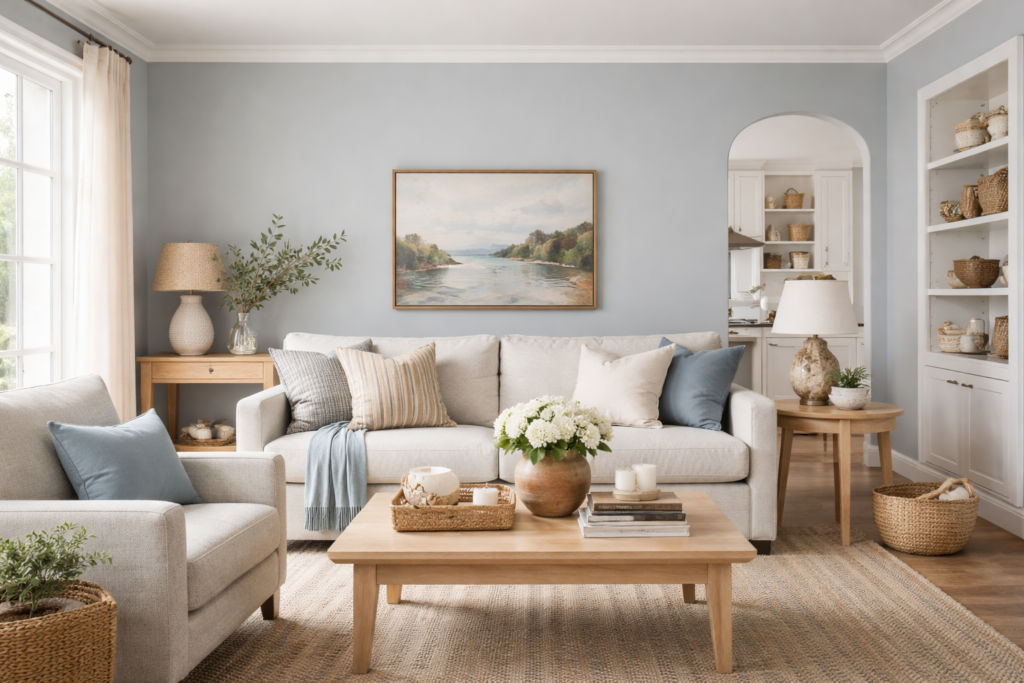
Blue-grays are tricky: too much gray and they look drab, too much blue and they look like a nursery. Benjamin Moore Normandy lands in a useful middle ground. It is color 2129-40 in the Color Preview collection, described by the manufacturer as a deep, distinguished shade of blue-gray with endless adaptability, and it has a light reflectance value (LRV) of 21.73.
That LRV makes it a medium-dark color. It is clearly lighter than a navy, but it will noticeably darken a room compared with a pale gray. On the wall it reads as a moody, slate-like blue-gray that shifts between blue and gray depending on the light. It works on accent walls, bedrooms, offices, kitchen cabinetry, bathroom vanities and exteriors.
- Benjamin Moore Normandy at a Glance
- Undertones and How Normandy Changes in Light
- Where Normandy Works Best
- Trim, Ceiling and Accent Pairings
- Normandy vs Similar Blue-Gray Shades
- Choosing a Sheen and Product for Normandy
- Testing and Painting Steps
- Troubleshooting Common Problems
- Cost and When to Call a Painter
- Frequently Asked Questions
The sections that follow cover the confirmed specs, how its undertone changes through the day, rooms it suits, trim and accent pairings from the maker’s coordinating list, and a side-by-side with similar blue-gray and slate shades.
Benjamin Moore Normandy at a Glance
These details come from the manufacturer’s color page at the time of writing. Check the current page before ordering, since collections and color information can be updated.
| Spec | Value | What it means |
|---|---|---|
| Color number | 2129-40 | Use the full number when ordering; it identifies the exact formula |
| Collection | Color Preview | A large, organized palette arranged in color strips |
| Color family | Listed under Neutral | Behaves like a versatile neutral despite its visible blue |
| LRV | 21.73 | Medium-dark: reflects about a fifth of light, so it adds depth |
| Character | Deep blue-gray (maker description) | Cool overall, shifting between blue and slate gray |
| Coordinating colors (maker list) | White Heron OC-57, Marilyn’s Dress 2125-60, Steam AF-15, Wish AF-680 | Soft whites, a cool off-white and a warm light gray for trim and adjoining rooms |
| Similar colors (maker list) | Alfresco 1672, Black Pepper 2130-40, Wolf Gray 2127-40, Stillwater 1650 | Nearby blue-grays and slates to compare |
Sheen is separate from color. Choose the interior or exterior product line first and confirm it offers the sheen you want for walls, trim or cabinets.
Undertones and How Normandy Changes in Light
Normandy’s base is a cool blue softened with gray. The manufacturer files it under neutrals, which hints at how it behaves: it acts as a backdrop rather than a bold statement, even though most people will see it as blue.
North-facing light pushes it grayer and darker, toward slate or stormy sky. South-facing rooms with strong sun bring out more of the blue, and it can feel fresher and slightly lighter. In the evening under warm bulbs, the gray softens and it can read almost like a muted denim. Very cool daylight bulbs make it look crisper and cooler.
With an LRV around 22, expect it to look one step darker on the wall than on a small chip. Large swatches tell you much more than a fan deck.
Where Normandy Works Best
- Bedrooms: cool, calm and enveloping, especially as a headboard wall or full room with white bedding.
- Home offices and studies: a focused, tailored backdrop that photographs well on video calls.
- Kitchen islands and lower cabinets: a softer alternative to navy that pairs with white counters and brass or nickel hardware.
- Bathroom vanities and walls: pairs naturally with white tile, marble and chrome.
- Accent walls in living rooms: adds depth behind a sofa or fireplace without the heaviness of charcoal.
- Exterior doors, shutters and siding: reads like a classic coastal slate blue against white trim.
In small, dark rooms with little daylight, Normandy can feel heavy on all four walls. If you want the color without the dimness, use it on cabinetry, a single wall or the lower half of a wall with a lighter color above.
Trim, Ceiling and Accent Pairings
Trim and ceilings
White Heron OC-57, a soft white on the coordinating list, is an easy trim and ceiling partner. It gives clear contrast without the harshness of a bright, cool white. Satin or semi-gloss trim keeps the edges crisp and wipeable.
Adjoining walls
Steam AF-15 is a pale, airy color that suits hallways or rooms opening off a Normandy space. Marilyn’s Dress 2125-60 is a cool, breezy off-white (LRV 75.59) that keeps a connected bedroom or bath light while staying in the same cool family.
Accent color
Wish AF-680 rounds out the coordinating list. Benjamin Moore describes it as an ultra-versatile gray with comforting warm undertones (LRV 58.58), so it suits adjoining walls or built-ins where you want to warm up Normandy’s coolness.
Materials and decor
Warm wood floors and furniture balance Normandy’s coolness. White oak, walnut and honey tones all work. Brushed brass adds warmth, while polished nickel and chrome keep things cool and crisp. Rust, camel, ochre and blush textiles contrast well; crisp whites and natural linen keep the palette calm.
Normandy vs Similar Blue-Gray Shades
The manufacturer lists these as similar colors. Compare large samples side by side in your room, because small depth and undertone differences grow on a full wall.
| Color | Code | How it compares |
|---|---|---|
| Alfresco | 1672 | LRV 21.68; a deep, dusty blue that shows more blue than Normandy |
| Black Pepper | 2130-40 | LRV 21.12; a cool, dark blue-gray at almost the same depth |
| Wolf Gray | 2127-40 | LRV 21.19; a rich, dark blue-gray at almost the same depth |
| Stillwater | 1650 | LRV 19.06; a grayish blue, slightly deeper than Normandy |
All four sit within about three LRV points of Normandy’s 21.73, so the choice comes down to undertone rather than depth.
Choosing a Sheen and Product for Normandy
Sheen changes how a medium-dark color looks almost as much as lighting does. Matte and flat finishes absorb light and make Normandy look softer, chalkier and slightly lighter, which suits bedrooms and living room walls with smooth drywall. Eggshell adds a little durability and wipeability for hallways and family rooms while keeping the color calm. Satin and semi-gloss reflect more light, so the color reads richer and a touch darker, and every dent or roller mark shows more clearly.
For cabinets and vanities, choose a hard-curing cabinet or trim enamel rather than wall paint, and allow the full cure time before heavy use. For exteriors, pick an exterior acrylic product and test the sample in direct sun, which can make blue-grays look noticeably lighter and bluer than they do indoors. Ask the paint counter to confirm that your chosen product can be tinted to 2129-40 in the sheen you want.
Testing and Painting Steps
- Sample large. Use peel-and-stick paint sample swatches or a 2 by 2 foot painted board and move it around the room.
- Check morning and evening. Blue-grays shift more than most colors, so look under daylight and your actual lamps.
- Test against fixed finishes. Hold the sample next to flooring, tile, counters and large furniture.
- Prep the walls. Patch, sand and clean. Medium-dark colors show surface flaws more than light ones.
- Use a tinted primer. A gray-tinted primer helps over white walls or patches and can save a coat.
- Apply two full coats. Keep a wet edge and roll each wall corner to corner.
- Mix gallons together. Combining cans in a larger bucket keeps color consistent across the room.
Troubleshooting Common Problems
It looks too blue: strong sun or cool bulbs boost the blue. Try warmer bulbs, or compare with a grayer neighbor like Black Pepper.
It looks too gray or flat: often a north-facing room. Add warm lighting, or choose a color that shows a cleaner blue in your light.
Lap marks or patchy color: caused by rolling over partly dried paint. Apply another full coat while keeping a wet edge.
Touch-ups flash: use the same batch and sheen, and roll rather than brush small repairs.
Cost and When to Call a Painter
Expect a gallon to cover roughly 350 to 400 square feet per coat. A medium bedroom with two coats generally takes two to three gallons plus primer. Professional painting usually runs about $2 to $6 per square foot of wall area depending on prep and region, with cabinets and exteriors priced separately.
Call a pro for cabinet refinishing (sprayed finishes look smoother), tall walls and stairwells, and exterior work above one story where ladder safety becomes a concern. If your home was built before 1978, test old paint for lead before sanding or scraping, and use lead-safe practices or a certified contractor if lead is found.
Frequently Asked Questions
What is the LRV of Benjamin Moore Normandy?
The manufacturer lists Normandy 2129-40 with an LRV of 21.73. That makes it a medium-dark color that adds depth and needs reasonable lighting.
Is Normandy blue or gray?
It is both. The maker describes it as a deep blue-gray, and it shifts toward blue in bright, warm light and toward slate gray in north light.
What trim color goes with Normandy?
White Heron OC-57, a soft white on the maker’s coordinating list, is an easy choice. Other clean, slightly soft whites also work well.
Can Normandy be used on kitchen cabinets?
Yes. It is a popular softer alternative to navy for islands and lower cabinets. Use a durable cabinet-grade product in satin or semi-gloss.
What colors are similar to Normandy?
The manufacturer lists Alfresco, Black Pepper, Wolf Gray and Stillwater as similar colors. Compare large samples in your own light before choosing.
Does Normandy work on a house exterior?
It can be tinted in exterior products and looks crisp on doors, shutters and siding with white trim. Test a sample outdoors, since sunlight makes colors look lighter.


