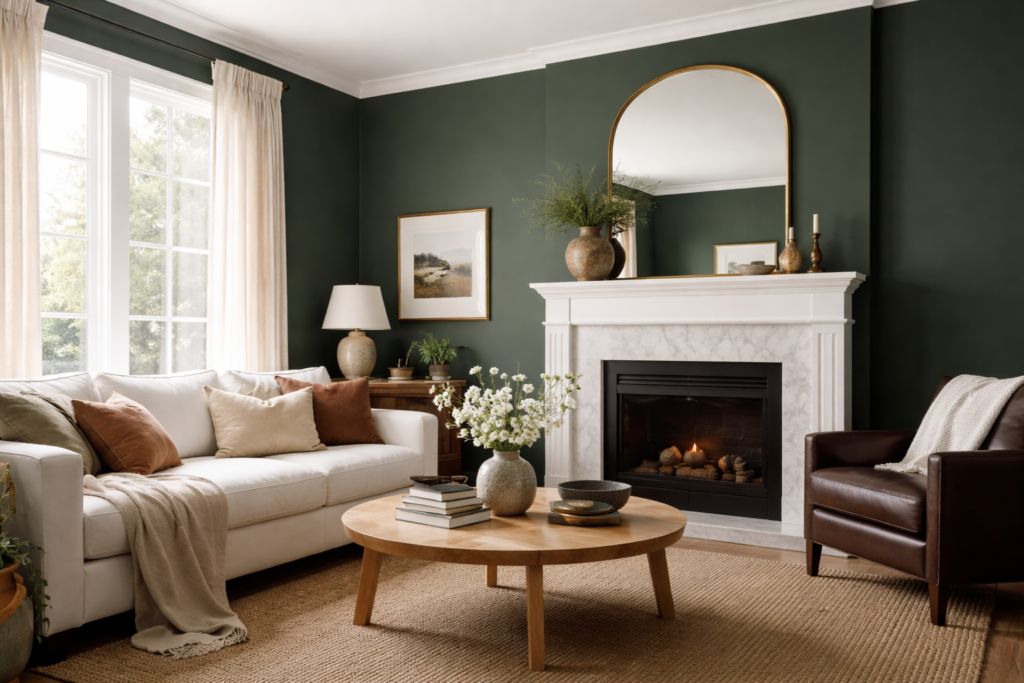
Dark green walls are back, but many deep greens look either too bright or muddy once they cover a whole room. Benjamin Moore Regent Green (2136-20) takes a different route: the manufacturer describes it as a deep pine green that verges on black. With a listed light reflectance value (LRV) of just 6.16, it reflects very little light, so on the wall it reads as a moody, almost-black green that reveals its color mainly where light hits it directly.
Its undertone is cool. The manufacturer files it in the blue color family, and its published hex value (#364042) carries slightly more blue than green, so expect a blue-black depth rather than a warm olive. That makes it a natural partner for crisp warm whites, brass, walnut, cognac leather and rich orange accents, and a strong choice for doors, cabinetry, libraries and exteriors with dramatic trim. Because the color is this dark, test it in the actual room, since it can look nearly black in low light.
- Benjamin Moore Regent Green Specs at a Glance
- Understanding the Undertones
- How It Looks in Different Light
- Rooms and Surfaces Where It Works Best
- Coordinating Trim and Accent Colors
- Side by Side With Near Shades
- Decorating Ideas by Style
- How to Paint With Regent Green
- Troubleshooting Common Problems
- Cost Ranges and When to Hire a Pro
- Frequently Asked Questions
Benjamin Moore Regent Green Specs at a Glance
These facts are confirmed on the manufacturer’s color page. Screen swatches of dark colors are especially unreliable, so judge a physical sample.
| Spec | Value | What It Means |
|---|---|---|
| Color name and code | Regent Green, 2136-20 | Order by code; several dark greens have similar names |
| Manufacturer description | Deep pine green that verges on black | Reads as near-black green in most rooms |
| Color family | Blue | A cool, blue-leaning green rather than a yellow-olive |
| LRV | 6.16 | Very dark: reflects about 6 percent of light |
| Undertone | Cool, blue-black | Looks teal-tinged in bright light, near black in dim light |
| Manufacturer coordinating colors | Mayonnaise 2152-70, Cloud White OC-130, Jack O’Lantern 2156-30, April Showers 1507 | Trim whites plus bold and soft accents |
| Best sheens | Matte or eggshell for walls; satin or semi-gloss for doors and trim | Higher sheens show more color but also more flaws |
Understanding the Undertones
Dark greens split into two camps. Warm greens carry yellow and lean olive or moss; cool greens carry blue and lean pine, spruce or teal. Regent Green sits firmly in the cool camp, with enough black in the formula that the green only shows clearly in good light.
- In bright daylight, you see a deep pine with a faint blue-teal edge.
- In dim corners and at night, it can look almost black, with a hint of green at the edges.
- Next to warm wood and brass, the green comes forward and looks richer.
- Next to true black, it looks clearly green; next to navy, it looks greener still.
- Next to cool gray, it can read flat and cold, so warm the room with other materials.
How It Looks in Different Light
North-Facing Rooms
Cool light deepens the blue-black side. Expect a very dark, enveloping room. That can be beautiful in a den or library, but add warm lamps so it does not feel cave-like.
South-Facing Rooms
Warm sunlight reveals the most green. This exposure shows Regent Green at its most clearly pine.
East and West Exposures
East rooms show more color in the morning and turn near-black by evening. West rooms look darkest in the morning and warmest at sunset.
Artificial Light
Warm bulbs around 2700K make the green feel cozy and traditional. Cool bulbs make it look more blue-black. Wall washers and picture lights on dark walls create a dramatic, gallery-like effect.
Rooms and Surfaces Where It Works Best
With an LRV around 6, Benjamin Moore Regent Green is a commitment on full walls, but it rewards the choice in the right spaces.
- Libraries, studies and dens with wood shelving and leather seating.
- Dining rooms used mostly in the evening, where dark walls feel intimate.
- Powder rooms, a classic spot for a bold, enclosing color.
- Kitchen cabinets and islands paired with warm white walls and brass hardware.
- Front doors and shutters, especially on white, cream or red brick homes.
- Exterior siding on modern farmhouses or cabins with natural wood accents.
Be cautious in small rooms with little daylight unless you want a cocooning effect, and on large ceilings, where very dark colors lower the perceived height.
Coordinating Trim and Accent Colors
The manufacturer’s coordinating colors cover trim and accent roles:
- Mayonnaise (2152-70): a soft, warm white for trim and adjoining walls that keeps the contrast gentle.
- Cloud White (OC-130): a popular warm white for crisp trim and ceilings next to dark green.
- Jack O’Lantern (2156-30): a bold orange accent, sitting opposite green on the color wheel, for a door, art or a small piece of furniture.
- April Showers (1507): a lighter companion color for an adjoining room or ceiling.
Other pairings that suit its cool depth: walnut and white oak, cognac and rust leathers, aged brass, blush and terracotta textiles, and marble with warm veining. Avoid stark blue-white trim if you want the room to feel traditional; it gives a harsh, high-contrast look.
Side by Side With Near Shades
Two other deep greens from the same manufacturer are worth sampling next to Regent Green:
- Tarrytown Green (HC-134): described as a deep pine green with a slightly cool cast, with a listed LRV of 9.71. It is a little lighter, so more of the green shows in typical rooms.
- Hunter Green (2041-10): described as a timeless dark green, with a listed LRV of 6.39. It is about as dark as Regent Green; compare them in your light to see which reads greener versus more blue-black.
Dark colors are hard to judge in small samples, so paint the candidates as large boards and compare them on the same wall at the same time of day.
Decorating Ideas by Style
A near-black green can suit many styles once the supporting materials are right. In a traditional library or den, combine it with warm white trim, walnut shelving, brass picture lights and a tufted leather chair. For a modern room, color drench the walls, trim and ceiling in one shade using different sheens, then add a pale oak floor and a few sculptural pieces so the space does not feel heavy. A cabin or lodge look comes together with knotty wood, plaid wool, iron hardware and a stone hearth.
On kitchen cabinets, the color pairs naturally with warm white walls, a white or cream countertop with warm veining and brass pulls. On exteriors, it makes a quietly dramatic front door against white or cream siding, and it looks handsome as full siding color on a small cottage or cabin with natural cedar accents and black or bronze hardware.
Plants look especially good against dark green walls; the leaves stand out instead of blending in. Add a large mirror or metallic accents to bounce light around if the room feels too dim.
How to Paint With Regent Green
- Sample large. Peel-and-stick sample sheets or painted boards around 12 by 12 inches are the minimum for a dark color.
- Prime with a tinted primer. Ask for a gray-tinted primer when covering a light color. It reduces the number of finish coats.
- Prep carefully. Dark paint shows dents, patches and roller marks. Fill, sand and spot-prime before painting.
- Keep a wet edge. Roll in full-height sections and back-roll to avoid lap marks, which show more on dark colors.
- Plan for touch-ups. Keep leftover paint and note the sheen; touch-ups on dark matte walls can flash if the sheen does not match.
Troubleshooting Common Problems
The walls look black. Low light is hiding the green. Add warm lamps and wall lighting, or try Tarrytown Green, which is lighter.
It looks streaky. Dark colors often need two to three coats over tinted primer. Apply even coats and maintain a wet edge.
Scuffs show easily. Flat dark finishes mark readily. Use eggshell or a scrubbable matte in high-traffic rooms and satin on doors and cabinets.
Cost Ranges and When to Hire a Pro
Samples generally cost a few dollars each. Premium interior paint commonly runs in the general range of $50 to $90 per gallon, and deep colors may need an extra coat. One gallon covers roughly 350 to 400 square feet per coat. Professional interior painting usually runs about $2 to $6 per square foot of wall area; cabinet painting is priced separately and often costs much more because of spraying and prep.
Hire a pro for cabinets, stairwells, exterior siding above one story and any job where a flawless finish matters, since dark colors expose technique. If your home was built before 1978, test existing paint for lead before sanding and follow lead-safe practices.
Frequently Asked Questions
What is the LRV of Benjamin Moore Regent Green?
The manufacturer lists an LRV of 6.16 for Regent Green 2136-20, which makes it a very dark color.
Is Regent Green warm or cool?
It is cool. It is filed in the blue color family and reads as a blue-leaning pine green that verges on black.
What white trim goes with Regent Green?
Warm whites work well. The manufacturer suggests Mayonnaise 2152-70 and Cloud White OC-130 as coordinating colors.
Does Regent Green look black?
In dim light it can look nearly black. In good daylight, the deep pine green becomes clearly visible.
Can Regent Green be used on a front door?
Yes. It suits front doors and shutters, especially on white, cream or red brick homes. Use a satin or semi-gloss exterior paint for durability.