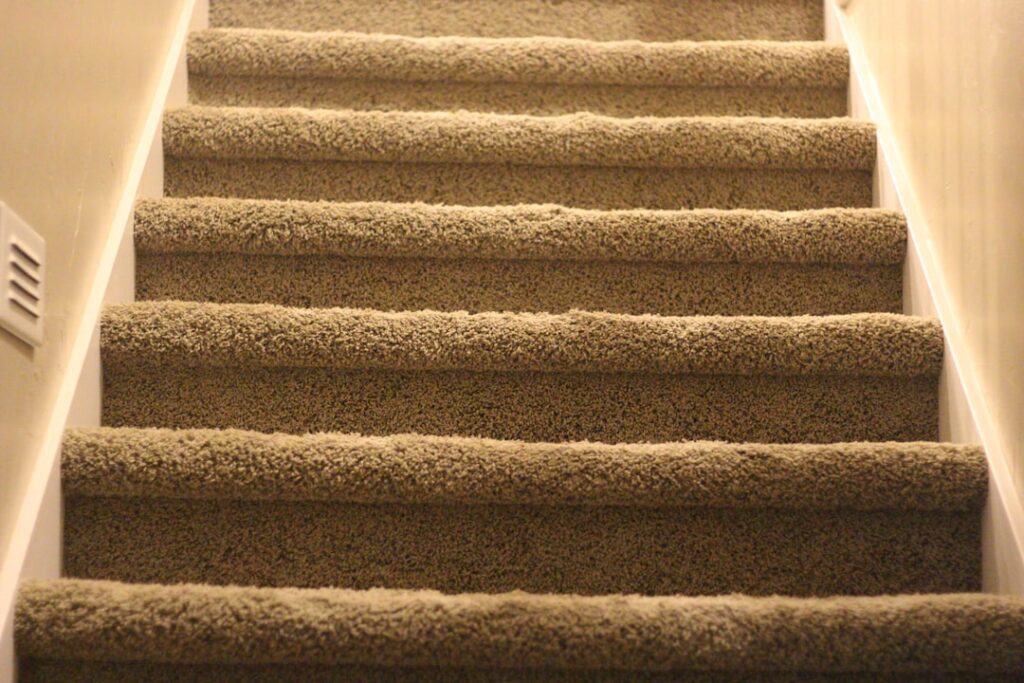
Choosing the best carpets for stairs requires a different approach than selecting carpet for any other room. Stairs take more abuse per square foot than any surface in your home. Every step concentrates body weight on a small area, and the nosing (front edge) of each tread bears the heaviest impact. After carpeting thousands of staircases, we know exactly which fibers, styles, and installation methods perform best in this demanding application.
Best Carpet Fibers for Stairs
Fiber choice is the single most important decision when selecting the best carpets for stairs. The fiber determines how well the carpet resists crushing, matting, staining, and general wear.
Nylon is the top choice for stairs. No other fiber matches nylon’s resilience, which is its ability to spring back after compression. Every step you take crushes the fibers on your stair treads. Nylon bounces back; other fibers eventually stay flat. For stairs specifically, nylon outperforms everything else by a wide margin.
Premium nylon brands to look for include Mohawk’s Continuum and Wear-Dated, Shaw’s Anso, and Stainmaster’s PetProtect nylon. These proprietary nylons include built-in stain and soil resistance that does not wash out over time.
Triexta (PTT polyester) is a solid second choice. Mohawk’s SmartStrand is the dominant triexta product. It offers good resilience (not quite as good as nylon), excellent built-in stain resistance, and a softer feel. Triexta works well on stairs in homes without heavy traffic or large dogs.
Polyester (PET) is not recommended for stairs. Standard polyester fibers flatten quickly under the concentrated pressure of stair traffic. We have seen polyester stairs show visible wear within 2 to 3 years, even in homes with light traffic. Save polyester for bedrooms.
Wool is excellent on stairs in terms of durability and beauty, but it costs significantly more and requires specialized cleaning. Wool’s natural resilience rivals nylon, and it develops a handsome patina over time rather than looking worn. Budget 2 to 4 times more than nylon for wool stair carpet.
Polypropylene (olefin) is inexpensive and stain-resistant but has the worst resilience of any carpet fiber. Do not use it on stairs.
Best Carpet Styles for Stairs
The carpet style (how the fibers are constructed) affects both appearance and performance on stairs.
Loop pile (Berber): Fibers form uncut loops that create a flat, dense surface. Loop pile is extremely durable on stairs because the loops resist crushing better than cut fibers. Level loop (all loops the same height) is the safest and most practical choice. Multi-level loop adds texture but can snag on heels or pet claws.
Cut-and-loop: Combines cut and looped fibers to create a patterned texture. This style performs well on stairs and is one of the most popular choices because it hides wear and adds visual interest.
Low-pile cut (textured or frieze): Short, twisted cut fibers with a casual, textured look. A good choice for stairs when you want a softer feel than loop but better durability than plush. Keep pile height under 3/4 inch for stairs.
Patterned woven (wilton or axminster): High-end woven carpets with intricate patterns. These are premium stair runner materials that perform beautifully and age gracefully. They are the traditional choice for formal staircases.
Styles to avoid on stairs: Saxony plush (shows every footprint and wears fast on nosing), shag (creates a safety hazard with unclear tread edges), and any carpet with pile height over 1 inch.
Patterns That Hide Wear
Stairs develop visible wear faster than flat surfaces. The high-traffic zone on each tread and the nosing area show soil and fiber compression first. Choosing the right pattern can keep your stairs looking fresh far longer.
Multi-colored patterns: Carpets with two or more colors in the pattern disguise soil and wear dramatically. A tonal geometric, herringbone, or diamond pattern in mixed shades hides high-traffic darkening far better than solid colors.
Heathered or flecked colors: Even solid-style carpets with subtle color variations (flecks of lighter or darker tones throughout) mask wear better than pure solids.
Medium tones: Very light carpet (cream, white) shows every piece of dirt and wear. Very dark carpet (charcoal, black) shows lint and lighter-colored soil. Medium tones like warm gray, taupe, greige, and medium brown are the most forgiving on stairs.
Striped runners: Horizontal stripes running across the tread width are a classic stair look that naturally breaks up the visual field and disguises wear patterns. Vertical stripes (running up the stairs) can create a dizzying effect and are best avoided.
Our most popular recommendation for stairs: a nylon loop or cut-and-loop in a medium-toned pattern with multi-color variation. This combination hides wear, resists crushing, and looks good for a decade or more.
Stair Runner vs. Wall-to-Wall Carpet
Deciding between a stair runner and wall-to-wall carpet is both a design and practical choice. Both options have clear advantages.
Stair runners cover the center of each tread while leaving the wood edges exposed on both sides. Runners are:
- More decorative and visually interesting
- Easier to replace when worn (without touching the entire staircase)
- Ideal for showcasing beautiful hardwood stair treads
- Available in higher-end woven patterns and materials
- Typically 27 inches wide for standard stairs, 30 to 36 inches for wider stairs
Wall-to-wall stair carpet covers the entire tread, riser, and stringer from wall to wall. Wall-to-wall is:
- Better for hiding damaged or mismatched stair treads
- Quieter (more surface coverage means more sound absorption)
- Warmer underfoot across the entire tread width
- Better for homes with young children who may step near the edges
- Less expensive per stair than many premium runners
If your stair treads are in good condition and you want a high-end look, a runner is the better choice. If the treads are worn, damaged, or made of construction-grade lumber, wall-to-wall carpet is more practical.
Runners are typically secured with tack strips or rods. Brass or iron stair rods at the base of each riser add a classic finished look. For a modern approach, have the runner professionally wrapped and stapled without rods for a sleek, streamlined appearance.
Padding Recommendations for Stairs
Stair padding requirements differ significantly from room carpet. Using the wrong padding on stairs affects both safety and durability.
Thickness: Use 3/8-inch padding maximum on stairs. Thicker padding (the 7/16 to 1/2 inch used in rooms) makes stair treads feel mushy, causes the carpet to shift at the nosing, and creates a tripping hazard.
Density: Use 8-pound density or higher on stairs. Dense padding supports the carpet better under the concentrated pressure of footsteps and prevents the carpet from wearing through at the nosing.
Best materials: Flat rubber padding is the preferred choice for stairs. It provides firm, consistent support without compressing like foam. Felt padding is another good option for stairs. Avoid rebond (recycled foam) on stairs since it is too soft and compresses unevenly.
Runner padding: For stair runners, use a 3/8-inch felt or rubber pad cut to match the runner width. Some runners, particularly woven types, may require no padding at all and are installed directly over a thin rug pad or double-sided tape.
Safety Considerations
Safety should be the driving factor when selecting the best carpets for stairs. A poor carpet choice on stairs is not just ugly, it is dangerous.
Pile height: Keep it under 3/4 inch. Thick pile obscures the edge of each tread, making it harder to judge where your foot lands. Low-profile carpet lets you feel the stair edge clearly with every step.
Pattern direction: Avoid bold, directional patterns that create optical illusions. Looking down a flight of stairs with a strong geometric pattern can cause dizziness, especially for elderly residents. Subtle, non-directional patterns are safer.
Secure installation: Carpet must be stretched tight on every tread and riser. Loose carpet on stairs is a serious fall hazard. Professional installation is strongly recommended for stairs, even if you DIY the rest of your home.
Nosing definition: The front edge of each tread must be clearly visible and tactile. Low-pile carpet maintains a defined nosing. Plush or thick carpet rounds the nosing off, making it harder to find your footing.
Color contrast: If your home has residents with vision impairments or mobility challenges, consider carpet that contrasts with the wall color so each step is clearly distinguishable. Some building codes require a contrasting nosing strip on commercial stairs.
Non-slip backing: Stair runners should be backed with a non-slip material or installed with tack strips. Never rely on gravity alone to hold a runner in place.
Installation Details
Installing carpet on stairs is one of the most technically demanding carpet jobs. The carpet must be stretched, folded, and secured precisely on every tread and riser.
Hollywood (wrapped) installation: The carpet wraps continuously over the nosing and down each riser without visible seams at the tread-riser junction. This creates a smooth, modern look but uses more carpet and requires skilled installation.
Waterfall installation: The carpet drops straight over the nosing and falls down the riser face. This leaves the carpet floating slightly under the nosing. It uses less material and is easier to install but looks less refined than Hollywood wrapping.
Cap-and-band: The tread and riser are carpeted separately with distinct pieces. This method is used for stair runners and patterned carpet where you want the pattern to align perfectly on each tread.
For wall-to-wall stair carpet, professional installation typically takes 2 to 4 hours for a standard 12 to 14 step staircase. For custom runners with stair rods, allow a full day.
We strongly recommend professional installation for all stair carpet projects. The margin for error is small, the safety stakes are high, and the tools required (knee kicker, stair tool, heavy-duty stapler) are specialized.
Cost Guide
Pricing for the best carpets for stairs depends on the carpet quality, runner vs. wall-to-wall, and installation complexity.
Wall-to-wall stair carpet (materials + installation):
- Budget nylon: $15 to $25 per step
- Mid-range nylon: $25 to $40 per step
- Premium nylon or triexta: $35 to $55 per step
- Wool: $50 to $100+ per step
Stair runners (materials + installation):
- Synthetic runner: $20 to $40 per linear foot
- Woven wool runner: $40 to $100+ per linear foot
- Stair rods (brass or iron): $8 to $25 per rod (one per step)
- Professional runner installation: $200 to $500 for a standard staircase
Total project costs for a standard 13-step staircase:
- Budget wall-to-wall: $200 to $325
- Mid-range wall-to-wall: $325 to $520
- Premium runner with rods: $800 to $2,500+
- Custom wool runner with brass rods: $1,500 to $4,000+
The padding for stairs adds $2 to $5 per step for rubber or felt padding. Old carpet removal is typically included in the installation quote or costs $50 to $100 for a standard staircase.
Frequently Asked Questions
What is the most durable carpet for stairs?
Nylon loop pile or nylon cut-and-loop in a dense, low-profile construction. Nylon’s resilience prevents crushing at the nosing where wear is heaviest. Look for a face weight of 35 ounces or higher and a pile height under 3/4 inch. This combination handles heavy traffic for 10 to 15 years.
Should stair carpet match the upstairs or downstairs carpet?
It does not need to match exactly, but it should coordinate. If the upstairs and downstairs have different carpet, choose a stair carpet that blends with both in tone and style. Stair runners give you more design freedom since they function as a distinct design element.
How often should stair carpet be replaced?
Quality nylon stair carpet lasts 8 to 12 years with normal residential traffic. Runners can be replaced more affordably than wall-to-wall. Signs it is time to replace include visible fiber loss at the nosing, flattened pile that does not recover with cleaning, and fraying at seams.
Is it better to carpet stairs or leave them bare wood?
Carpet is safer, quieter, and warmer on stairs. Bare wood stairs look beautiful but are slippery (especially in socks), noisy, and show scratches and wear quickly. If you want the wood look, a stair runner gives you the best of both worlds: wood on the edges with a safe, quiet carpet path in the center.
Can I install stair carpet myself?
We advise against it for safety reasons. Stair carpet installation requires precise stretching, cutting, and securing that directly affects the safety of everyone who uses the stairs. Poorly installed stair carpet is a fall hazard. Professional installation typically costs $150 to $300 for a standard staircase and is well worth the investment.